Showing posts with label 2010s. Show all posts

Friday, April 22, 2011

Cold Weather

Dir. Aaron Katz
2010


After the unprecedented and widespread success of mumblecore during the first half of this past decade, it now seems that the movement is split between two distinct ideological strains: Movies About Real People and movies about real people. The former contains the opposing poles of mumblecore. At one end is the Hollywoodization of the movement (or as I like to call it “The Michael Cera/Ellen Page Effect”) based on the pretense that awkward lovability, dialog that sounds spontaneous, and fantastic scenarios that betray the central conceit of being a film that is ostensibly realistic, will sell tickets across demographics and appeal to the debatabe desire of the viewer to see him or herself represented on screen. The other strain, of course, is the origins of mumblecore. The early films of Andrew Bujakski, the Duplass brothers and others initially brought together low budget necessity and modest conceptions about identity and place within culture. From these lowly origins these filmmakers created a genre so seemingly artless and affectless that their films eventually came full circle; transformed into trite and self-conscious pieces of anti-cinema.

So what about films about real people (perhaps, given the nature of the argument, even the italics should be done away with)? In Cold Weather director Aaron Katz mines the myriad complexities of utilizing a medium that relies heavily on invisible artifice to create something that is breathtakingly of-the-moment. He begins by utilizing a common template of mumblecore: nerdy loner type can’t find a job. Thankfully this characterization, unlike so many other mumblecore films, does not become the film’s premise. Doug, the aforementioned nerdy loner, moves in with his sister, Gail, in Portland, Oregon. While she finds a respectable job at a law office, Doug, a forensic science major, can only manage to get work at an ice factory. Doug has a subtly complex relationship with his ex-girlfriend, Rachel, which eschews backstory and exposition in favor of meaningful yet discreet gestures and insinuations. At the ice factory, Doug meets Carlos who seems specifically designed to tear down negative Latino stereotypes. Yes, he is a factory worker with a sideways baseball cap, but he’s also a popular DJ and a Trekkie. Admittedly, Carlos' characteristics are a little out of left field. Katz is far more convincing when dealing with confused and specialty-less 20somethings with all the self-defeating baggage of the under-employed, over-educated middle class.

The structure of Cold Weather allows for these characterizations to blossom and grow quietly in the restful pauses between the driving narrative moments of the film. After a neat inversion of the meet-cute formula (Doug purposefully introduces Carlos to his ex), what feels like a rom-com-for-the-rest-of-us, takes a surprising turn when Rachel disappears from her motel room. Though it may seem a conceit, given Doug’s love of the Sherlock Holmes mystery novels, the manner in which Katz puzzles out Rachel’s disappearance is compelling and highly original. Despite an early reference, Cold Weather is thankfully more Law and Order than CSI, and still more frustratingly grounded than either. Rather than follow the slippery slope of montage “crime solving” sequences, Katz concentrates on the rhythm of detective work. Scenes of silent snooping are contrasted by frantic car rides set to the sharp syncopations of Keegan DeWitt’s score, which owes much to the on-point neuroticism of Jon Brion’s Punch Drunk Love soundtrack.

As the mystery unravels, Katz’s influences begin to unpretentiously reveal themselves. Rachel appears and admits that she is involved in a money smuggling plot that involves a very Lynchian henchman in an anachronistic cowboy hat and vintage muscle car. So too does the gorgeous scenery and graceful camera movement of the film suggest a great love of cinema, in particular the effortless tableau of Hitchcock. However, the film's most enjoyable aspect is seeing Doug and company “play detective.” Comedy is meticulously grounded (no meta-isms here) and the drama and suspense plays out naturally though little is directly explained beyond Rachel’s mid-film reappearance. The point is the process not the result, as painfully realized by Katz’s conclusion. Sitting atop a parking lot waiting for Carlos and Rachel after slashing the tires of the “bad guys” and stealing back the briefcase full of money (the tropes look deliciously fun on the page), Gail and Doug enjoy a moment of downtime, the kind that punctuates the film and generally adds to our emotional investment with these undeniably likable and relatable people. As Doug plugs in a mixtape he made for Gail in high school the film abruptly cuts off.

So unexpected was the ending that the viewer has to be left wondering if there isn’t a missing final reel somewhere that, in lieu of wrapping up loose ends, would at least provide a logical closing frame. Katz, who cut his teeth in mumblecore, inexplicably falls prey to the spontaneity of the low-budget filmmaking process. In the process he disappointingly disturbs what was otherwise a thrilling, yet understated exploration of the dynamics of mystery. Cold Weather is a compelling study of what it means to represent real people in cinema and how best to utilize the classic conventions of a genre piece in innovative ways, yet it ends up demonstrating the unfortunate signs of mumblecore’s precocious eccentricities. Still, one cannot undervalue Katz’s unflagging commitment to his art and the accomplishments therein. Let’s just hope that next time Katz remembers to deliver the goods before celebrating his victory.

Sunday, February 27, 2011

The King's Speech

Dir. Tom Hooper
2010


It can sometimes be difficult to consider the whole picture when one element of it stands out so noticeably. Colin Firth tends to be that element. Take for instance, last year’s A Single Man. A fine film carried far on the shoulders of Firth’s performance and Tom Ford’s progressive, if sometimes mishmash, artistic direction. A year later and we arrive once again at the Colin Firth picture of the year: Tom Hooper’s The King’s Speech. This is not to draw direct comparison to Mr. Ford’s picture, though there are striking similarities, but rather to suggest that Firth’s dominant personality tends to overshadow the film’s other merits. In Mr. Hooper’s film those merits are plentiful indeed.

To begin, the screenplay by David Seidler is solidly built and well paced. As with Firth’s performance, which drives the narrative progression, it is dynamic and secretive. Seidler himself is reportedly cursed with stammering, a fact that adds an even greater emotional depth to the film and lends Firth’s performance an air of loving respect. Themes of repression and civic duty punctuate the inspirational tale of King George’s personal triumph in what would come to be seen as his country’s “darkest hour.” Though occasionally pushing its melodrama too far, the film nonetheless retains modesty without sinking into the murk of sentimentality. That a film should be emotional, nationalistic and inspirational, while balancing an objective sense of history and a subjective, lived-in approach to characterization is a feat that is as impressive as it is difficult.

In The King’s Speech we are permitted to enter the realm of the aristocracy. It is a pleasure the viewer relishes secretly. As with Stephen Frear’s The Queen, we are presented with a considerably darker vision than that of our speculative imagination. In the court of the King of England, composure is the true ruler. The film’s characters wear faces that look to be carved out of stone and their demeanor and speech is controlled as to reveal no indelicate emotions. That our protagonist and hero, the soon to be King George VI, can hardly carry on a conversation, never mind make a speech (the importance of which is deftly conveyed in a newsreel of Hitler’s notoriously rousing bombast), is an example of aberrant behavior that we learn is systematically punished. George’s sessions with speech therapist Lionel Logue (a delightfully cheeky Geoffrey Rush) turn therapeutic as Logue attempts to explore the King’s unhappy childhood.

The term “correction” comes up numerous times. That the corrective process for soon-to-be King George VI should include psychological bullying by his family and torture by his nurse, is emotionally provocative, yet given what the film chooses to present to us about English aristocracy, it is also not quite surprising. This corrective behavior is perhaps best surmised by King George’s wife, Elizabeth (an ironically distant Helena Bonham Carter), who, in perhaps the film’s most emotionally raw moment, recalls that she at first did not wish to marry him because she would essentially be giving up her own life for a life of “indentured servitude” to the people of England. Contrasted with the King’s abdicating brother and the emerging forces of modernity (radio and the second World War), it is powerful statement in favor of the very forces that have, up until this point, kept George a stammering recluse.

There are numerous other elements worth exploring in The King’s Speech, from cinematographer Danny Cohen’s precise use of wide angle lenses in claustrophobic sets to the lavish but never baroque artistic direction. However, in conclusion, I believe it is worth mentioning how The King’s Speech, on the eve of what many are predicting to be its victorious Oscar night, is one of the last films to wear the banner head of the UK Film Council before it’s abolition this past year. That such an elegant and impeccably produced film might go on to out muscle some of the year’s most heavy hitting Hollywood films, seems a national triumph in and of itself. Not being English, I naturally can’t be certain of this. Though just as King George’s triumphs symbolically reflect the strength of nation, perhaps, stretching the metaphor for purposes of editorial denouement, one could suggest that The King’s Speech represents the strength of the film industry that backed it. For the sake of Tom Hooper, the English film world and cinephiles everywhere, I can only say: I hope so.

Monday, February 7, 2011

The Social Network

Dir. David Fincher
2010


It’s difficult to write about The Social Network for a variety of reasons. First and most superficial is that in the age of digital immediacy (spurred at least in part by the film’s subject) writing a review of a major Hollywood film that was released over four months ago is basically a cultural crime. Given the timing, not nearly close enough to be relevant to the massive discourse that surrounded the film (though with the approach of the Oscars, chatter about the film has once again picked up) and not nearly far enough away to be considered retrospective, this review is admittedly out of place. But that is beside the point. Yet another obstacle standing in the way of an insightful, centrist review of The Social Network is the dominating ubiquity of the film’s subject: Mark Zuckerberg and Facebook. Yet, to the credit of director David Fincher and screenwriter Aaron Sorkin, the greatest challenged faced in reviewing this film is the not my timing, nor the film’s subject but rather the characterization of that subject. In a film that establishes the result of its own narrative twists and turns before we have even settled into its world, The Social Network shifts the responsibilities of the narrative from telling an engaging story (which it largely does) to illustrating a greater internal conflict of desires and prejudices.

Much has been made of Fincher’s auteurist interest in the loner. While he has evolved from the puerile heavy-handedness of Fight Club, Fincher remains unapologetically infatuated with those who exist on the margins of society’s concept of normality. Yet, rather than make his protagonists into heroic archetypes, he endows them with double edged faults that also function as strengths in their near pathological drive toward discovery. In Mark Zuckerberg, David Fincher found his narrative soul mate, or at least very malleable character clay. Fincher derives pleasure in creating characters whose own impulsive drives to discover truth inhibit their ability to function in the real world. They cause the setbacks to their quest. Whereas Fight Club abandoned the realms of reality, Zodiac on the other hand found an unnerving obsessive tendency in those caught up in a serial murder investigation. In that film we watched as individual worlds came apart in the face of a towering, seductive mystery. That theme is reprised in The Social Network.

What we know immediately is that Mark Zuckerberg (Jesse Eisenberg) wants acceptance. What we realize only later is that, due to his anti-social personality type, he is largely incapable of making this happen for himself naturally and is forced to seek alternative means. In doing so he is already beginning to upset the nature social order, which is represented paradigmatically in the landscape of Harvard University and the elite social institution, Final Clubs. Yet, it is not until Zuckerberg’s first meeting with the Winklevoss twins (both are played by Armie Hammer) and their Joe Peschi-esque sidekick Divya Narenda (Max Minghella) that the ideological subtext of the film is first introduced. The brothers and their “business partner” need a programmer to help them establish an elite, Harvard only, online social network. Midway through their explanation of Zuckerberg’s duties, he cuts them off stating that he will work with them. Yet, we already have the impression of what we know will come to be. To throw it in the face of the Winklevi and all they represent, Zuckerberg will secretly undermine the whole system of elitism and privilege that Harvard (allegedly) stands for by ensuring that his online social network (Thefacebook) is spread as far as possible. Though some might argue that the character of Zuckerberg initially never had any intention of spreading Thefacebook, as that would deteriorate its usefulness in establishing who is “cool” and who is not, I would in turn suggest that Zuckerberg, as someone who gives the finger to authority and social convention, saw in that moment a chance to stick it to the exclusive attitude that rules not only Harvard but the entire Capitalist system. It was not an opportunity that he was ever capable of turning down.

In a way this is all conjecture. Aaron Sorkin bravely resists exposition (with exception of a briefly stilted moment where Zuckerberg lays out the goals of Thefacebook to a freezing Eduardo), which leaves a lot to be decided by the viewer. The kind of minute characterization I described is not beyond understanding but implies a kind of rigorous psychological strategizing that the film betrays at times. Take for example the characterization of the Winklevi. They are comic parodies at best, a ridiculous Ying-Yang pair that spend so much time offsetting one another that they forget to actually prohibit Zuckerberg from adopting their original idea. So too do we run into problems with Zuckerberg’s “best friend” Eduardo Saverin (Andrew Garfield), who is portrayed as weak minded and unnaturally loyal to the slippery Zuckerberg, even as their company grows exponentially and Mark becomes increasingly reclusive. The inclusion of Napster founder Sean Parker (Justin Timberlake makes a fine turn here) seeks to further increase cultural credo. While his influence on Zuckerberg is explicit throughout, his ultimate exit, as the paranoid pseudo-schizophrenic he is suggested to be, feels lazy and mythologizing. Yet, it is a testament to the strength of the story (or the collective weakness of the audience) that we brush these flaws to the side. We become as pathological and isolated as our protagonist. What we want is to understand Mark.

That understanding is tidily wrapped up in the denouement of The Social Network, which leaves a stale taste in one’s mouth. Assistant prosecutor Marilyn Delpy (Rashida Jones) delivers a monolog that is, at its start, culturally incisive (any good prosecutor is capable of making Mark look like a perpetrator because he has done nothing to victimize himself), equating a personal sense of dignity or perhaps unwavering self-admiration to a confession of megalomaniacal vices that no jury will ever see past. Zuckerberg has defended himself throughout the film and lied through his teeth about various incidents, yet he exudes a strange form of personal honor (or maybe psychological detachment) that keeps him from ever doing anything that does not feel right to him, even if those actions are wrong in the greater scheme of social morality. Yet, it is the case of his diluting of Eduardo’s shares (another instance of Zuckerberg’s contempt for elitism: he punishes Eduardo for being selected by a Final Club) that prompts Delpy to suggest that Zuckerberg is not an asshole but rather someone who is trying hard to be an asshole. Zuckerberg buys it and the film concludes with him sending a friend request to his ex, which is as good as a real apology nowadays, I guess.

But why? Without editorializing too much, Zuckerberg looks like, acts like, and talks like an asshole. Why is it necessary to assure him and the audience, in the end, that he is in fact a good guy? Zuckerberg’s opposing desire for acceptance and hatred of elitism are surely interrelated but a conclusion that posits these characteristics not as byproducts of a cultural system that constantly screws the underprivileged (a dangerous word to use in relation to a white kid from Harvard, but no less apt in this circumstance) anti-socialite but as a form of personal weakness is insulting and ideologically incoherent, especially considering the speech that preceded it where Delpy reminds Zuckerberg that he is fucked precisely because he wears “fuck you” flip flops. This failure to follow through is the film’s ultimate weakness yet it is inevitably excusable. We understand how the system works. Sorkin and Fincher deliver the neatly packaged ending and relinquish the strain of ambiguity. Hollywood does not like ambiguity because audiences, by and large, do not like ambiguity.

Many have suggested that “the next big thing” will ultimately usurp Facebook, as it did to Myspace and Friendster. Yet, to hear Zuckerberg explain it in the movie, equating online social networking to fashion by suggesting that Facebook will never be finished but will instead evolve over time, makes one wonder if Facebook hasn’t in fact added a new strain to the history of communication but rather taken a step in its evolution. It is a heady suggestion about a medium that came into existence so that college students could get laid easier. Yet, to doubt its historical and cultural relevance is to admit either Ludditism or total cultural illiteracy. And that’s coming from the guy who just saw the Facebook movie.

Thursday, February 3, 2011

True Grit

Dir. Joel & Ethan Coen
2010


I’m developing a theory: if you want your film to be middling, benign and commercially successful get Steven Spielberg on your producers list. Quips about Gremlins and Men In Black aside, one glance down what has to be the most bourgeois filmography in the history of the art reveals that Spielberg has bank rolled some of the last 3 decades most richly middlebrow fair. There’s no arguing that Steven Spielberg has become synonymous with popular American cinema of the highly profitable variety. So, as the credits began to roll in the final moments of Joel and Ethan Coen’s latest film, True Grit, with our amputee protagonist walking stoically off into some unknown distance, I was less than surprised by who’s name I saw directly after the Coens themselves: Executive Produce Steven Spielberg.

What’s objectionable about Spielberg is not that he is offensive. Just the opposite, in fact. His films are, for the most part, boring or at least predictable. They are characteristically uncharacteristic. In an age when even Michael Bay can be considered an auteur (one who is also, might I add, in Mr. Spielberg’s pocket), Spielberg’s films make a compelling argument for a reevaluation of that precious, aged film theory. Why do I bother making a fuss about Spielberg? Because True Grit, as the colorless Western procedural it was, belongs to this same ilk of ubiquitous Hollywood filmmaking. Almost entirely void of the dark undertones and incisive black humor that have made the Coens’ best films canonical and iconic pieces of American cinema and their less-than-great films precious oddities, True Grit is, as regular cinematographer Roger Deakins captures so well, as lovely and lifeless as the slice of the American Southwest where the film is shot.

In True Grit everything is where it’s supposed to be. Having no experience with the story (a remake of a 1960s John Wayne vehicle, itself a direct adaptation of Charles Portis’ novel) I still had little trouble predicting where everything was going to happen. Here, Maddie (played with overt precision by Hailee Steinfeld) is abandoned by her hired Marshal, Rooster Cogburn (Jeff Bridge: the Dude in chaps, wise cracking his way through an obvious character arc). Now, Texas Ranger La Boeuf (played with charming self-deprecation by Matt Damon) makes an idiot of himself. Then he does something brave to make up for it. A shotgun tears through the roof of a house here and a character learns how to love and care for another person there. There’s nothing wrong with a solidly built film, which True Grit inarguably is, but there is so little about this film that distinguishes it that, upon first viewing, even the experienced cinephile is at a loss to identify it as a Coen brothers film.

Yet, there are a few distinguished aspects of True Grit, which betray the otherwise bland texture of the film. The first is a solitary moment, mid-film, in which two “villainous” characters are being interrogated by Cogburn. As one “flips” in order to keep from going to prison, the other grabs a knife, cuts off his fingers and then stabs him in the heart. At which point Cogburn takes out his pistol and shoots the cutter, point blank, in the face. The viewer is spared no detail in this ordeal (although the low lighting helps for the squeamish and faint of heart) and for a minute it looks like this sleeper might arise from its slumber. Yet, we quickly return to the monotonous tone of the first half. Burn After Reading, a film critics were surprisingly dismissive about, had a similar sequence that was even more affecting perhaps because it was the face of an idiot protagonist that was getting blown off and not some nameless henchman. Another fascinating particle is the character of Tom Cheney (Josh Brolin) who is, as it would turn out, more a cowering imbecile than an evil villain. Compared to Anton Chigurh (Javier Bardem) of No Country for Old Men, Cheney delightfully undermines the stereotype of the merciless Western villain.

Tepid fair though it may be, True Grit will no doubt get name dropped this award season alongside Fincher’s beyond-culturally-relevant The Social Network and Aronofsky’s flawed Black Swan in what has been another middling, benign, and altogether average year in Hollywood. Last year things got “political” (and self-congratulatory) at the Oscars, when the world rejoiced in snubbing the Rich White Man’s film of the year (Avatar). I wonder if this year, just on the basis of the heavy hitting films of the last 6 months, we won’t return to that tried and true Spielbergian model where the widest reaching film always wins.

Thursday, August 12, 2010

The Other Guys

Dir. Adam McKay
2010
2.0


By now, no one should be confused about what kind of a movie they're going to get from writer/director Adam McKay. His films function as wish fulfillment for Saturday Night Live devotees masochistically demanding that show's aesthetic be stretched well beyond its capacity and ignominiously retrofitted with indiscernible attempts at plot. They've been treated to a number of hit-or-miss (mostly miss) spinoff films over the years but McKay's special brand of sketch comedy indebted features manage to dodge the “spinoff” tag, the kiss of death for critical success. A former Second City member and SNL head writer, perhaps it is McKay's history as a socially minded comedian and his position as an occasional contributor to The Huffington Post that informs one of the more misguided forays into the realm of political comedy with his most recent feature The Other Guys. I wish I knew what someone like Arianna Huffington thought of Mr. McKay's pretensions of serious political commentary within this most plebian bromance.

Surely this must be a parodic farce. Following in the footstep's of last year's brilliant In the Loop and Jason Reitman's reportedly efficient condemnation of corporate decadence and emotional distance, Up in the Air, is it possible that we already have to suffer a lowest common denominator parody of the timely critiques of endemic political and corporate corruption those films proffered? Missing even the screwball sophistication of the Coen's Burn After Reading, The Other Guys is a philistine reworking of the “buddy cop” formula that is unfortunately convinced of its own nonexistent cultural criticism. Though billed as a parody, the film nails all the tropes of the genre without invention or traces of humor (as always with McKay, jokes are found between not within plot points) from the dealing-with-it-my-way psychological baggage of Mark Wahlberg's Terry Holtz or Ferrell's best good-cop-with-a-dark-past impersonation. These archetypes are only funny when they actively avoid acknowledging the thin vestments of their implausible personalities.

And avoid they do. Not just in a failed caricature of machismo defense mechanisms but in McKay's characteristic avoidance and downright fear of plot development. It's no wonder, really. His films predictably fall apart under the slightest demands of narrative. Try comparing the film's first half an hour with its last. In the first: an opening pyrotechnic-laden chase sequence (reminiscent of every action flick with a malnourished budget since the dawn of CGI) followed quickly by a frankly mind numbing series of police procedural sketches. In the last: a shootout massacre built up to by moments of “what the hell are they talking about” last minute plot points. Judging by the film's beyond-heavy-handed final credit sequence, McKay seems to think he's designed a conspiracy thriller and a scathing political satire in one laugh out loud romp of a good time. That he could be any further from the truth seems pretty much inconceivable.

McKay's conviction in satirical posturing and the pre-established precedent of a spoof comedy accounts for his blatant use of sexism and racism as tools for pandering to dick-in-hand loners and latent cynics. He makes limited attempts to account for these errors of taste but his defensive jokes are dated before they even leave the cinema's speakers. The film lobs so many softballs at easy targets, relies so heavily on Ferrell's brand of physical and verbal deadpan and comes up with so few noteworthy jokes (the best of which are a silent wrestling match at the wake of two accidentally suicidal cops and Michael Keaton's repeated references to 90s girl pop group TLC) that it's hard to believe that this is the same director who delivered the deliciously idiosyncratic Anchorman earlier this decade. That film, the cult American comedy of the last ten years just behind Superbad, had a couple of luxuries: existence outside the Appatow brand and audience expectations for McKay set just a notch below veteran disappointer Kevin Smith. That McKay can no longer cash in on these advantages certainly does not stop him from trying.

McKay's medium is sketch writing, a still under appreciated art form. The extent to which most people understand the liberties and restrictions of sketch comedy is in weekly doses of SNL. McKay writes well in short, discrete incidents but can't string his comedy (nor his drama) together sensibly in feature form. That he has tried is honorable but that he continues to make no improvement is disheartening. McKay is digging his own grave as a one trick pony. That his latest film will be the cause for a handful of guffaws is beside the point. The Other Guys shamefully prostitutes itself for easy laughs, cuts its losses and gets you out of theater before you start demanding a slide show presentation on the respective salaries of the Hollywood producers and stars involved in the kind of film so detached from its own lack of merit that it truly believes itself to be not only educational but entertaining.

Monday, August 2, 2010

Inception

This review was originally published here on Tiny Mix Tapes

Dir. Christopher Nolan
2010
2.5


Since seeing Christopher Nolan's Inception for the first time more than two weeks ago I have cycled through a series of feelings from glossy eyed amazement to utter contempt to cool irony and finally plain disappointment. I've settled on disappointment because I think it is the most judicial of all emotions one could possibly feel about a film like Inception and its director Christopher Nolan. Nolan came from a modest, innovative background in the early years of this past decade and has built steadily toward envelope-pushing studio productions. His films are enjoyable and thought provoking due to their characteristic combination of confident spectacle and earnest intelligence. They are introverted and textually interact almost exclusively with themselves although they are capable of being read widely. Up until now, Nolan has seemed uninterested in his place amongst heavy hitting filmmakers. Unexpectedly, it is pretense and a cocksure attitude about the ideological content of big budget blockbusters that causes Inception to feel disingenuous and insecure. Those same characteristics are also utilized to dismiss contemporary Hollywood cinema as vapid and insincere. Ironically, this pretentious attitude is the reason Inception has risen to levels of extreme, undeserved recognition amongst viewers and critics.

Inception represents the zeitgeist of popular American cinema. So saturated by dainty romantic comedies, predictable slasher reboots and disingenuous, market driven sequels even a humble version of Inception's high concept psychological thriller could have attracted a wealth of attention. However, modesty is not the strong suit of summer blockbusters. Inception is no exception with immodesty becoming the genesis of innumerable gestures that cause the film to be both absurdly entertaining and gratingly insufferable. At every step the film overcompensates as best exemplified by the relentlessly brooding score that places a dramatic emphasis on even the most stale bites of dialog as if to suggest that every miniscule detail is of the utmost importance. Bloated and self-congratulatory, Inception eventually becomes unwieldy and ends as an absolute mess. Nolan's previous film, The Dark Knight, was also something of a mess, albeit a mostly endearing one. That film opted for noir polemics over, say, the dialectics of Westerns or as the Joker said best “an unstoppable force colliding with an immovable object.” The effect was undeniably disabling. While not everyone appreciated the choice, Nolan took a big risk that delivered in the form of one of the most talked about films of 2008.

With Inception, Nolan largely abandons his history of challenging polemics in favor of a manipulative and highly unethical cinema of distraction. After an expository opening half burdened by malnourished jargon and an obligatory chase sequence, the film succumbs to trope after action film trope, dismembering and condensing three genre films into one. The back half of the film is a four-tiered reverse-heist complete with kidnapping, car chase, Matrix-esque zero gravity fight scenes and vintage 007 extreme sport killing sprees. Not surprisingly, this initially thrilling setpiece so lacks self-restraint that it eventually becomes inane. Nolan gets so caught up in his action film purism and the complexity of his interrelated mechanisms that his screenplay falls into film limbo; drama and action drifting around purposelessly. I suppose one could sardonically praise Nolan for designing a film that adheres to self-made dream logic.

What Nolan should not be praised for, however, is designing a consistent or meaningful film. While the film's action is occasionally engaging the actors who take part in it are almost entirely vacant. Nolan's characters lack any kind of depth. Even Dominic Cobb (Dicaprio), who receives most of the screenplays enervated emotional energy, is an archetype of very plain proportions. Joseph Gordon-Levitt's Arthur is a snoozy stiff. The capacity of Ellen Page's Ariadne to perceive the very obvious signs of Cobb's psychological damage seems to indicate that on some level Nolan realizes that his characters are flimsy and uninteresting. This is all pretty predictable fair from Nolan. He seems to relish using actors who can't fulfill the basic needs of their characters. With the exception of Marion Cotillard as the underdeveloped but still deeply disturbing vision of Cobb's deceased wife Mal, the remainder of the characters are more Bruce Wayne and Rachel Dawes than Joker or Leonard Shelby. Noteworthy is Wally Pfister's cinematography which is even better than it was in The Dark Knight. Here he gives action sequences room to breathe and deftly captures Inception's surrealist universe. Its just too bad Nolan's subconscious didn't populate this cinematic dream world with less clunky projections.

Pauline Kael once said of Stanley Kubrick's 2001: A Space Odyssey (both the film and its director have likely been of some great influence on Christopher Nolan) "If big film directors are to get credit for doing badly what others have been doing brilliantly for years with no money, just because they've put it on a big screen, then businessmen are greater than poets and theft is art." Though ripe for commentary and conversation, Inception is a deeply flawed film. Shooting to be mind blowingly great, it ends up just OK. Not nearly as audacious as folks have made it out to be, Inception is the kind of self-important art that preys on the insecurities of its patrons. I suppose we shouldn't be surprised as Nolan takes his film's psychological premise to its most literal extreme, doing to his audience exactly what Cobb and his gang do to poor Robert Fischer: implant a simple idea in the most elaborate and lavish way possible. Nolan's simple idea? That Inception is a film worth getting excited over and believing in. That idea has taken hold amongst many but remains, just as in the film, an immoral coercion of our emotions and ego.

Monday, June 21, 2010

Toy Story 3

This review was originally published here on Tiny Mix Tapes.

Dir. Lee Unkrich
2010
9.0


I have made no secret about my adoration for Pixar Animation Studio. Be it from an academic perspective or a humanitarian one, I've been singing the studio's' praises publicly for a couple years and privately for as long as I can remember. However, rather than spend time waxing nostalgic over my first experience seeing Toy Story as a seven year old or drawing parallels between Pixar's developmental progress as a studio and the thematic content of its filmography, I will instead simply say this: before Toy Story 3, I hadn't had so much fun at a movie in years. From its opening setpiece, a classic western with an increasingly hysterical modern tilt, to the shards of raw emotion that stick out with greater clarity than any 3-D projection, Toy Story 3 is as remarkable a film as it is a delightful night out with friends and family.

Magnificently dovetailing with Pixar's recent output, the film is equal parts prison drama, three-hankie weepie and family comedy, blending the emotional reach of Up with the theatricality of WALL-E. Beginning as a comedy of errors with the ensemble of Toys being mistakenly thrown out rather than extradited to the green zone of the family attic, Toy Story 3 initially offers much space for the audience to wonder whether the film won't be the adrenal adventure of its predecessors. Perhaps a small, contemplative film: more Bergman than Spielberg. Knowing it's a kid's film, it's still not totally unreasonable to imagine Pixar pulling off such a trick. Considering the existential thoughtfulness of Up, the near avante-garde visual texture of WALL-E, the New Wave-ish glory of Ratatouille not to mention the critical and commercial success of all three, Pixar was primed to make a film that further transcended the static notion of modern children's films. The manifest of this possibility is the complex ideological debate of individual ingenuity vs. group integrity that surges throughout the first act. The film builds up to Marxist fervor at the utopian day care center which the Toys (with the exception of Woody) choose over the return to a position of subordination to a benevolent ruler (the seventeen year old Andy) who has all but forgotten their existence. For a short time it almost looks like Toy Story 3 is set to become a heady dystopian fever dream of soviet proportions.

What happens instead is far more fitting and much less pretentious. The contention between the individual and the community continues but as a subtext rather than a full blown theme. The day care center is revealed to be a feudal hierarchy. At its apex is misanthrope Lotso Bear who parades as southern gentleman while his cane and limp evoke the tyranny of Orson Welles' crooked police detective in A Touch of Evil. The day care is divided between the heavenly Butterfly Room and the hellish nightmare of the Caterpillar Room (characterized by a deft parody of the terrifying camera work in Requiem for a Dream). When Buzz Lightyear attempts to reason with kingpin Lotso he discovers the horrific extent to which Lotso rules his toy kingdom. He is “brainwashed” and returns to the Toys as a foot soldier of injustice, holding his former comrades in captivity. Woody returns out solidarity with his fellow Toys and arranges a rescue mission that becomes the central, astounding setpiece of the film's second half.

This second half, which prominently features the film's most impressive narrative twists, sublimely realized emotional landscapes, visual gags (I just about died laughing at Mr. Tortilla Head) and one liners fully overpowers the social subtext of the film's first half. Which, to be honest, is fine. While adults and critics alike will no doubt salivate at Pixar's by-turns comic and terrifyingly accurate reimagining of captivity narratives, prison dramas and classic horror films, the task of paying it back to the old masters who inform and influence their work has always been second to Pixar Studio's desire to create new works of authentic genius. This may sound like conjecture but how often does a film bring together ideological dialectics and stunning visual invention all while de-vilifying commercialist capitalism? By my count, three.

For a film that accomplishes so much from a studio that has been at the peak of its creative power since 2007, Toy Story 3's final sequences are something of a swan song to the cinema of our lives. A handful of us have had the honor of growing up alongside Pixar. If Andy's handing off his “friends” airs on the side of sentimentality...well...that's just fine. It is rare in cinema that such a passionate and heartfelt relationship should spring up between not only viewers and a single film but viewers and an entire studio's creative outpouring. But such is this case with Pixar. Though their films never fail to be as dynamic as anything the art house world has to offer, it always feels like the folks behind the films are gently consoling us. They are insisting that it's OK to hold on to certain things forever. The imperative to grow up, to become an adult, can and should coexist symbiotically with the need to remain, at least in part, a child. If we could all hold onto our sense of childlike wonder and imagination the way Pixar's team has than Toy Story 3 wouldn't just be the prized object we celebrate fleetingly but just one more enchanting plaything in the toy box of our endless youth.

Thursday, May 20, 2010

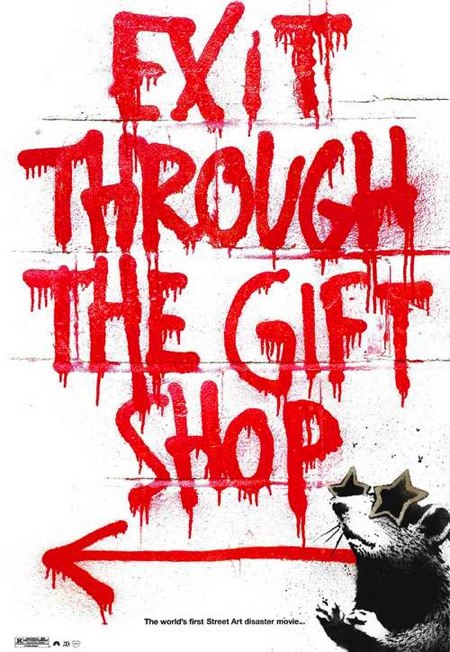
Exit Through the Gift Shop

This review was originally published here on Tiny Mix Tapes.

Dir. Banksy
2010
10.0


In light of the serious theoretical debate surrounding English street art pioneer Banksy's “documentary” Exit Through the Gift Shop I'd like to pose a multi-tiered question. In our highly academic engagement with the complexity of the Banksy ethos aren't we becoming the victims of the very same joke we are trying so desperately to escape being the punch line of? Is this obsessive Holier-Than-Though atmosphere just a malignant side effect of the critic's self loathing? Are we not as bad as L.A.'s soulless faux-literati who parade their affectations of seriousness and insight (not to mention sincerity) or the art collector pricks who juxtapose Banksy's work alongside minor Renoirs without batting an eye? Hugging our pretensions close we have unknowingly become the targets of Banksy's anti-expectation art. Critics have made a lot of oblique assumptions about Banksy's intentions with Exit in a vain attempt to deconstruct his film and simplify its elliptical dialectics. I'm going to attempt to be less crass but no more succinct: I am the victim of Exit Through the Gift Shop's recondite gag, if it in fact exists at all, though I try so hard to escape the ideological pot holes other critics have fallen into on their way toward “figuring out” the film. As we look desperately for the code to decipher this endlessly unfurling life à clef, Banksy laughs all the way to the moral bank to deposit the sea of coins we've tossed into the infinite fountain of the occult, from which he draws not only his healthy humanitarian salary but also the inspiration that has propelled him into the stratosphere of modern art.

Exit Through the Gift Shop is in turns affecting, insightful and hilarious. It supercedes narrative constraints in a way that is pure Banksy: emotionally modern and structurally post-modern. Banksy, despite his capacity for vicious satire, is devotedly human at heart. His work is a seismic indicator of his dedication to the people often overlooked by sovereigns and tycoons. However, his tactics are reactionary. Street art itself is a reaction to the depravity of high art. Banksy's hidden identity is a retaliation against celebrity which itself is often a facade masking an ugly reality. Exit, like the rest of his art, is emotionally rich and psychologically complex. And the premise? Deliciously meta! A French ex-pat (Thierry Guetta) who never stops filming promises to create a documentary which is never truly made and in turn becomes the subject of a new documentary (accredited to a man without a face) which some propose (in a paranoid attempt not to be the tag line of an elaborate and possibly self-created Banksy hoax) is itself not a documentary at all.

For any person with intellectual hang-ups this will be something to lose sleep over. Banksy, who has undergone a dramatic apotheosis at the hands of a desperate and self-degrading youth culture, is an artist for whom the immediacy of his medium has always been its most important aspect. It is the act of street art, not so much the culture that formed out of the connection between himself and other artists, that defines Banksy's genius. His genuine love of and adoration for the people for whom his work serves as a reminder of life's trials and tribulations as well as its simple pleasures is supported through his contempt for and subversion of fascism and abusive social institutions. This naturally stands in stark contrast to the supercilious seriousness of today's youth who selfishly utilize anything and everything as a means of assimilating its "importance" into their own lives in the vain hope of finding the one thing that is going to validate their entire existence. If these holy fools ever managed to find the immortal something they want so desperately they would undoubtedly strangle the life out of it.

As for the film's proto-idiot savant protagonist, for whom the final product and/or the process by which that product is reached is always secondary to how it can utilized for self-serving desires, his self-constructed alter ego, Mr. Brainwash, gets it all wrong. During the film he notes that “street art is about brainwash,” which the viewer interprets as Thierry rightly recognizing street art's themes of anti-authoritarianism and contempt for political corruption. What the film reveals however is something altogether darker: that the “artist”-by-way-of-pathological-observer-gone-culture-debasing-charlatan (not to be confused with filmmaker, documentarian or even authentic artist), who inarticulately expresses himself through bumbling non-sequitors and confused metaphors, has accidentally discovered street art's power of manipulation over not just wanton youth but snarky bourgeoisie as well. While Mr. Brainwash rakes in thousands of dollars for derivative works of kitschy pop art pastiche, Banksy, Shephard Fairey and others look on in horror and disbelief. The latent disciple of street art has unwittingly overthrown the masters.

If all this has you scratching your head like the apes of Banksy's graffiti then consider yourself unequivocally united with the collective subconscious of all who have viewed this brilliant meta-docu-film. More than just an engaging social and psychological study, the film is also a eulogy for the lost innocence of not only street art but man as well. Effortlessly constructing a spellbinding tale of obsession, fate, identity and illusion, Banksy has once again created a work that will undoubtedly turn commercially successful (and inevitably be co-opted by the “hip” who will further misconstrue and denigrate its diverse set of meanings) despite the great lengths he goes to show his derision for such a possibility. The film has already fallen prey to intense self-congratulating skepticism (which somehow passes for criticism...?) and there is no end in sight for that. Exit Through the Gift Shop's impeccability is in its refusal to glorify the viewer's intellect or their capacity to uncover the remote “truth” of a film. The back patting experience of contemporary art house cinema and the stupefying effects of the Hollywood blockbuster prove, in Banksy's paint stained hands, two sides of the same coin: one that is meant to make the viewer feel superior. Banksy instead places a shadow just outside the viewer's peripheral vision and dares us to guess what it is, where it comes from and what it means for us. But unlike so many filmmakers his well being does not rely upon our interest. In fact, Banksy's take it or leave it disposition may be the most mysteriously engaging aspect of his work. Like Plato's allegorical cave we struggle against the chains of our expectations all while philosopher king Banksy beckons us forth into the searing rays of enlightenment.

Banksy
has always been an artist aware of the capacity for his art to disappear forever. This idea obviously chokes the creative subconscious of Mr. Brainwash but if anything it arouses in Banksy the ability and knowledge to achieve the transcendental attitude by which he goes on surreptitiously making his art, in plain view of the public, largely for himself. Given all this intrigue, this may be the best time to ironically suggest that the film quietly told me what it was about in one brief snippet wherein a passerby to Banksy's mutilated telephone booth piece when asked what she thinks about it wryly replies in a sublimely Banksian manner “someone doesn't like BT telephone service.” In other words: analysis has its cost. So, shut up and watch the damn movie.