Showing posts with label 2000s. Show all posts

Thursday, February 3, 2011

Dogtooth

Dir. Yorgos Lanthimos
2009


While watching Yorgos Lanthimos’ Dogtooth, I was reminded of an American independent film from a few years ago called Ballast. When I saw Ballast in the winter of 2009, I got out of the theater with a strange feeling. I went home and penned my first film review (the reason you won’t find it here is because it is woefully inadequate as a piece of criticism and helplessly self-involved). My review went something like this: have you ever experienced a work of art and had no idea what to make of it? Later, I went on to discuss an intellectual inferiority complex that I believe I still possess. Despite that set back, in recent years Ballast has become one of my favorite films. Nowadays, I could tell you all about the gritty realism and the use of non-professional actors that recalls Italian Neorealism, as well as the sheer, unmistakable beauty of the cinematography and the heartbreak of the quiet story. But back in the winter of 2009 I was just as confused and slightly upset as I was when I finished watching Dogtooth just a few days ago. Experience, however, has taught me that this kind of feeling should be treasured.

Two names that have gotten a lot of mention in relation to Dogtooth’s elliptical, ambiguous style are European establishments Michael Haneke and Lars von Trier. For anyone familiar with these two titans of cinema, this should come as little surprise. Dogtooth mines the post-horror landscape Haneke and von Trier have been exploring in films such as The White Ribbon and Antichrist. In Dogtooth, Lanthimos explores the horror of the banal. Many have made insightful assertions about the film being an ideological reflection of an anti-state attitude or the nightmarish protocol of raising children in the relative seclusion of the bourgeois. Yet, these are projections of critical thinkers. The film itself is relatively formless though it plays something like a bleak coming-of-age story. Three “children” (they are at least in their early 20s) are held within their parents compound and fed lies about the outside world. Their parents alter their linguistic universe (a “zombie” is a little yellow flower, a salt shaker is a “telephone”) and thus unhinge the children from their base of reality. When one daughter blackmails the woman who is paid to have sex with her brother, she receives two videotapes (Rocky and Jaws...make of it what you will). This act sets off a chain of irrepressible events that result in the girl attempting to escape her family home after she removes her titular Dogtooth, its loss being the symbol of freedom in the demented world of the film.

Along the way taboo moments (the boy’s sexual encounters become disturbing when his father offers him one of his virginal sisters) are balanced by darkly amusing ones. The father explains that the house cats the children see around the yard are fearsome predators who are responsible for the death of their other brother, who, it is suggested, escaped sometime before the film begins. One gets the distinct impression of a playful heart behind Lanthimos’ cryptic film. He seems to be teasing the audience. It may be that we are part of some kind of self-reflexive cinematic experiment, not unlike the social and psychological experiment the parents are performing on their children. Lanthimos is testing our tolerance and our trust.

Yet, this is not the film of an egghead auteur. The exquisite manor in which the family lives is contrasted by stark acts of violence, which punctuate seemingly innocuous yet somehow deeply troubling moments of childlike play. The parents seem intent upon protecting their children from all outside forces, including nature, yet the film’s conclusion seems to affirm what we already know to be true: certain forces can not be stopped and any attempt at repression simply augments their power. Yet, it is still significantly terrifying to realize that were it not for our insider’s perspective, this idyllic home of an upper class Greek family might be resemble an antiseptic Utopia.

There are so many smart ways to analyze Dogtooth that it can be overwhelming. Yet, the film is not meant to assault your pride or your intellect. Rather it seems meant as a dark reimagining of everyday life at its most profoundly basic. It does not transcend quality, yet that same cinematic quality is uniquely tempered by a kind of extraordinary vision of contemporary 1st world culture. The family’s rituals are so like our own it is frightening. Perhaps, that is why Dogtooth got under my skin, just as Ballast did. Though the two films are worlds apart they cut through the thick of the abstract to illuminate a kind of unification. That unity was enough to make Ebert cry after viewing Ballast. It’s enough to make me scream after Dogtooth.

Tuesday, August 10, 2010

Gangs of New York

Dir. Martin Scorsese
2002
7.4


Watching Martin Scorsese's Gangs of New York recently, I came to appreciate–rather belatedly I must admit–certain drawbacks to the now [in]famous auteur theory. Of course, the theory itself is meant to define a director as an author of a film by highlighting thematic and stylistic motifs from the his/her output. The goal was to realize authorial preeminence within an industrial process. The consequences of an academic theory that proffers solidarity with an artist only make themselves evident much further down the line, when aged auteurs are given greater credence than their upstart contemporaries. Gangs of New York plays like a study on the inborn flaws of auteurism. Foreshadowing the narcissistic debacle of Quentin Tarantino's Inglourious Basterds (2009), Gangs is ultimately not a self contained historical epic but a Martin Scorsese Historical Epic.

Beginning a film with a vainglorious and highly orchestrated battle sequence that skews aestheticization of violence in favor of glorification via rapid editing and ill-advised, anachronistic score choice (not to be confused with the ironic audio visual juxtaposition of, for instance, Scorsese's own Mean Streets), exceeds the limitations of 'minor transgression'. It cheapens the sincerity of the entire enterprise. This imprudent tactic leaves Scorsese with a lot of ground to make up. Thankfully, the remainder of the film is rhythmically and tonally well tempered. A period drama about Irish immigrants in New York City during the mid-19th century, the film's script surreptitiously extracts dramatic plot points while moving gracefully through a compelling story. Scorsese's attention to surface details both broad and confined is simply extraordinary. His sets are towering marvels in particular the subterranean Irish tavern of the Five Points.

Scorsese has become well known for extracting memorable performances from his leads and Gangs is no exception. Daniel Day-Lewis' William “Bill the Butcher” Cutting anticipates the fire and brimstone of America's own Daniel Plainview in P.T. Anderson's There Will Be Blood (2007). Cameron Diaz's Jenny Everdeane is one of Scorsese's strongest female characters and the director's most forceful indictment of the misogyny more than occasionally found in his own films. And of course there is Scorsese's muse, Leo. His understated performance as Amsterdam Vallon, the son of a slain Roman Catholic priest, stands quietly and thus all the more noticeably in the shadow of Day-Lewis' furious histrionics. The emotional territory he covers in Gangs (in particular, contradictory feelings of guilt and loyalty) would be covered again in Scorsese's magnificent The Departed (2006) but it is not the weight of the burden but the mode of coping that makes his restrained performance so affecting. His internal angst reveals itself seldom but the verisimilitude by which he conveys Vallon's psychological trauma lends his trajectory an undeniable sense of fatalism and gives his performance meaningful depth.

Then the problem is not within the superficial fabric of the film. With great performances, unparalleled art direction and a fine script, what is lacking in Gangs is found in the smallest but most unexpected errors of confidence. In particular, in two long time Scorsese collaborators: editor Thelma Schnoomaker and DP Michael Ballhaus. Both have worked with Scorsese since the 1980s and perhaps one can chock these mistakes up to hive mind mentality. Schoonmaker's editing on her first collaboration with Scorsese, Raging Bull, undoubtedly played a part in that film's critical success. In Gangs, her cutting is mostly appropriate but occasionally (as in the aforementioned battle scene) becomes an exercise in excess. Rapid alternations between POV and third person shots cause the action to be confounding and disorienting but hardly heighten the immediacy of the violence. Ballhaus' cinematography is practiced and patient. In one sublime sequence his camera outlines the entire existential journey many of the immigrant Irish will make: arriving in one boat, departing in another and finally arriving “home” in a third wooden vessel. His shots are well composed though his muted tonal palette, handsome as it is, seems calculated to meet the expectations of an American period drama. Furthermore, he occasionally injects a “Scorsese shot”, particularly favoring the dolly zoom most memorably used in Goodfellas. The technique is as tasteless here as it was brilliantly metaphysical in that film.

The fact that Gangs of New York comes embedded with Scorsesean calling cards does not render it defective but certainly has a pejorative effect. The problem is not with the motifs themselves. His ideological themes of masculinity, patriarchy, Catholic guilt and morality are adequately explored here as they are in many of his other features. However, despite the good faith by which he investigates these subjects, the sheer amount of material Scorsese attempts to cover even in a film of such girth, while incorporating ample amounts of romance and action, inevitably invites skepticism in regards to what could have been left on the cutting room floor. Scorsese's hamburger comes with everything on it effectively reducing the impact of individual flavors and textures. Each additional aspect obscures the subtleties of the others. Shifting the film's political agenda into high gear toward the finale eclipses the intricate underpinnings of the emotional relationships between the principle characters, especially Vallon and Cutting.

My last complaint is in regards to how, despite the sheer amount of creative intensity, Gangs of New York is in some ways sadly predictable. Everything about the film is entirely explicable. Scorsese opts for legend over myth and grounds his film in historical realism occasionally airing on the side of melodrama. Which is not a cinematic sin but does jive with the Scorsese's history of innovation and the film's tangible sense of self-importance. Gangs can be placed in a very broad category of historical dramas which attempt to place discrete relationships and intricate emotions, some of which are intrinsically linked to the time period, into a wider socio-political and historical context. The goal is to make the viewer aware of the likeness between what they are seeing in the “past” and what they live in their daily lives. Contemporary relevance in period films can often get over extended for the sake of viewer empathy. In doing so, some or all of the unique perspective of the time can be lost. Scorsese generally demands a lot and Gangs in particular is so saturated with detail and context that it very nearly alienates the viewer. There is much to enjoy in Gangs of New York. Still, it will never be a great film. For better or worse, it always be a Martin Scorsese film.

Monday, August 9, 2010

The Dark Knight

Dir. Christopher Nolan
2008
6.9


The problem with retrospective criticism is obvious. A film's value is dynamic. It changes over time based on a number of variables. Of particular interest here is how the quality of the films that follow it in the director's oeuvre might adversely affect an otherwise accomplished feature. For me, no two films better emphasis this dilemma than Christopher Nolan's The Dark Knight and his follow up, the turgid Inception. Two years ago The Dark Knight so thrilled me that I went to see it in theaters a half dozen times. I fondly remember weeks of infatuation and discussion amongst peers. Since that time, I have tried to embrace an unyielding critical eye that will righteously recognize superficiality; not simply looking past but looking through. I admit that on occasion I have overcompensated. In my youthful attempt to aggressively assert my opinion, I may have treated some films more harshly than they perhaps deserved. I failed to exercise the discretion and rectitude I have come to respect in many of the critics I follow. I am still, it seems, in the anti-navel gazing stage of my development as a film critic.

Which makes reanalysis that much harder. Inception so negatively influenced my opinion of Christopher Nolan that I was persuaded to reevaluate what I loved so much about The Dark Knight. Much of what I initially enjoyed is still present: the orchestration of spectacle, the convincing use of archetypes as mouthpieces for oppositional philosophies, Heath Ledger's still awe inducing performance. What crops up though, which cannot be excused as projection of doubt, are various flaws which detract from the pleasure of analytical examination. Though Nolan, with the assistance of his brother Jonathan, manages to write sophisticated monologues that inform like a college lecture on the fundamentals of philosophy, he largely fails to write many characteristically human interactions. Case in point: Bruce Wayne and Rachel Dawes strained relationship is certainly not helped by a noteworthy lack of humanity in their conversation. As Bruce Wayne has to constantly conceal his alter ego, so too does Nolan sometimes inexplicably conceal fulness of being beneath an exterior shell of fractured identity. Though we are meant to sympathize with Bruce Wayne, the viewer is often at odds with Wayne's lack of genuinely sympathetic characteristics.

There is also the inevitable complaint about the film's structure and lack of a distinct climax. The film prefers incident over arc to power its narrative. Though, as in Inception, each setpiece heightens the film's overall intensity, the dead air between them tends to suffocate rather than extend the drama. By the end, the hazards of the film's numerous action sequences are fully divorced from the emotional drama that initially propelled them. The intensity is inexhaustible but its impact is deadened by Nolan's decision to make the whole back half of his film a climax (sound familiar?). The irony of the bathetic consequences of such an adrenally influenced decision is somehow base and transcendental. Motivations are expository and relatively clear though not necessarily simplified. Nolan designs a complex polemical web with The Dark Knight and rigorously avoids resolution of ontological dissonances. This lack of resolution is the fundamental characteristic that keeps the film from disappearing into the void of sterile action cinema. It is also the film's most well deserved plaudit.

Nolan should be lauded for taming his wild horse of a film though the fact that he is responsible for its bad behavior slightly diminishes the accomplishment. Though The Dark Knight's conclusion doesn't quite hold water it is nonetheless comforting to see a director willing to put his reputation at risk both intentionally and inadvertently. Throughout the film, Nolan juggles chainsaws and swims with killer sharks; knowing full well that his solipsism may cause him irreparable harm. If anything was evinced by Inception it was that Christopher Nolan has a dangerously high opinion of himself and his films. While that film took fewer risks than The Dark Knight and resulted in a notably smaller pay off, it cemented directorial traits one could have chosen to identify or ignore in The Dark Knight. Interviews with Nolan elicit empirical levels of conceit, misplaced confidence in his base knowledge of the world and stubborn artistic inflexibility. He is amiable but vaguely puerile in his conception of how movies should be made.

A good friend pointed out that Inception is a highly enjoyable movie to watch but does not hold up under close scrutiny. I second this notion. As for the The Dark Knight, it fairs far better but is still best enjoyed viscerally rather than academically. The film captures an insular and microcosmic world that bears more than a slight resemblance to our own. Nolan supplies his film with a largely empathetic populace: confused, naïve to the complexity of the law, bigoted and self-righteous. That so many words are minced in reference to “the people” conveys directorial accordance with the film's assertion about the unnerving lack of facility for the principles of democracy to effect change. For a film so enthusiastically involved with diametrically opposing pairs, it is disheartening that this conclusion exists without opposition. Inception left me with little hope that Nolan fully appreciates or even recognizes this subtextual insinuation. In the end we are left to wonder if the reason why Inception was such a bloody mess was because Christopher Nolan amputated himself in some indelible way with The Dark Knight.

Friday, July 16, 2010

A Single Man

Dir. Tom Ford
2009
7.5


In dealing with Tom Ford's debut feature film A Single Man, I came to the conclusion that it would be ideal to write two reviews. The first would discuss the film's sexual politics. In fact, just in reading or hearing about the film one is likely to find out, first and foremost, that A Single Man is about a gay man. While this review would no doubt defend the film as being about a lot more than “a gay man” it would also note, at the risk of sounding bigoted, how, were the film about a straight man coping with the loss of his heterosexual partner, two reviews would be entirely superfluous. In other words: controversy and timeliness are built into A Single Man's take on America's relationship to homosexuals. This same review would draw parallels to 2008's Milk and ask whether or not sexual persecution in cinema is exploitative when it is shown by a person of the same orientation being portrayed? On a tangent this review might also attempt at defining the difference between gay cinema and the academically fetishized blanket genre “queer cinema”.

The second review is the one you will find here. This review critiques the film's cinematic merits. One could suggest that this is a restrictive means of judging a film. No art lives inside a cultural vacuum and a film like A Single Man is as likely to change an uncertain voter's perspective as any campaign speech. And while the Prop 8 debate still rages on, in this tiny corner of the world I'd like to talk a little about color, light, dedication and love. A Single Man is a day in the life of George Falconer, an older English man who teaches at a university in Southern California. As you've likely gleamed from my introduction, George is also gay. Having lost his lover of 16 years in a car crash 8 months earlier, George has finally had enough of his internal suffering and decides to kill himself. The story is told alternately in stylized flashback sequences and present tense vignettes between George and his housekeeper, sexually curious student, former female lover (Julianne Moore is divine as damaged goods) and myriad others.

Director Tom Ford is an openly gay fashion designer turned filmmaker who impressively financed the entire seven million dollar project himself. Ford is self-proclaimed lover of cinema and his handsome film is evidence enough of that. With sets designed by the folks over at AMC's powerhouse drama Mad Men and outfits that would make Edith Head swoon, A Single Man is an impeccable looking film. Ford's attention to detail is remarkable and not limited to sets and costumes. The film teems with erotic energy. Certain body parts, mouths in particular, become so intensely charged with sexuality that their image seems pressed to the screen, just about to burst through. There is also Colin Firth's performance as George and his ability to tell the whole story of his emotional life with just his face. Ford meticulously captures the sometimes hallucinatory subtlety of George's perception with remarkable efficiency.

Of course all this attention to lush detail has a cost. Fashion tends to work in dizzyingly fast paced or instantaneous mediums (run way shows and photo shoots respectively). At times it seems as if Ford is trying to capture too much in a single shot, an understandable side effect of the fashion industries need for “the perfect photo”. Unfortunately, in conjunction with this perfectionism is Ford's insistence on premature cutting and editing. While his unique use of filmic blush, where the cold color palette saturates at moments of physical or emotional intimacy, is an impressive derivation from Hitchcock's historic use of lighting as mood, Ford tends to rush things along forgetting to give his film room to breath. Cutting is properly used in places (ex. George's fragmented flashbacks of receiving the news of his lover's death), but overall Ford has difficulty committing to long takes and mise en scene.

A Single Man is a film about the fragility of perfection. On the exterior the stodgy, stiff, immaculately soignée George is a picture of English intellectual rigidity. Inside though he is something else entirely. George is best surmised in a mid-film, haunting tableau of his desk where all his important possessions are arranged perfectly while his revolver sits at an angle, disturbing the pristine symmetry of the arrangement. The audio visual aspects of Ford's film are as impeccably put together as George's wardrobe and home. But his film lacks inner turmoil; George's restless soul. Ford's drama is uneven and his dialog is stilted, just a shade too literary. What we miss is the shattering and putting back together again of George's heart. Firth works hard to overcome the slow script but in the end chocks up an incredible performance that the film does not completely deserve. Maybe the film's subject matter was just too close to home for Ford and he compensated by making the text into more of a film than it otherwise needed to be. Whatever the case may be, A Single Man represents an impressive, fresh faced debut from a director worth looking out for.

Thursday, July 8, 2010

The Road

Dir. John Hillcoat
2009
6.0


What makes a novel unfilmable? With regards to The Road, John Hillcoat's adaptation of Cormac McCarthy's novel of the same name, many critics have settled comfortably on the director's inability to capture the “tone” of the novel. The novel itself is a compact epic about the condition of the human soul under intolerable pressure and the small means by which one survives both personal and global catastrophe. McCarthy's “tone” is one of patience and grief; love and doubt. Evoking a sense of American spiritualism, McCarthy's novel is spacious even at claustrophobically suspenseful moments. The text's episodes are punctuated by the physical blank space on the page which isolate them from each other and give the reader an indeterminable sense of time passing. And rightly so, as the characters themselves have no sense of time. As the father himself says “for ever is no time at all.” Perhaps this is the biggest difference in tone: where McCarthy strips away the artifice of his medium (including chapter markers, punctuation and character names) in an effort to connect the reader viscerally to the tragedy of his story, Hillcoat pads his melodramatic adaptation with cinematic fluff only occasionally exhibiting a capacity to transcend cinematic restrictions.

In this way director and elder protagonist are ethically linked. Throughout the film, the father (Viggo Mortensen) fails to reconcile his now-archaic morality with its absence in the post-apocalyptic world. He renders everything in black and white terms: they are bad because they cannibalize and we are good because we suffer before God. In a civilized world this view is functional, if overly simplistic, but morality in the new world is as useless as the scattered dollar bills and shelled out computers found in the ash covered country houses and burnt-out cities of the film. The Road represents a world in which economic and moral systems of value have imploded. The Father clings desperately to his roots as a conscientious human being though he gradually sheds his sense of identity when he leaves his wedding ring and photo of his wife behind. Still, he continues to draw lines on a canvas that no longer exists and never fully abandons himself to the moral grey zone of the new world. What is more complicated still is that this self-righteous “good man” is also a bigot. Though he claims faith, he trusts no one. By the film's conclusion he has not fully reconciled himself to the overhanging cloud of savagery which has been creeping in on him as slowly as death.

So too does Hillcoat never fully abandon the pretenses of narrative in favor of a post-Hollywood cinema the likes of which might have stunned unsuspecting viewers. Of course, this is not entirely his fault. A film is not a novel. A film, at least on this kind of scale, is not an individual endeavor. Even if Hillcoat had desired to supersede the rigorous guidelines of the American studio system it is quite likely that an intolerable amount of bureaucracy would have stood in his way. Be that as it may, let us not forget Billy Wilder. Or Hitchcock. No doubt comparing John Hillcoat to Alfred Hitchcock is going to sound crass and controversial but the point is that expansive, subversive work can be realized under the restrictive hold of the modern studio system but it must be done fastidiously and with great inspiration.

So, it isn't Sunset Boulevard or Rear Window but The Road is not a complete wash. Though Hillcoat lacks total authority over the original text, nevertheless the film does a couple of things quite well. Javier Aguirresarobe's cinematography is a manic depressive relative of Roger Deakin's on Andrew Dominik's The Assassination of the Jesses James. Here, rather than fields of golden wheat and snow covered valleys, Aguirresarobe elegantly captures each dying blade of grass and sagging telephone poll. In flashback, saturated cold orange light is expertly used in contrast with the film's monochromatic present tense. Also in common with Jesse James is a score from Nick Cave and Warren Ellis, the purveyors of dark Americana. Unfortunately, due to the film's already heightened and over-milked melodrama, Ellis and Cave's score is insultingly ineffective. Perhaps the snatches of diegetic piano music occurring occasionally throughout the film would have sufficed. Mortensen puts in another performance for the books, although Kodi Smit-McPhee as his son manages to upstage him at crucial moments. Charlize Theron is fine in flashback sequences as an emotionally devastated mother who chooses death over suffering. The singular recurring prop, a pistol with two bullets, resonates with intense dual meaning: survival or suicide.

In the end we are faced with what The Road could have been (elegiac tone poem) and what it is (moralizing studio melodrama). For what he might have intended to do with the text, perhaps it best to say that Hillcoat attempts too much. Despite minimalist dialog the film covers morality, God, the myth of Prometheus, value systems, modern family relationships (the film's finale resoundingly concludes that the rural Christian nuclear family, dog included, is best) in the context of a psychological thriller that simply doesn't excite. In short, there is too much pristine imagery and not enough acting. The depth of the characters' relationships rely too much on audience inference, which is ironic given how often Hillcoat forcibly directs our sympathies. In the future the director must commit himself more fully to his work lest it disappoint audiences on both ends of the cinematic spectrum.

Friday, April 9, 2010

A Serious Man

Dir. Joel Coen and Ethan Coen
2009
8.8


Co-en-i-za-tion:
-noun
the attribution of a universal or symbolic quality to transient and otherwise helpless human beings.

A Serious Man, the Coen brothers' 14th feature, opens with the quote “Receive with simplicity everything that happens to you.” If ever there was an aphorism which the characters in the brothers' films applied less to their lives, I would like to see it. Whether it be the vendetta driven Lewelyn Moss or the scheming of Jerry Lundegaard, Coen characters have a unfailing tendency to complicate their lives in a misguided effort to simplify them. In A Serious Man we bear witness to the trials and tribulations of Larry Gopnik (Michael Stuhlbarg). In a state of constant frenetic panic, Larry's world unwinds until nothing remains but the very core of his being. In it's calling into question the usefulness of allegory and its subsequent affect on our ability to endure misfortune, the Coen's make one of the more remarkable turnarounds of their impressive career. A Serious Man exalts rather than depraves the suffering of its protagonist, easily making it the most humanitarian film in the brothers' grim body of work.

Over the course of their career, the Coens have become masters of allegorical realism. The self-contained worlds of their films give the impression that there is always a lesson needing to be learned. Occasionally this attribute has devolved into absurd social satire (Burn After Reading) but for the most part the Coens have maintained the heady combination of stories unique enough to capture our interest but universal enough to sustain the high moral ground they tend to tread upon. A Serious Man aligns itself most closely with Fargo as a film about the universe inflicting its indifferent wrath upon a man. Like Jerry Lundegaard and Barton Fink before him, Larry Gopnik becomes painfully aware of his own simplicity and impressionability, which in turn shatters the small world he lives in. However, the parallels to A Serious Man are not found simply within a single text or within the Coen's oeuvre. The film is a composite of numerous stories with each marking the point at which faith in a higher power must either be accepted or rejected.

To call A Serious Man a film about Judaism is both a under and overstatement. The important religious elements are here (faith, morality, fidelity, etc.) but the film is not simply about a man coming to terms with God's way (“The boss isn't always right, but he's always the boss.”). Larry, in Murphy's Law free fall, is driven by the question “Why?” but the Coens are driven by a different, related question: “How?” How do we believe? The brothers point to the religious significance of allegory and parable which have played a large part in how they tell their own stories. Where Larry, in vain attempts to assert his seriousness, seeks to understand the math or the reason behind his suffering, the Coens suggest that there is no reason and never was. In their impressionistic use of the story of Job (Larry), David and Goliath (Larry's habitually pot smoking son Danny [Aaron Wolff] is hounded by the beastly Fagle), and Adam and Eve (the film's prologue in the Polish shteti) among others, the Coen's are really illustrating a complex portrait of the uselessness of parables as a means of, or reason for, living.

This reading is complicated because without the allegories to give it existential buoyancy A Serious Man might never leave its narrative bed; lying prostrate in the face of an uncaring universe. When Larry seeks spiritual guidance from a trinity of Rabbis he finds the naivete of the junior Rabbi an immediate tool for reassessment. When this fails, the practiced pragmatism of the 2nd Rabbi, who not only gives Larry a feasible solution but also becomes the mouthpiece for the Coens assertions about the use of purpose driven tales, only redoubles Larry's conviction that God wishes him to suffer. From the 3rd Rabbi he is given nothing, which is perhaps all he ever needed. Throughout the film various characters give credence to Larry's suffering as he proclaims to everyone “I haven't done anything!” The tighter Larry grips his metaphysical oiled rope, the faster he descends into the swirling madness of the film's finale.

“I understand the math. I don't understand the cat,” Larry asserts to his blackmailing Korean student, Clive. In this case the context is Shrodinger's Paradox, but the quote can be read widely. Larry is a rational man but the world is not a rational place. Through sheer perseverance Larry attempts to understand why these unfortunate incidents keep occurring in his life but ironically detaches himself from their real life consequences. We constantly are catching him in media res, always shocked by some new fact that, to him and us, has come out of nowhere. Though it may sound like a world of suffering, the Coens actually come to empathize with Larry. Calling attention to their own thematic use of allegory, the Coens have finally found a character they do not wish to make a martyr of contemporary morality. They almost give him a satisfying ending but then it wouldn't be a Coen brothers film without some level of ambiguity. Larry's call from the doctor and the approaching storm are not the final nails in the grave of the Gopniks or the Jewish clan at Saint Louis, Minnesota. They are, in fact, reiterations of the film's opening quote. We never truly figure out what is right and wrong because the destructive will of the universe (or God) comes to sweep us all away before our existential queries are answered. With questions swirling around the film's ending (What will happen Larry? Why isn't Danny frightened of the oncoming tornado? What is the significance of the recurring Jefferson Airplane song?), the film's iconic final shot may be the best answer. Or perhaps better still are the words of Clive's inconsistent father: “Please, accept the mystery.”

Wednesday, April 7, 2010

Fantastic Mr. Fox

Dir. Wes Anderson
2009
6.3


For what it could have been, anyone might have assumed Wes Anderson was the perfect director for a film adaptation of the Roald Dahl's Fantastic Mr. Fox. Anderson has a history of channeling the repressed trauma of childhood and chronicling the misplaced desires of patriarchs while still being lovingly committed to traditional familial values and affection. However, while Dahl presented a knowing and gentle sympathy for children, Anderson's Mr. Fox appears mysteriously callous toward kids and adults alike. In the last decade, the director's profound empathy for his characters has receded leaving in its wake a shallow, superficially delightful circus of fantastic auteurist signifiers (the “Anderson trademarks”: slow motion sequences over 60s pop music, perfectionist refinement of costume and set detail, banal quirkiness, etc.). What makes Anderson's films fun to watch used to be meticulously balanced with what made them difficult to watch. His archetypes (the unholy trinity of The Loser, The Stoic Wife and The Bastard) though recognizable throughout his filmography have been systematically reduced from flawed but beautiful statues to infantile water color portraits. Much as Mr. Fox delights in lateral movement over depth of field (see the film's opening sequence) so too has Wes Anderson come to delight in fanciful vision over rigorous realization.

Perhaps the question really is: why the high standards for Anderson? While he is certainly of the American school of auteurism, beyond The Royal Tenenbaums it is arguable that Anderson has done little that is anywhere near as complete. Rushmore is the pretentious purist's favorite while The Life Aquatic was perhaps his most accessible film (or at least most widely seen) before Fantastic Mr. Fox. Darjeeling Limited was a failure on almost every level and one is hard pressed to find a casual viewer whose actually seen Bottle Rocket. However, this lack of obviousness, the vague sense of the occult, is what brings viewers back to Anderson's films even if they themselves don't realize it. While Anderson's most important elements and themes came together with exquisite empathy in The Royal Tenebaums, it has largely been left up to the viewer to discern the importance (or lack thereof) in the remainder of his oeuvre.

And for the most part it has been there: the psychological portraits of the aforementioned archetypes and their patient and sympathetic dissection, the non-linear transgressions into bizarre, idiosyncratic worlds, and the strangely updated sign posts of classic cinema. Anderson has always represented an intentional and thus self-aware digression from the norms of Hollywood. Despite his big name rosters he has never been an actor's director. His films are alternatingly cathartic and not with narrative structures that air on the side of nomadic and ephemeral. Though his art direction is compulsively organized, the films themselves appear loose, capable of going in one direction or another; shifting their weight distractedly while making plot decisions on the fly. There are no real surprises in Anderson's filmography because everything is some kind of a surprise.

So, where does Fantastic Mr. Fox fit into all this cerebral cinephilia? It doesn't. The trend one could identify as early as The Life Aquatic has been fully realized. With Mr. Fox, Anderson has largely abandoned his early earnest efforts to portray unrealized characters. He opts instead for the venue of children's film and uses it as an excuse for lazy and hopelessly disappointing workmanship. Mr. Fox, (here The Bastard becomes not a “son-of-a-bitch” but a “Wild Animal”) is worse than his predecessors, who recited self-prepared speeches about their obvious short comings without really believing in them, by knowingly betraying the one's who care about him all the while celebrating for them their fortune at having such a “fantastic” presence in their lives. This difference is naturally thin and difficult to nail down in writing but painfully obvious on screen. It is also greatly aided by an important inter-oeuvre thematic transgression: constant character (and thus viewer) empathy for The Bastard. Compare the way Mr. Fox's family (with the exception of his son Ash who plays the alienated and hopelessly self-deluded Loser) and friends treat his selfish actions throughout the film with the coldness Royal Tenenbaum is met with upon his return to his family home. Despite the seemingly great lengths that Mr. Fox goes to win back the respect and adoration of everyone (ironic yet expected given that this has always been his intention) they are physical not emotional hurdles. The 85 minute adventure narrative condenses all Anderson's once carefully detailed themes into visual tropes and dull exposition.

Anderson has always loved The Bastard, the one who turned his back on everyone who ever gave a damn about him in order to satisfy some internal, animalistic and deeply (although never too deeply) repressed desire. Mr. Fox is Anderson's most simplified and fully-realized Bastard. A self declared Wild Animal, Anderson embraces this default persona and calls for all the film's animals to all become “Wild,” which, if we follow the analogy, means they should all become slaves to their respective primal instincts. Which, especially at the point during which this action is called for by Mr. Fox, should not involve working together to help the the bastard who has, of course, single-handedly gotten them into their current predicament. The Bastard used to be a loner in Anderson's films: the guy no one wanted to see, much less help. In Fantastic Mr. Fox he becomes the down-and-out self-sacrificing character who all other characters eventually come to pity despite that he has not truly changed nor attempted to. Which, for anyone dedicated to the subtly of Anderson's films, is even more disappointing than the film's deplorable deus ex machina finale. In the end, despite Fantastic Mr. Fox being the ill-fitting puzzle piece of Wes Anderson's authentic puzzle of modern relationships, the film is best summarized by the simple platitude (which is also Anderson's uncomfortable, obvious and contradictory self-reference) Mrs. Fox expresses at the film's cavernous mid-point: this story is just too predictable.

The Hurt Locker

Dir. Kathryn Bigelow
2008
9.6


With a film as culturally significant as Kathryn Bigelow's The Hurt Locker it can be difficult to identify a critical starting point, especially at this late hour. I begin this way because after its sweep of the Oscars, its feted run at the major international film festivals and the editorial press it has received from nearly every film magazine in print not to mention the publicity it has accrued through American political journals, it is difficult to imagine a time when The Hurt Locker did not exist on such a broad plane. Had I written this review while the film was still in theaters or even upon my first viewing several months ago this introduction would have never crossed my mind, never mind this page. Nevertheless, here we are. As a budding critic I feel the push to add my personal perceptions to the insurmountable melting pot of analysis that surrounds the film. However, as a young cinephile for whom great films often take on an untouchable, transcendent quality I struggle with reconciling my intrinsic and often contradictory desire to be both an objective spectator and enthralled participant. Fortunately, I found a cinematic outlet for this internal conflict in the landscape of struggle that defines The Hurt Locker.

Though The Hurt Locker is indisputably greater than the sum of its parts, its ten minute opening set piece nevertheless sets the hyper-kinetic and fragmented tone of the narrative. Captured under the tyranny of the relentless sun, the film instantly makes psychic connections to Spike Lee's Do the Right Thing and Albert Camus' The Stranger, works driven by that celestial malevolence whose unforgiving intensity can shatter the soul of man. This scene, as with all other major set pieces in the film, is intensely calculated to produce a specific effect: the tension-release of drug addiction. The impatient POV shooting combined with the extra-diegetic sound of jets screaming overhead and confrontational babble readily assert the intensity of the fear we immediately recognize in ourselves and the relief we feel when the bomb finally does explode. This technique invariably lays the framework for painful self-actualization in the viewer and the infinitely more complex sense of guilt that will arise when we realize our self-indulgent proclivity for immediate resolution over long term suspense. Barry Ackroyd's masterful cinéma vérité camerawork, a distant relative of Emmanuel Lubezki's more phantasmal work with Alfonso Cuaron, immediately interpolates the viewer into the position of voyeur. This placement puts us alongside the crowd of Iraqi civilians who watch casually from their balconies as the film's bomb squad protagonists go to work. The conclusion of this powerful opener casts an ominous influence on the way the bomb diffusers view these detached witnesses. Not only that, their paranoid gaze implicates our own displaced pleasure at watching personal and political drama unfold.

These themes (voyeurism and addiction), for which Ackroyd's jittery camera and Sergeant William James' (the brilliant Jeremy Renner) cigarette are the respective symbols, maintain a ripeness of meaning throughout the film. The film's self-declared agenda, to elucidate the “war as drug” metaphor, is thankfully proved in context rather than in exposition. Not unlike Apocalypse Now!'s hallucinatory realization of the Vietnam War as a personal battle of remote morality versus conditioned madness, The Hurt Locker supposes that a radical shift must take place within any man at war in order for him to either thrive in his environment or flee the face of horror. At first, Sergeant James seems an archetype, a Pragmatic Nihilist, but spoils this simplicity in his questionable attachment to (and ultimate obsession with) the Iraqi boy he befriends. My personal favorite reading of James' character is the modern Leviathan: a composite of America's contradictory desires and misplaced trust, a comparison that takes on a level of superficial believability whenever James' dons his Man-God bombsuit. He is at once Pontius Pilate washing his hands (or body) of the blood of an innocent and Jesus Christ the self-sacrificing savior of mankind. In the end, of course, Bigelow does all these reductive types one better by proving that James' is just a man with one love: life in the crosshairs of death.

James' presence is the catalyst for the painful catharsis' of his fellow team members. Sergeant J.T. Sanbourne (Anthony Mackie), the dogmatically conservative member of the group, discovers in himself an acute jealousy at being outperformed by the new maverick. After a near death experience in the film's final set piece, Sanbourne drops his facade of machismo and flaunts an unwavering affection for both James and the world he has left behind. Specialist Owen Eldridge (Brian Geraghty) is troubled from the start, hoisting on himself the blame for the death of his former team leader. A reappearing Army therapist adds an introspective and revealing quality to Eldridge's suffering, while simultaneously offering him the emotional support soldiers often deny themselves in the face of wishing to appear unbreakable. It is of course a purposeful irony that said therapist's untimely death in the field would be the impetus for Eldridge's immediately-repressed nervous breakdown. While Sanbourne initially outwardly despises James and then comes to love him, Eldridge goes from expected ambivalence to indignant hatred after a frenzied and ill-conceived mission results in an injury which hospitalizes him.

With an appropriate if melodramatic epilogue leading into the film's much needed metaphysical 'release', The Hurt Locker concludes by being nothing short of outstanding. A feverish travelogue through the dark night of the soul, the film bridges a thirty year gap with the greatest of hyper-realist war films: Apocalypse Now! While that film was a hazily beautiful piece of deconstructionist filmmaking and despite the great number of obvious differences, The Hurt Locker is truly its cinematic complement. Here the drug of choice is not a psychedelic which distorts reality and detaches the participants from the grotesque realities of war, but a narcotic which brings the immediacy and visceral intensity of combat to an almost intolerable closeness. The Hurt Locker is, in short, the most complete and intense staring contest any lover of cinema could ever hope for. You blink, you die. So, how did you do?

Friday, April 2, 2010

Mid-August Lunch

This review was originally published here on Tiny Mix Tapes.

Dir. Gianni di Gregorio
2008
7.2


Intermittently throughout Gianni di Gregorio's debut feature Mid-August Lunch (of which he is the writer, director and lead actor) I couldn't help but ask myself “What would Woody Allen do?” Gregorio the writer/director culled his screenplay from a would-have-been scenario: in mid-August, just before the Italian summer holiday Ferragosta, his landlord drops in to remind him of his mounting debt. The landlord gives Gregorio the option of wiping the slate clean by watching after his aging mother for a few days. Where Gregorio the writer/director, who already spends much of his time caring for his own madre, pridefully declines, Gregorio the character resignedly acquiesces. Knowing this fictional fork in the road, Gregorio the actor fails to convince the audience he is living anything other than a fanciful daydream; a “what if?” scenario one muses on absently rather than considers thoughtfully.

Allen, who often relived the most acutely painful and rapturous moments of his life through his films, managed to maintain a distance between himself as an artist and the intimacies of his private life even as they were being portraying honestly on the screen. Gregorio intuitively limits the artistic and emotional distance between himself and his precious chamber comedy. It's important to realize that Gregorio did not originally write the part for himself. However, when it came time for production and a “middle-aged man, more or less an alcoholic, who had lived for years with his mother” was called for, Gregorio presumed the autobiographical nature of the part would allow him to easily transition between the subjective, lived-in role and his directorial duties. This assumption proves incorrect. Gregorio's Gianni is a shallow, uni-dimensional character, lacking the intuitive self-criticizing and moral doubtfulness of Allen. Gianni's character is a patron saint of patience and humility. Even his constant consumption of wine is merely a crutch the director uses to insinuate rather show Gianni's frustration and stress.

Once this initial barrier of absurdity is crossed and the ladies (four in total) settle in with Gianni as their dutiful caretaker the film does take on a relieving, earnest realism. The set pieces are finely realized and range from the comic (the landlord's mother escaping for a night of drinking and smoking and her misguided attempts at seducing Gianni) to the genuinely affecting (the chattering mother of Gianni's doctor thoughtfully reminisces about her youth as the camera moves slowly across the room toward a dimly lit open window). In fact, the film's most imprecisely enjoyable moments occur when Gianni is elsewhere and any combination of the non-actors playing his lounging geriatrics are left to their own devices. They quibble and elicit fond forgotten memories drawing an attentive portrait of a culture that is quietly disappearing.

This particular aspect is definitely the film's strong suit: the credence given to the experiences and the motivations of the elderly. When it comes to consensus on aged Italians stereotypes abound: from venerable and dangerous (think Tony Soprano's mother) to callous and crazy. Few take into consideration the loneliness faced by the elderly who, even in their ostensible childishness, are nevertheless reaching out desperately for camaraderie. The acute sadness felt at the film's final scene where Gianni announces that the landlord will be arriving soon to retrieve his kin is the mature complement to kids at summer camp. The “it's over already?” sensation and the pleading with the retrievers for just a few more precious moments in the anomalous universe they've built for themselves through mutual affections and shared experiences. Though Gregorio alleviates the tension coarsely by turning it into a half-hearted joke, the attentive viewer retains the impression nonetheless.

This Italian indie proves not so much an outstanding success as a modest and occasionally elegant first effort. Gregorio, whose previous credits include co-writing the critically celebrated Gomorrah, has proved that he can do wide scope writing in a socio-political context. However, it has never been an accepted assumption that because one can paint beautiful landscapes that one can also produce a fine portrait. Though Mid-August Lunch is clearly a beloved pet project and one more devotedly human than Gomorrah if Gregorio is to exceed the unpretentious expectations set by his debut he may want to take a page from that other, aforementioned triple-threat filmmaker.

Thursday, March 25, 2010

Ratatouille

Dir. Brad Bird
2007
9.5


In their October, 2008 edition Sight & Sound magazine published a series of essays at the heart of which was the question “Who Needs Critics?” In editor Nick James' article he argues for an increase in honest criticism noting “we live in a culture that is either afraid or disdainful of unvarnished truth and of skeptical analysis.” True, this sound like an indictment of the populous rather than the preacher but James makes it clear that film critics are as much responsible for their own decline as are their readers (or lack thereof) and the industry they make their living off of. Fast forward to February, 2010. In that issue the magazine published a review of the most recent Twilight film, New Moon, which concludes by defeatedly asking “why do we bother?” As New Moon, Avatar and a slew of others proved this year, the 'critic-proof' blockbuster is going to be watched despite any amount of serious critical abuse. So why commit to writing about them? Though far from its central theme, the notion of critics' responsibility to their audiences is explored poignantly in Ratatouille, one of the few critically lauded and commercially successful films of the decade.

Though his role in Ratatouille is understated and representative of Pixar's classic “mirror antagonist,” simultaneously representing the internal struggle of the protagonists while allowing for a conventional tension-release narrative structure, food critic and vampirical (note: thanks for the word choice Alanna) antagonist Anton Ego proved an unexpected contrast to Pixar's history of inflated villains and a telling insight into the world of criticism. Ego represents the finest in cultivated taste and the contradiction that taste often neglects new experience. Though certainly a throwback to a time when the printed word held greater meaning, Ego's epiphany at the hand's of Ratatouille's central protagonist, Remy the rat, is no less important. In a moving flashback to his childhood we see Ego in a rural French cottage on the edge of impoverished tears. His mother places before him a bowl of the titular peasant dish. We watch as solace emerges from behind his weary face. The moment reconciles the fundamental contradiction latent in providing objective critique of a fanatically adored art. The predominant complaint against critics, especially those at Sight & Sound, has always been that they are emotionally and socially detached from those who would be reading their reviews. In pursuing their medium so devoutly they have alienated themselves against those who watch films for the sheer pleasure of the moving image. The critic is too often looked on as one who has lost the ability to enjoy the simple pleasures of their passion.

So, is a review of New Moon superfluous in the same way that a gastronomical review of Olive Garden is? Yes and no. Pleasure comes in many forms in both food and film. The tastes of both are certainly lowest common denominator at best. However, it is Ego himself who admits that bad reviews are fun to read and write. Certainly a professional film critic may have a harder time candidly pointing out how truly awful the Twilight films are due to the advertising interests of certain third parties, but this circumstance can permit or perhaps even encourage a twisted re-reading of the narrative. Same with Olive Garden. Instead of asking “who could possibly enjoy this?” perhaps ask “why is this particular cuisine so popular?” What does it say about our culture? Though certainly anyone who is truly interested in anything, be it food, film or otherwise will not wish to spend much of their time toiling in the endless banalities of the low, they must not, under any circumstances, dismiss the possibility of pleasure and surprise at any juncture.

Which leads directly into what Ratatouille is actually about. Epitomized by Chef Gusteau's mantra “Anyone can cook,” the film suggests that, try as we might, we cannot always predict from which corner of any occupational universe the “next great thing” will come from. Admittedly, the film is Pixar's most fantastic to date, calling for a suspension of disbelief so great that were the film not so rigorously sequenced it could have quite easily fallen into the realm of hopeless cinematic kitsch. Despite its premise (a rat wishing to become a cook and the human marionette who aids him), at its heart the film is quite pragmatic and almost painfully honest. Diagramming the xenophobia still prevalent in modern France (see: Jacques Audiard's A Prophet), Ratatouille's acute sense of melancholy stems directly from a prevalent social issue aggressively addressed through cinema. Though occasionally expository, the film unfolds beautifully. Pixar's animation team captures all the delights of the City of Light, allowing even the sewers of the famed Parisian rats to appear vaguely impressionistic. The film draws it's influence from the country's rich history of films that fall between the art house and the cineplex, utilizing an irregular structure but appropriating certain criterion from popular genre films (see: the film's ingenious chase sequence and the numerous illusions to Rififi and the caper films of the 1950s). Containing perhaps the least over simplified conclusion in Pixar's history, Ratatouille is a film dedicated to its social conflict and driven to deliver an answer rather than a not-quite-comforting-enough pat on the back.

So what does all this mean in terms of the film critic? With the film's central themes of identity and place within a cultural system, the bottom line is that we must expect great things but not to expect them to come from certain preordained regions. The film purports that by choosing a career (chef/critic) or an identity distinct and different from those we live with (human/rats) that we are instinctively closing ourselves off to a portion of humanity that may truly surprise us. Sadly, the film brings to light that this sort of behavior in society is not only accepted but encouraged. The ultimate difference between a critic like Nick James and a film like Ratatouille is the difference of intent. James wishes to wrestle back some of the prior importance of the professional critic in order to raise international cinematic standards in audiences. Ratatouille gently suggests that a professional critic is just a person with a passion that all too often gets the better of them; that their social position and projected self-importance can easily overshadow the subject they profess to loving. In other word the critic can become more important than the food/film/et al. As to which position I commit my loyalties, I will submit myself willingly to this closing ambiguity: I'm just a man with a movie blog.

Tuesday, March 16, 2010

WALL-E

Dir. Andrew Stanton
2008
9.3


When I reviewed Pixar's Up a few months ago I mistakenly labeled WALL-E as “overtly political.” Needless to say, further viewings have revealed a much greater depth of field. WALL-E's combative message is not merely aimed at the near sighted politics of greedy, flag-waving fascists but at anyone who has bought into the edenic capitalist consumption myth of having whatever we want whenever we want with no consequences. Taking place over 800 years in the future the film's themes find their roots in the California gold rush, the early days of oil, and the roaring 20s. Though WALL-E's point is clear the film is never obtuse and manages to do what Pixar does best: tackle a specific and relevant issue through the narrative framework of entertaining cinema. In this case it's a humanitarian message of preservation and symbiosis by way of a taut romantic thriller.

“Taut romantic thriller” may not be the first words that come up when discussing WALL-E. That is largely because the film was marketed as a movie for children and as a culture we have systematically lowered our collective expectations about the capacity for a children's movie to be either engaging or insightful. Lowered expectations may account for a fraction of Pixar's critical success but pales in comparison to the consistent accomplishments of the studio. The Pixar family are cinephiles. Over the course of ten films they have channeled, referenced and parodied so many great and memorable films that their Cinema of Reference has become a complex web of influence and tongue-in-cheek cultural pandering to mature audience members. This is not meant to sound negative. However, we have to ask ourselves if we aren't suppose to laugh at the by-now-cliche references to 2001: A Space Odyssey? Perhaps we are, but what do we make of the live-action Hello, Dolly that WALL-E watches obsessively and mimics enthusiastically? And how do we account for the influence of Mack Sennet and Charlie Chaplin on the film's delicious use of slapstick? Never mind the intricate use of realistic camera angles and techniques which subtly show deep gratitude to the principle output of Roger Deakins and Barry Ackroyd. By all accounts, WALL-E is not merely an incidental piece of children's entertainment but instead an impeccably balanced and fully realized work of art.

Perhaps what I enjoy most about WALL-E is the level of critical discourse that surrounds the film. To add to the ideological melting pot I'd like to suggest that WALL-E diagrams three different relationships to the universe: the Human, the Analog and the Digital. In the film the Human is heavily repressed, almost completely subordinate to the Digital, suggesting the timeless idea that we are slaves to our technology. The Digital is the streamlined and ultimately degrading process of subjugating one's own desires to one's duty. The Digital works unconsciously and effectively to accomplish its “directives” before embarking on its next objective. The Analog is the meeting point of the two. Technological but imperfect, the Analog is filled with a sense of history; a memory that is not its own (hence WALL-E's adoration for Hello, Dolly). The Analog works in cooperation with the Human but effectively utilizes the time and energy saving components of the Digital. Admittedly esoteric, this theory is built up throughout the film's plot and truly comes together in the film's closing credits which show short scenes of machines working in combination with humans to heal the Earth. Avoiding the pitfalls of Luddite doctrine, WALL-E suggests that technology (both Analog and Digital) work in cooperation with humanity. The film plainly states that we need to control our technological reliance. We must also reconcile our desire to explore the infinite domain of the Digital with our duty toward our planet, each other and our selves.

Considering the strong influence of the post-apocalyptic film genre, WALL-E brilliantly avoids the inconclusiveness and lack of resolution those films so often contain. The film's objective is admirably optimistic albeit in a characteristically simplified way. The film's only flaw is a effectively impotent antagonist. This nominal “villain” is a HAL 9000 protege cleverly named Auto whose only motive is “staying the course” aka maintaining the methodical (if unintentional) disintegration of the population's empathy and collective conscience, not to mention their anatomy. At the film's climax the Captain (who symbolizes the oppressed Human mentioned earlier) overthrows Auto and by doing so emancipates the ship's passengers from the tyranny of their own self-imposed slavery. The Axiom is revealed to the audience as a Panopticon with Auto seated at its zenith.

Herein lies the cinematic problem: the need for an antagonist when the true enemy is the weakness of the collective. The focal point of the film is not who is to blame but how to fix the problem. This is, of course, refreshing in an world where there is a constant need for scapegoats and it is heart warming to consider the possibility of moving beyond our crude system of ulterior motives disguised as moral righteousness. However, as a cinematic reflection of the real life situation we are in, this notion leaves something to be desired, especially if one considers how the humans are portrayed as blameless idiots who destroyed Earth simply because they didn't know any better. This idea is excusably one dimensional and the uplifting message of working together tends to over power the question of whether or not we are destined to repeat our same mistakes. By and large, however, WALL-E succeeds over other films which attempt to grapple with the true nature of our current dependence on technology and our susceptibility to what is easy. The film never once becomes heavy handed or “overtly political” but rather exists in a sublime sphere of inspiration and humanely motivated filmmaking, deftly blending stunning visual poetry and empathetic insight to produce a humble portrait of humanity through the lens of technology.

Monday, February 15, 2010

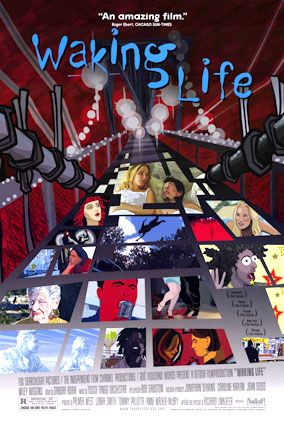
Waking Life

Dir. Richard Linklater
2001


This review is dedicated to the dialectical frustration of the film it purports to critique...

There is a fundamental contradiction latent in Richard Linklater's Waking Life. The film speaks at length about consciousness, mobility, living and being alive but in order to view the film we have to sit on our couch and experience the film passively; let the waves of progressive animation break over us; drown in its moody, philosophical diatribes; surrender to the stupefying experiences that is Waking Life. In utilizing this process I think Richard Linklater is trying to gesture toward film's existence in a “world of the dead”; a world of semantic visual language that, since its birth, has come under closer and closer constrictions until finally it arrives at its current state: modern cinema with all its limitations, both inherently in the medium (physical) and outside of it (financial), structurally built into the system by which all film comes to be and be seen. Of course the biggest contradiction of all is Linklater's voice in Waking Life. Is the film a serious testament to the myriad ways in which human beings find reason to live and connect with people? Or is it an ironic document, psycho analytically detached from its subject matter, about the hypocrisy of people preaching an active existence but who live in a constant state of ideas and dreams?

In honor of Linklater's subversion of narrative form I will self-destruct my own critical narrative. Here are two spoilers: 1) I hated this film. 2) The answer to the question above (and to all the questions posed throughout the film) is: there is no answer. In reference to the first spoiler I defend my tactless denunciation by suggesting that the conscientious film lover discovers a paradox in Waking Life. The viewer does not necessarily hate the film it is “bad”, in the critical and hyper objective sense, but rather because the film is actually not much of a film. It is a collective stream of consciousness that forms no parallels and obeys no laws. It adheres to no preconceived rules and thus ends up being some form of mutant neo-cinema. Yes, we view it projected on to screens or flashed onto our televisions like any other film, but Waking Life operates in complete opposition to the expectations of even the most well-viewed movie fan. The film transgress its initial self-awareness (a scene of studio musicians recording the film's eerie score) and enters a bizarre state of permeability between the viewer and the nominal protagonist.

The viewer is dragged into the film via fantasy POV shooting and is addressed directly by the film's hyper stylized characters (many of whom are rotoscoped versions of Linklater collaborators and friends). This faux-documentary style is all the while counterbalanced by the abstract narrative of our “protagonist” and his journey from unconscious observation to conditioned awareness. The viewer takes this journey in just the opposite direction, initially perturbed and offset by almost every aspect of Linklater's film and later completely entranced by it. The intensity of Linklater's audiovisual process, which some have suggested to be in sync with the film, while being hugely impressive is nonetheless completely distracting, disconnecting the viewer from the essasyistic network of ideas which Linklater has scrupously collected and loosely connected to one another. As the final credit sequence rolls the viewer has either completely rejected the film or accepted blindly its aura (and potential illusion) of knowledge, creativity and enlightenment.

To call this film difficult would be a dramatic understatement. In fact, it is nearly impossible. The film is conceived as a series of hallucinatory episodes, from the sublime to the intensely visceral, meant to mimic the dreamscape in which all the unconscious thought process an individual might have throughout their life is articulately stated by a number of talking heads. The films title and preeminent theme (if one may be so bold...) is that of the differences and similarities between the world of dreams and the “waking life” which is, of course, discussed at length, with Linklater tediously wandering from one semi-plausible explanation to the next. Perhaps the film's most inadvertently pleasing facet is how this “waking life” is referred to us by its opposite: the film. The film, which is a pure construct, drawing attention to its own construction through its dynamic animation and the absurdity of its non-linear structure, reminds us that outside of this film there is a whole life that we are meant to interact with. But therein lies the problem. Is this the climax of Linklater's eulogy on life or the punch-line to a nasty joke?

As formerly stated that troubling question remains unresolved. The obsessively nomadic structure means the viewer is never firmly rooted in one idea before he is lifted off to another one. Affective film making is scattered throughout, but the Waking Life is mostly an authoritarian and derisive approach to the communication of ideas. Where hints of the celestial may appear they are immediately stomped out by the coldness of the cerebral, punished for their attempts at transcendence. The film ends up being an elliptical meditation on life, death, dreams and how all three (apparently) relate to one another. It invites contemplation and active participation without ever leaving your living room. It is thus a contradictory statement, one that attempts to wield far too much control over its own contradiction, and as a result becomes the perfect example of art's uselessness. Utterly didactic and un-fulfilling, through Waking Life Richard Linklater has abandoned his duty as a filmmaker in order to tell (at length) instead of show, proclaiming all that is absorbing, arresting and illuminative in both fiction and non-fiction because it is communicated intrinsically rather than letting the film divulge its hidden self.

Thursday, February 4, 2010

The Assassination of Jesses James by the Coward Robert Ford

Dir. Andrew Dominik
2007
9.8


2007 was a hell of a year for film. Were it not for P.T. Anderson's magnum opus, the Coen's darkest (and possibly best) venture, the Palm D'or winning 4 Months, 3 Weeks and 2 Days, David Fincher's glorious Zodiac, the impeccable I'm Not There as well as several other outstanding films from directors new and old, The Assassination of Jesse James by the Coward Robert Ford may have had a chance of establishing its own mythic stature. This isn't meant to downplay the critical and commercial reception of the film nor to eschew its quality. Just the opposite: it is an attempt to suggest that through its incredible psychological depth mirrored in its breathtaking pictorial quality and ability to co-opt American myth to comment back on American myth making, The Assassination of Jesse James was then and continues to be, like James himself, ahead of its time.

In age inundated with films of all types and quality, from the hysterical spectacle of the Hollywood blockbuster to the outsider installation-ready art film, suggesting a film is “ahead of its time” may be kind of a moot point. Which films recognize and represent our cinematic time? In 1942 when Orson Welles released Citizen Kane, a film that utilized a myriad of unseen techniques to a sophisticated and highly effective end, it was not so obvious that the film was “ahead of its time”. In fact, like so many masterpieces before and after it, it was a critical and commercial failure; rejected by its viewership like one fickly rejects an unappealing flavor in a dish. Almost 70 years later it is unanimously praised as the most important film of all time. Upon my first viewing of The Assassination of Jesse James I rejected the film on the grounds that it was blaise mythologizing, tedious and banal, creating an artificial gravity around a subject that could not hold its own weight. In retrospect I can say that I was not paying enough attention. Closer examination revealed a world of psychological intimidation and obsession. Themes of distortion, of vision through the smearing of camera lenses and blurry windows of the picture perfect colonial houses and of time through the panoramic vistas with clouds rushing by above them, etched an aching metaphor of Robert Ford's painful detachment from reality and Jesse Jame's descent into madness. The quantity of characters and their offscreen movement, before seemingly untraceable, shaped itself into a dramatic symphony of elements; a exquisite counterpoint of desire and duty. Most importantly, the severe but never overt emotional undertones of the film came through, as a crescendo, building to a soaring catharsis of a climax reaching its hand out of the screen and tugging the viewer by the collar into the depraved and alienating world of myth.

The myth that the film relies so heavily upon is actually based, as much as possible, on fact. The central story, that of Jesse James “befriending” Robert Ford (the true central character of the film) and his eventual, intentional death/suicide at his hands, is true. The myth, that is not so much cruelly debunked as it is gently, if painfully, revealed, is the one in Robert Ford's mind. That myth, of Jesse James as a God, is further encouraged by the film's voice over narration which unveils details of Jesse's inner life that create a rich subtext of his sometimes inexplicable actions and abilities. The film is less about an accurate portrayal of the past as it about personal, subjective history. It not about knowing the textbook facts but memorizing the penny arcade story, which is of course more interesting and much more revealing. The film's core story sometimes feels like the stuff of myth, although it is firmly grounded in historical realism. The myth exists in between the words and the actions, in the breathing room that Dominik expertly allows for. It is during these moments, when we are asked to study the nervous twitch of Ford's face or the omnipotent reflection in Jame's eye, that the infinite myth of the film reveals itself.

Dominik takes both a minimalist and maximalist approach to his film. The aforementioned emphasis on spaciousness in the dialog and the supreme concentration on his actors (still not enough has been said about Casey Afleck and Brad Pitt who offer career expanding and career topping performances, respectfully) is uniquely balanced by his rigorous attention to period detail and a noteworthy ability to subtly illuminate and apprehend the viewer, both of which greatly deepen the film's astounding ethos. The film also represents a perfect conjunction of minds. Dominik, working with veteran actor Brad Pitt alongside no-longer up-and-coming Casey Affleck, utilizes the multiform talents of director of photography Roger Deakins (who impressively also filmed No Country for Old Men that same year), procures Nick Cave and Warren Ellis who create a score wonderfully harmonic with the meloncholy tone of the film, and snatches Spielberg's editor. Spare no expense, indeed! And the result is a masterpiece of modern cinema.

Though it may be cinematic blasphemy to continue the line of reasoning that compares The Assassination of Jesse James to Citizen Kane but nevertheless the parallels linking the two are evident. Thematically and cinematically the two are cut from the same cloth. Whether James proves to be as important as Kane is for history, and the omnipotent power of myth, to decide.

Friday, January 29, 2010

Wendy and Lucy

Dir. Kelly Reichardt
2008
9.0


Director Kelly Reichardt's 2008 film Wendy and Lucy has been described as a “politically urgent road movie.” Though it may seem a trifle particular, Wendy and Lucy hardly gives the sense of any urgency, be it political or otherwise. Rather the film moves slowly and quietly, unfolding in a way that is both precious and intensely difficult. There is also the problem of the genre “road film” which in this case is entirely nominal. Meeting Wendy just as her car breaks down in a quiet Oregon town, the viewer finds the protagonist covering very little in the way of pavement. However, metaphysically the film is a constant state of determined wandering. The question is then: what defines a road film? Is it the pretense under which so many characters and people alike set out on: the hope of uncovering some occult or sublime truth about themselves or humanity. Or is it instead some unconscious and thus inescapable urge to escape? It would seem to be the difference between a want and a need. Something created or driven by an outside force and the internal struggle for spiritual survival that presses all other needs to the side. Wendy and Lucy, as a film, travels the latter route and arrives painfully at the spiritual awakening that so many seek to achieve while watching America roar past them.

Based on the short story “Train Choir” by Jon Raymond, Wendy and Lucy instantly gives the impression of a short but masterfully written novel where every word is carefully selected in order to achieve maximum affect (think Hemingway). The film is also highly reminiscent of the late master director Ingmar Bergman. Here the stark countryside of Sweden has been replaced by an almost picturesque (if implacable) small American town. Wendy (Michelle Williams) chaffs with the town's locals who seem to have achieved some sort of sad, monotonous stability with only the smallest hints of the "political urgency" mentioned earlier. Placing the film in a contemporary context the viewer knows the times are troubled. While the story may take place on the fringe of economic stability, the film does not hit you over the head with sentiment or guilt. Rather it is Wendy whose straits are more dire and urgent than anyone she meets in town.

She has arrived in town only to find that her car won't start and, after an uncomfortable incident with a rhetoric charged youth at a grocery store, her dog, Lucy, has gone missing. Lucy in turn becomes the symbol of Wendy's own lostness. Wendy's search for Lucy quite literally becomes a search for herself. So charged by her unconscious need to be reconnected with Lucy, Wendy forgoes all other hardship. Even a potentially dangerous encounter with a deranged homeless man only strengthens Wendy's resolve to find Lucy. When she does, seeing her sitting happily in the yard of a foster family's home, the tight constraint and determination that had held her together up until this point snaps. She weeps at seeing Lucy so happy without her and realizes that if she is to truly succeed in her journey toward becoming a happier more fulfilled person (for which her destination of Alaska is only a tangible, if idealized, representative) she has to let go. The film proposes that in order to move forward one must blow away the last sediments of the past. Her catharsis is magnificently placed alongside a scene of her boarding a train and an extended shot of the placid coniferous trees of North West America blending beautifully together, framed by the setting orange sun.

Supported by a unique ensemble cast of mostly unrecognizable or non-actors (with the notable exception of Will Patton) Michelle Williams carries the film's emotional weight as if it was truly her own. Her performance is engaging and pitch perfect, reminiscent of the most memorable of classic performances. Enough can not be said about her acting accomplishment in this film and though the framework is lo-fi indie the emotional depth she communicates with such a sparse script is beyond measure. The film itself succeeds where many “character films” do not due to its utterly engaging vision of a classically structured America disintegrating before our very eyes. The words of the Walgreen's security guard ring loud in our ears “There used to be a mill here. Now I don't know what people do.”

The film could have easily succumb to myth making, what with the extensive use of train whistles and the socially marginalized that populate their barren tracks and woods, if it were not so humanizing in its vision. The film does not seek to propagate the mysterious charm of isolation and travel, the mixture by which some assume a spiritual awakening will manifest. Rather it seeks to show the depravity of such ideas; the sheer unmistakable absurdity of wanting such circumstance. If Wendy's rejection of Lucy is any indication then we may conclude that enlightenment is not in looking but in finding. Maturity and self-understanding are the results of facing what we discover, be it good or bad. Understanding and divulging this sublime understanding, Wendy and Lucy is as socially committed as it is effortlessly poetic.

Up

Dir. Pete Docter and Bob Peterson
2009
8.9


There is really no need to introduce Pixar Animation Studios. No need to explain how, over the past 15 years, Pixar has released the most timeless and transcendental animated features since the golden age of Walt Disney. Furthermore, it is pointless to note that Pixar is a studio comprised of adults making sophisticated and thoughtful films, consistently marketed toward children, that obliterate age demographics. Instead let's focus on the micro evolution of Pixar's thematic content and vision. Toy Story was primarily a singular childhood fantasy which dealt with the less than instinctive practice of social acceptance. Finding Nemo used a dual narrative in order to find common ground between the desires of children and the protective qualities of overbearing parents. Ratatouille etched a beautiful portrait of the relationship between independence and interdependence in romance and society. WALL-E delivered a universal (and overtly political) message against ennui and the distractions of the digital age. With Up, Pixar's 10th feature, the studio has delivered its foremost adult film. With themes of aging, loyalty and the burden of memory, Up is Pixar's most finely cultivated and quietly introspective film yet.

Known more for humanizing marginalized animals and objects (fish, rats, toys, robots, etc.), Up is only Pixar's second film to exclusively follow human characters. Moving beyond the familial adventure of The Incredibles, Up is both familiar and unfamiliar to the studio's filmography. To begin, its principle character is a senior citizen. At first this choice may seem unorthodox but Pixar brings in familiar elements to marry the film with the rest of its canon. First, the tried and true “unlikely ensemble”: the old man (Carl), a pudgy and useless boyscout (Russell), a 13 foot tall exotic female bird named Kevin, and a “talking” dog called Dug. Second, the growth of the principle character who remains obstinately insular until an emotional breaking point whereupon he commits himself wholeheartedly to righteous morality and the happiness of his companions. Pixar's films could be considered structurally formulaic in this sense, but each navigates its scenario in a way that is so thrilling and highly involved that the complaint becomes virtually invalid.

In each of Pixar's films there is some sort of initial disturbance ranging from the innocuous arrival of a new toy to the capture of a fish's sole offspring. These are the moments, which are usually affixed with modest tension, which catapult the narrative into motion. Up doesn't necessarily break this pattern but the film does structurally postpones its ascent into linear narrative. Beginning with Carl's childhood and the meeting of his eventual wife Ellie, the film enters a harrowing and emotionally wrenching montage that encapsulates the passing of time and the strife of two lovers. It is unveiled that Carl and Ellie's dream is to travel to South America and discover the enchanted lands of Paradise Falls, which first captured their mutual imagination when they were children. However, as so often happens in the real world, events interject. As the montage progresses there is shot after shot of a glass coin jar, which contains their funds for the trip, smashed in order to recover from loss (injury, destruction, etc.). The montage is particularly moving in its dealing with two mature themes which are broached silently and sadly: an incapacity to have children (or perhaps, worse still, a miscarriage) and Ellie's death. Cinematically masterful this montage serves a very special function for the rest of the film: it injects meaning into personal objects causing them to later become representative of Carl's memory.

Carl, after battering a civil servant and being ordered to abandon the house he has lived in for most of his life, inflates thousands of balloons and soars into the sky toward South America. The rest of the story is an exercise in classic Pixar adventure, although at times the film works a little too hard to overcome its own sentimental inertia. Carl remains dedicated to the house which has become the embodiment of his dead wife. Even with the buoyancy of adventure (which the balloons represent) the house (Carl's memory) still remains a burden to him until circumstances arise that force him to choose between this precious relic of his past or a new life of meaning. Choosing the latter, there is a beautiful and iconic shot of the house, colored balloons still tethered to it, sinking away into the clouds: a weighty and powerful memory finally being released by its owner.

Back in 1995 I was seven years old and likely polishing off the last of the Walt Disney classics that I was raised on. That same year Pixar released its first feature and, in retrospect, its safe to say that a new epoch began. While Toy Story's animation was groundbreaking then (and still remains a milestone in digital animation) it is a “child's plaything” in comparison to Pixar's recent accomplishments. Known for their uncanny attention to detail, since the turn of the century the studio's animators have exploded into larger and larger digital environments. From countries to continents; the epic vastness of the ocean to the infinite reaches of the universe, Pixar has visually transported viewers to the very limits of imagination. Though it may seem a somber step back from WALL-E's intoxicating spectacle, Up moves viewers in a distinctly different way: emotionally. The subtlety and communicable depth of the film far exceeds anything yet achieved by Pixar. Though not without fault, Up is yet another massive achievement from a studio still reinventing itself and redefining popular cinema.