Showing posts with label 2006. Show all posts

Thursday, January 28, 2010

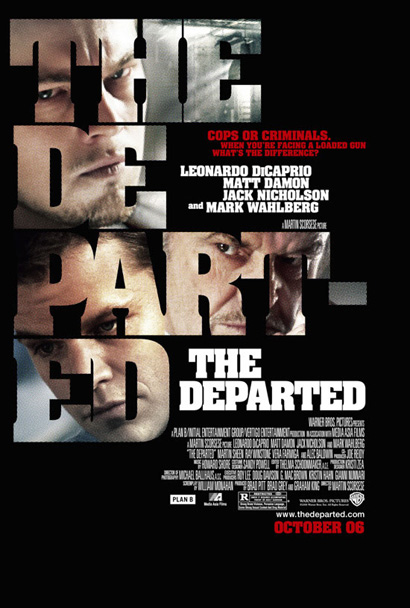
The Departed

Dir. Martin Scorsese
2006
9.3


Martin Scorsese is a man's director. In forty years he's nearly perfectly the mobster film, a genre more frequently avoided by women than war films or sci-fi movies. And you can easily see why: his mobster movies tend to conform to male stereotypes: an affinity for violence, sex, power, and essentially all the things the typical man is supposed to want as defined by the propaganda of consumerist culture, that we have furthermore accepted as truth. The mob itself is centered around a system of patriarchy: a system measured by male desire. This system states that a man who does not want anything is useless. The things mobsters pathologically desire become objectified. Sex, money, property, and respect all become means of measuring a man's greatness. Women in mobster films (including Scorsese's) are almost always on the peripheral. On occasion two men may fight over a women but it is not, generally speaking, because of some profound connection but rather an intrinsic need to assert dominance. In The Departed, Martin Scorsese's most rigorously taut and suspenseful film, the all-consuming “mob mentality” is profiled and defined with greater precision than ever before. Encased in what can only be called the best screenplay of the decade Scorsese unleashes a powerhouse of stars and, per usual, directs them to cinematic greatness. In the face of such a towering and enchanting success, it is easy to overlook his history of misogynistic film making and easier still to accept it as a term and condition of an exceptionally talented director.

One could argue that The Departed pointed to an elevation in Scorsese's consideration of women. However, the recurring motifs of sons, impotence and sexlessness, which could potentially be used to support this point, do more to increase the insecurity and fallibility of the principle male characters than to heighten the stature of the film's neglected females. In fact the film's only principle female role functions more as a meeting point for the film's two deceivers, and her character is flat and remotely lifeless. However, this is the only flat and lifeless portion of the film. Trying to summarize the film's plot would indeed be an unfortunate decision at this junction. With The Departed Scorsese unleashes a hail of details in conjunction with violent sensory overload (the often discontinuous diegetic system alone is brilliantly disconcerting) that literally leaves the viewer stunned. This is perhaps Scorsese showing his own form of dominance over a genre that he helped define and keep alive since the 1970s.

Though Scorsese does not adhere to standard thriller film levels of suspense and detail, he roughly maintains their ratio. Not only are the levels of plot detail and visual excitement simply extraordinary, Scorsese imbues his film with his own polished psychology theories. There is, of course, the symbiotic relationship of law and crime which is explored in most every “crime” movie, but rarely to such a degree. The film's recurrent “what's the difference?” theme (facing a loaded weapon, cui bono?, could I do murder?) finds deep roots in the Neitzchaen principle of moral superiority or “beyond good and evil.” Direct references are made to Freud, however they are more for emphasize on the undercurrent of philosophy pounding in the blood of this film rather than for intellectual vanity. Scorsese takes his film is so many exciting directions at once that it's hard to recognize, even after several viewings, what is actually stimulating you. The Departed marks the difference between a film that is too complicated and poorly handled and one that the viewer gets more out of every time they watch it. It's a difference that's difficult to quantify but William Monohan's screenplay masterfully fills every crevice of curiosity and follows each loose end to its respective conclusion. You get done watching The Departed and you don't scratch your head and go “Huh?”. Instead, you feel like you need to go lie down or take a walk. You feel like you've just finished something seriously involving although you've only been sitting on your couch. In short, it's exactly how a movie should make you feel.

Despite all his achievements both in The Departed and its predecessors, Scorsese has still not managed to completely level with women. To illustrate, think of The Departed's final sequences as sex. The phallic-pistol erupting, which here would represent the male orgasm and directorial climax, causes the death of Costigan (which the viewer has unknowingly been anticipating) and the voyeuristic peak of the viewer's (representative of women) climax as well. This moment would have been the perfect cinematic rendering of mutual pleasure between director and viewer, had not two more murders taken place within seconds of that initial one and one more just before the final credit sequence roles. These sequential murders become symbolic of selfish pleasure (taken on by the director) for which we feel very little. They feel vaguely excessive and cheap: a means of ushering the film's finale which, while not rushed, doesn't feel entirely appropriate. Perhaps its our ingrained sense of American, bureaucratic law and order that informs our conviction that someone should have been arrested, although our most basic and instinctual sense of justice is satisfied with the final death. Nevertheless, Scorsese is surely putting the finishing touches on a grotesque portrait of primal urges. In doing so, however, he almost involuntarily associates himself with the engendered and dealt-with flaws of the characters he portrays so brutally. The act is corrupted and dangerously indulgent. It exercises the same system of desire etched out by the mob itself. For a film so sophisticated its conclusion feels unnervingly primitive. Perhaps it is best to conclude by saying that even a film as well thought out and executed as The Departed still cannot help but give insight into the mind of the man behind it.

Saturday, November 14, 2009

The Science of Sleep

Dir. Michel Gondry
2006
6.8


In the 1930s during Stalin's rise to power many great filmmakers in the Soviet Union were accused of formalism and subsequently banned from producing their art. Formalism, as described by film historian David A. Cook is “the sometimes deadly sin of exalting the aesthetic form of a work above its ideological content.” In other words: style over substance. Early landmark Soviet directors such as Dziga Vertov, Lev Kuleshov, and national hero Sergei Eisenstein, were all silenced under Stalin's artistic tyranny. Today, things are quite different. Style is exalted. David Fincher and Quentin Tarantino, whose respective style occasionally become a means unto itself, are among America's most popular directors. The 21st century has thus far bore witness to impressive advancements in reproducing life via film technology. Between Peter Jackson, Tarantino, Pixar, and a host of films such as Children of Men, Crouching Tiger, Hidden Dragon, and Mulholland Dr., silver screen possibilities have never seemed more infinite. Among the technically ambitious there is French director Michel Gondry whose pioneering visual work, like Fincher and Spike Jonze, stems from his time spent producing music videos. If you've never seen one of his music videos I suggest starting here. Gondry spent the early part of his film career working closely with the brilliant screen writer Charlie Kaufman, a union that produced Human Nature (2001) and the romantic epic Eternal Sunshine of the Spotless Mind (2004). In 2006 Gondry wrote and directed The Science of Sleep, which is a film that ultimately proves the difference between a visually stimulating film counterbalanced by an intoxicating and bitter sweet script and a visually stimulating film that exists by and for itself.

Following in the vein of Eternal Sunshine, The Science of Sleep is the story of a rather twisted romance. Stephane (Gael Garcia Bernal) returns to his former home in France after his father dies. Here he meets and falls in love with his neighbor, Stephanie (Charlotte Gainsbourg). Their relationship begins with a series of bumbling, half-witted lies that later create an opportunity for comedic relief. Said relief is necessary as Stephane is a horribly awkward, insular and hyper creative person whose imagination has a tendency to take control. As the film begins to swirl downwards like water draining from a sink, we find out that Stephane is largely unable to separate reality and his dreamworld. His wild imagination roams free while sleeping, but occasionally (and more often as the film progresses) it entirely detaches and the result, psychologically, is vaguely interesting rather than insightful. Gondry clearly knows how to handle and enhance the visual aspect of Stephane's unconscious paradise, but his grasp on its psychological aspect is at best basic, and at worst horribly understated. Stephane is portrayed as a child and his desires conform to his adolescent concept of romance. The problem is that Gondry fills the cinematic dead space between ocular episodes that border on hallucination with emotional responses to them that could only be the biproduct of a more experienced person, one with acute knowledge of death and the twisted, confusing realities of the world. This contradiction ruins the emotional continuity of the film to the point at which it literally falls apart. The film's final sequence, a very obvious reference to Freudian wish-fulfillment, is a narrative cop-out if there ever was one.

Though hugely flawed in its ignorance of psychological relations, The Science of Sleep is still a visual masterpiece. Gondry's art direction is simply unparalleled and is taken to its very limit. The sheer amount of vision required to visualize and produce everything from the vivid, surreal dream sequences of Stephane to the plausible and pleasant aesthetics of Stephanie's Parisian apartment is awe inspiring. This is not to suggest that Gondry was alone in this endeavor, but The Silence of Sleep is very clearly his brainchild. He proves, without any trace of doubt, that he is a genius visionary and a prolific innovator. Still, The Science of Sleep fails in spite of, or perhaps because of, this vision and artistic perseverance. The film plays like an extended music video, subjecting the viewer to a lavish display of artistic refinement and technological know-how, but ultimately fails to form a cohesive statement. It is likely his work with Kaufman encouraged a reevaluation of traditional film structure. However, Gondry takes the idea one step too far and abandons it altogether. Gondry, like Stephane, operates best in the absence of reality, with nothing tethering him to his fears and insecurities. I shall conclude simply by saying that, despite its impressive stimuli, Stalin probably would have exiled Michel Gondry to Siberia for The Silence of Sleep.

Monday, March 2, 2009

Inland Empire

Dir. David Lynch
2006
n/a

My own theory about the works of Pablo Picasso, in particular this one, is that his genius extended from his dissemination of objects and scenes so as to allow them to take on an entirely different, unknown meaning as symbols. The work of Fabulists such as Italo Calvino and critical theorists like Roland Barthes attempts to subjugate the body of symbols that make up our visual, written and spoken versions of the world, also known as semiotics. Semiotics are built upon a kind of equation. There is the signifier, which is generally the spoken or written word. Then there is the signified which is the visual representation of the word. For instance, when we hear the word “tree” an image of a tree instantly appears in our brain. Between the two, the word and the image, is a certain formlessness which allows each person to come to their own conclusion of what is a “tree”. With Picasso, I believe, the idea was to destroy the symbol in order to give form to the idea of the symbol, rather than the symbol itself. This means decoding the values latent in the subconscious process of turning a word into a visual icon. David Lynch, as a film director, uses a similar process when constructing his films. He scientifically dismantles our fear in order to show us where it comes from. The result is abstraction; an unfamiliar body of symbols and signs that are as thrilling as they are difficult. The 21st century, thus far, has yielded two astonishing, surrealist works from Lynch: 2001's Mulholland Dr and 2006's Inland Empire. While Mulholland Dr entertained the idea of a linear narrative for about an hour and a half, it then proceeded to plunge deeply into a psychedelic and wholly upsetting universe of disillusion and abandonment. Inland Empire forgets structure altogether, choosing instead to weave its epic revolting grandeur through a series of twisted vignettes. The result is cataclysmic. Lynch defines fear by ripping apart everything that scares us and displaying its bloodied, maggot filled entrails. It is in this process that Lynch reveals the abstraction of terror.

I can safely say that Inland Empire was the most nightmarish film I've seen in quite some time. More importantly though is why. While Lynch certainly utilizes certain cinematic cliches to heighten tension (shadows, microtonal music, visible character fear) as an audience we don't feel a profound enough connection to our main character to be scared for her. In fact as she contorts and defamiliarizes, we actually end up becoming afraid of her. What scares us is Lynch's keenly subconscious understanding of uncomfortable objects or persons. A gun, a man with a lightbulb in his mouth, another man smiling menacingly, a light that blinks from white to red, a Polish women who speaks of evil, people in rabbit costumes. Separately each one of these symbols is uncomfortable, but in succession that lack of comfort builds into anxiety and then into fear. We desire resolution, an explanation as to why these images are occurring, and certainly some glimmer of hope for a happy ending. However, this is a David Lynch film. His endings are hardly ever even “endings” and even rarer are ones that, by contemporary standards, might be considered “happy”. The film is largely intangible, and you gets the impression that you've missed some terribly important detail that would string the plot together. In fact the only thing that really holds the dark sketches together is a rough sense of parallel structure, with certain phrases or scenes being repeated throughout the film, although generally obscured in location or meaning, which really only furthers feelings of being on the peripheral; far away from any kind of extrinsic meaning, but also dangerously close to some greater kind of understanding.

That understanding is the truth that fear, once alleviated from its symbolic and hyper specific circumstance, is still a terribly powerful force. Lynch is a master of cataloging evil in all its various incarnations, from curiously amoral to sinisterly other-worldly. Had Lynch arranged Inland Empire in such a way that it followed a discernible plot or structure the effect would not have been quite so powerful. The way he juxtaposes conversations about trips to Pomona by bus and girls with blond wigs, drug addictions and holes in their intestines with the bloody street death of our main character kills any sense of reality, but in place of reality a greater feeling of dread. If there was ever a work of art that deserved the title Kafkaesque, Inland Empire is truly it. Its radical design and deconstruction of Hollywood tropes of suspense and horror, and subsequent reassembly of those same tropes into new, as of yet untranslatable symbols defies reason.

Symbols take on meaning only after a general idea of what they stand for can be agreed upon. But even with the most common of symbols, personal taste delineates exactly what image said symbol conjures up. For “tree” any number of kinds of trees can be imagined, but it is their general characteristics (roots in the ground, some kind of leaves or branches, a trunk, etc.) that fill the remote region between the signifier (the word “tree”) and the signified (the image of a tree). In Inland Empire a new body of symbols for fear are produced, but we are at a loss at how to translate them. It is very exciting. Like being a child again, we are granted an opportunity to allow our first impression of these symbols to govern how we feel about their appearance in the future. By disdaining from concrete examples of fear and terror, Lynch has created a work that plunges deep into the mystic formlessness of those words and cleaves from that mass a totally unique and daunting vision of fear and a revolutionary means of communicating.