Showing posts with label 1990s. Show all posts

Friday, May 7, 2010

A Taste of Cherry

Dir. Abbas Kiarostami
1997
9.0


More than a decade before critics came up with a term for the growing trend of thoughtful albeit at times affectation smothered films featuring protagonists plodding their way through life's dreary necessities (also known as Slow Cinema), Abbas Kiarostami anticipated and transcended the movement. However, as in all arenas of history there is rarely one discreet starting point for a movement and to suggest that Kiarostami's A Taste of Cherry laid the foundation for Slow Cinema would be indelicate and ignorant. What A Taste of Cherry does discreetly represent is an apex of the pre-Slow Cinema age of spiritual perambulating over perfunctory story telling, a trait which would later become one of the myriad slippery signifiers of Slow Cinema. More so than its debatable cinematic importance (the film did win the Palm d'Or at Cannes after all) is the film's power as a cinematic metaphor of projection.

This concept of projection works splendidly in cinema because it is bound to the most basic and common manner in which film has historically been viewed. However, the kind of projecting required and unconsciously elicited by A Taste of Cherry is defined by its viewers. Unlike the flash-bang of narrative cinema with its constructs and manipulations, A Taste of Cherry takes away the tension/release or question/answer framework which most narrative features adhere to. In the absence of clear direction and motivation in the film itself, the viewer is left to decide everything. Rather than have questions answered or even have them posed at all, we as viewers have to project onto the film our own desires, misgivings and insecurities. Thus the film takes on a unique quality of assimilated personality and vulnerability.

We enter into a cerebral mode early on as Kiarostami interpolates us not as perverse voyeurs but spiritual passengers. We spend much of the film in protagonist's Mr. Badhi's passenger seat (fittingly this seat was filled by Kiarostami himself throughout the shooting). Badhi drives slowly around Tehran before entering into the city's solitary foothills, all the while eliciting an unknown favor from strangers. As it turns out Badhi is seeking someone to bury his body after he commits suicide. Upon this revelation the film releases some of its former passivity and begins to ease the viewer into a series of episodes which constitute a familiar “life in a day” structure. In and through meandering conversations with three outsiders (a soldier, a seminarian and a taxidermist) each with a profoundly different relation to death (the soldier destroys life, the seminarian attempts to maintain it, and the taxidermist seeks to preserve it) Kiarostami demonstrates, via the reactionary Badhi, man's evolution from the bullying anti-logic of youth to the closed-door spirituality that has little relation to a real, complex world and finally the practiced pragmaticism of the aged who accept death begrudgingly. Each episode is a journey for Badhi not simply through physical terrain but his soul and intellect as well.

If there is a theme in A Taste of Cherry it might be the meeting point of the latter two. Badhi has calculated that his life has no value amongst the living although the doubt that slips in toward the film's conclusion is a telling reminder that value like life itself is dynamic. The same kind of calculation might be practiced on film or any art for that matter. What merits excellence and aren't our perceptions wielded (at least in part) by our pretenses? Badhi appears well off and in good health although his tanned handsome face slopes downward toward his self-dug grave. However, this is not enough for him and while we never discover what has prompted his decision to end his life Kiarostami seems to be suggesting through the film's minimalist dialog that the reason is not so important. For Badhi, as with Kiarostami, the action becomes subordinate to the decision to act.

Of course all this investment in Badhi and his journey evaporates with the film's conclusion. Kiarostami pulls away the curtain of artifice that exists in even the most methodically unmethodical regions of cinema. Handicam footage of the shooting of A Taste of Cherry reveals, however, not the “tiresome distancing strategy” Roger Ebert interprets, but rather an uncharacteristic openness to cinema's largest intrinsic fault: its corrupted imitation of real life. Even in a film as visually beautiful and emotionally haunting as A Taste of Cherry, Kiarostami's willingness to interrupt his own quiet reverie should be celebrated rather than condemned. The footage, only a few minutes worth, evokes a tangible human relationship between people which we retrospectively discover mimics our own relationship to Badhi. The moment in which lead actor Homayon Ershadi hands Kiarostami a cigarette illustrates a sublime counterpoint to the heart breaking final shot of Badhi's face: eyes closed, lit by strands of lightning darting from the heaven he hopes to soon occupy. The closing shot of soldiers (whether they are actors or actual army men is never made clear) socializing along the slopes underlines the intention of this unlikely inclusion: in every act of theater, beyond every curtain and behind every character there are human beings whose lives are the inspiration for and starting point of all performances.

Thursday, March 11, 2010

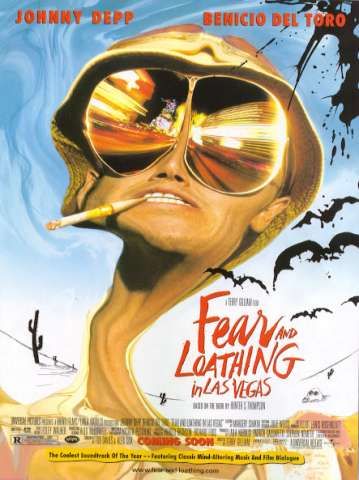
Fear and Loathing in Las Vegas

Dir. Terry Gilliam
1998
6.0


Several directors have attempted to adapt Hunter S. Thompson's magnum opus Fear and Loathing in Las Vegas. It was hyperrealist Terry Gilliam who finally translated Thompson's intoxicating vision of a post-Love/Vietnam era America to the silver screen. It's not difficult to see the arresting appeal of Thompson's work especially to a visual filmmaker like Gilliam. Artistically the text falls far left of Norman Mailer and Tom Wolfe, opting for autobiographical involvement rather than journalistic detachment, but lands a little closer to center than William S. Burrough's seminal Naked Lunch, with its manic moods and recondite prose. Thompson's invented technique of Gonzo Journalism, utilized in this famed outing, fused the narrative elements of fiction with the cerebral objectivity of a reporter in the field, attempting to create a seamless, unconscious reporting; a sort of journalistic automatism. The start of the novel, the significant Dr. Johnson quote “He who makes a beast of himself gets rid of the pain of being a man,” identifies both the central theme of the text as well as Thompson's intent. By subjugating the superego to the primitive ferocity of the id, through whatever means or substances deemed necessary, Thompson planned to reach anti-enlightenment: a state of mental and physical suffering so savage and visceral that he might truly escape the burdens of mankind. Hunter S. Thompson called Fear and Loathing in Las Vegas a failed attempt at Gonzo journalism. Sadly, Terry Gilliam's version fails as well, offering nothing more than a boiled down “greatest hits” version of this dizzying psycho analysis of America and its system of values at the turn of an epoch.

Gilliam's film begins its transgressions immediately. Before introducing the aforementioned Dr. Johnson quote, Gilliam juxtaposes stock footage of Vietnam protests with an eerily sweet rendition of “Favorite Things”. Despite being unnervingly Lynchian, Gilliam changes gears instantly with Johnny Depp's introspective and unabashed voiceover monolog and those tone setting opening lines. Immediately the contradiction becomes clear. Thompson sought to expose himself to the very horror of the American Dream letting his poetic stream-of-consciousness transport the reader directly into the story. The novel reads like a post-modern Heart of Darkness set on the west coast of America during the early 1970s. Rather than deliberately satirize his subjects Thompson's sharp prose and witty insights were mere footnotes to the shameful story that was unfolding right before his eyes. Gilliam's method, on the other hand, is contrived due at least in part to his medium. Gilliam, an internationally celebrated visual auteur, is an entertainer whose awe-inspiring vision occasionally detracts from any socio-political message he intends to broadcast. Example: Fear and Loathing in Las Vegas attempts savage satire and ends up being 90 percent slapstick and Gilliam's hallucinatory vision of American dystopia. The film's opening montage may be the director wearing his soul and feelings naively out on his sleeve (or perhaps vainly trying to attract viewer sympathy through emotional coercion), but the greater embarrassment is how he immediately rescinds them, destroying any value they might have had to the audience who will no doubt begin to wonder just what motivated Gilliam to adapt such a novel in the first place.

There are, however, a couple of sincere moments of filmmaking which fit nicely into the film's narrative framework. The first is the most celebrated and oft-quoted section of the novel: the “wave” speech. Epic, universal and beautifully written, this passage is fitted with an appropriately understated scene of Thompson/Duke (Johnny Depp) staring thoughtfully out the window of his Las Vegas hotel. The second moment is longer and of greater impact. In a North Vegas diner Gilliam puts together the finest set piece of the film, wherein Dr. Gonzo (Benecio del Torro and his incredible beer gut) demonstrates the much down played dark side of the drug abuser while Duke sits watching with ambivalent detachment as the diner's waitress turns to stone at the sight of Gonzo's hunting knife. Perhaps most terrifying of all is the sobering realism of the scene. The viewer is desperately and emotionally drawn into what is otherwise a circus of vivid visual effects and simplified contemporary philosophy.

Despite its many faults including a shamefully pro-drug conclusion ( or pro-madness in respect to Gilliam's oeuvre), Fear and Loathing in Las Vegas is not so much a singular misguided attempt at cultural critique but rather a sign of the times. It misses genius and controversy (the two statuses Gilliam professed to desiring most from the project) but alongside films like The Matrix and Fight Club emerged as a stylized signifier of a new decade of decadence and depravity in cinema. These films look incredible, come loaded with easily digestible subtext and end up offering an ambivalent moral open endedness. If there is no longer a voice like Thompson's in the literary world to put into apocalyptic and rapturous terms the very tangible horror of our time it is a small comfort having a filmmaker like Gilliam who can translate those same potent thoughts into moving pictures while other more uncompromising artists pick up the inspirational slack. Though it fails to be much more than an impotent screen adaptation of a visual, entertaining and culturally revealing novel, Gilliam's Fear and Loathing in Las Vegas succeeded in introducing the text to a new generation, resurrecting the timeless and restless message of Hunter S. Thompson.

Wednesday, March 11, 2009

Velvet Goldmine

Dir. Todd Haynes
1998
8.1

At what point does a life become absurd? When does a person quit being a human and become a persona or a personality, incapable of dissociating between their surrealist lifestyle and the likelihood that they are addicted to their own sense of escapism? In his brilliant 2007 fiopic on Bob Dylan, I'm Not There, director Todd Haynes theorized that this happens only when some kind of trauma forcibly slices and bleeds through into an existence that has evolved into a social and cultural lifestyle: forcibly crippling the gaping hugeness of exterior recklessness and waking an interior humanity that can be covered up but never entirely forgotten about. What made that film incomparable was its blending of realities, its fractal poster of one of the best, and at the same time in a more literal sense, least, known figures in contemporary music, and its ungodly collision of pure fantasy and debilitating reality. Stepping back 10 years we see the roots of Haynes' unique vision of personality and his theme of identity that he would further develop in the 21st century with Far From Heaven and I'm Not There. Velvet Goldmine, which centers around the life of David Bowie (known as “Brian Slade” in the film and played by Jonathan Rhys Meyers) and his relationship with Iggy Pop (“Curt Wilde” played by Ewan McGregor), does not pulsate as far out or as deeply as I'm Not There, but instead tries to unearth (and in a manner highly reminiscent of Citizen Kane's detective-esque narrative about uncovering the truth behind an infamous and controversial pseudo-historical figure) some kind of truth behind the glittery facade of the 70s glam rock movement in England and its affect on two of its most well known icons.

As with I'm Not There, Velvet Goldmine utilizes healthy doses of fiction and fantasy. Haynes' masterful and amazingly careful control over the artifacts in his films allows for these fables to blend with the written and oral history he is essentially remaking to create a picture that is almost entirely aware of itself in ways that its protagonists can never be. Velvet Goldmine understands its own mythology, and uses that knowledge (in the form of UFOs, pearls from Oscar Wilde, and impossibly well-timed meetings and introductions) to both undercut and underscore its own vicious and amoral landscape. Haynes designs Brian Slade as a gawky, awkward and troubled youth who, after discovering a passion for music, is inspired by an early performance by Curt Wilde in which the singer is seen jumping around the stage, removing his clothes, being aggressively sexual (in general, not towards a particular gender), and causing a scene that would ultimately lead to the basis of his character, Iggy Pop, being called the Godfather of Punk. It is the late 60s and Slade decides to take that idea and transform it into something mostly unseen before. As the film progresses Slade falls further into the deep, dark passages of his alter ego and stage persona “Maxwell Demon”, based heavily on David Bowie's Ziggy Stardust image, and as he does so becomes further infatuated with himself and his status as the penultimate pop icon of the time.

The film cuts between retroactive memories of Slade, as told by former lovers (his wife, one-time manager, and Curt Wilde himself) in order to, in 1984, discover “what became of Brian Slade?” Christian Bale plays an English rock journalist, Arthur Stuart, and Glam Rock devotee on a quest to discover, in the ten years since Slade faked his own shooting at a concert, who or what he is now. It's hard to tell whether Bale is remarkable in this role or entirely miscast, especially during his flashbacks as a sexually repressed teen in 70s England, working himself up to embrace the glam trend by buying Slade's records and dressing in a mostly asexual manner. It is revealed that through traumatic childhood experiences, which find a mirror in the experiences of Slade (beaten up at school, early exposure to vaudeville and homosexuality) and Wilde (electroshock therapy to “cure” him of his early signs of homosexuality), Stuart developed an entirely confused notion of sexuality and its relation to popular culture. In dual explorations of Slade's past and his own, he finds that their paths, both physically and psychologically, have met before and continue in a bizarre sort of parallelism. The film vaguely resolves its extrinsic plot line by concluding that androgenuous sex icon Brian Slade has transformed into a generic 80s arena lounge-ish star Tommy Stone, who falls somewhere between Rod Stewart and Roxy Music's Bryan Ferry.

If this all sounds very confusing, bordering on esoteric, that's because it is. Velvet Goldmine turns in on itself a few too many times and there are certainly moments where it is difficult to maintain a static concept of time and identity. While the film is, like all the films of Haynes' that I've had the pleasure of seeing, chock full of personality and iconography (Velvet Goldmine's version of the early 70s is one of the best and most authentic since Kubrick brainstormed what the future would look like in Clockwork Orange) and brings together a daunting number of literary (Oscar Wilde is quoted continuously) and cultural (was that Alice Cooper?) influences, the fact remains that it is too much for an audience to handle. It is not that the film loses focus, but more that its focus is so wide that it's difficult to see anything very clearly and instead the viewer is left with memorable scenes and impressions of the characters, rather than cleaving at the grit of the characters themselves. In retrospect I can safely say that Haynes perfected this unique film style, the fiopic, in I'm Not There; tightening up potential lose ends and further embracing duplicity and confusion to make a picture that was more wholly organic. I'm Not There embraced a viewer perspective of not only the history of its central character, Dylan, but also of the film's narrative, leaving mysteries to be solved independently rather than explained. That film was more a character study and less an attempt at a linear tribute to highly personalized concepts of historic events. Velvet Goldmine paved the way for this sometimes indulgent, but immaculately exceptional film style, but ultimately could not decide between embracing its own curious and occasionally confounding nature or attempting to explain away what it spent painstaking amounts of time building up to be enigma.