Showing posts with label 2001. Show all posts

Monday, February 15, 2010

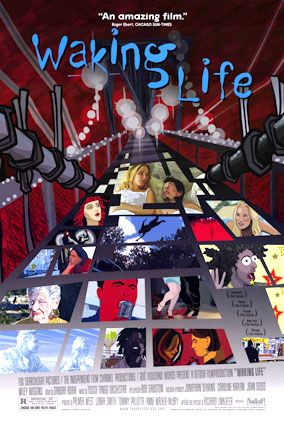
Waking Life

Dir. Richard Linklater
2001


This review is dedicated to the dialectical frustration of the film it purports to critique...

There is a fundamental contradiction latent in Richard Linklater's Waking Life. The film speaks at length about consciousness, mobility, living and being alive but in order to view the film we have to sit on our couch and experience the film passively; let the waves of progressive animation break over us; drown in its moody, philosophical diatribes; surrender to the stupefying experiences that is Waking Life. In utilizing this process I think Richard Linklater is trying to gesture toward film's existence in a “world of the dead”; a world of semantic visual language that, since its birth, has come under closer and closer constrictions until finally it arrives at its current state: modern cinema with all its limitations, both inherently in the medium (physical) and outside of it (financial), structurally built into the system by which all film comes to be and be seen. Of course the biggest contradiction of all is Linklater's voice in Waking Life. Is the film a serious testament to the myriad ways in which human beings find reason to live and connect with people? Or is it an ironic document, psycho analytically detached from its subject matter, about the hypocrisy of people preaching an active existence but who live in a constant state of ideas and dreams?

In honor of Linklater's subversion of narrative form I will self-destruct my own critical narrative. Here are two spoilers: 1) I hated this film. 2) The answer to the question above (and to all the questions posed throughout the film) is: there is no answer. In reference to the first spoiler I defend my tactless denunciation by suggesting that the conscientious film lover discovers a paradox in Waking Life. The viewer does not necessarily hate the film it is “bad”, in the critical and hyper objective sense, but rather because the film is actually not much of a film. It is a collective stream of consciousness that forms no parallels and obeys no laws. It adheres to no preconceived rules and thus ends up being some form of mutant neo-cinema. Yes, we view it projected on to screens or flashed onto our televisions like any other film, but Waking Life operates in complete opposition to the expectations of even the most well-viewed movie fan. The film transgress its initial self-awareness (a scene of studio musicians recording the film's eerie score) and enters a bizarre state of permeability between the viewer and the nominal protagonist.

The viewer is dragged into the film via fantasy POV shooting and is addressed directly by the film's hyper stylized characters (many of whom are rotoscoped versions of Linklater collaborators and friends). This faux-documentary style is all the while counterbalanced by the abstract narrative of our “protagonist” and his journey from unconscious observation to conditioned awareness. The viewer takes this journey in just the opposite direction, initially perturbed and offset by almost every aspect of Linklater's film and later completely entranced by it. The intensity of Linklater's audiovisual process, which some have suggested to be in sync with the film, while being hugely impressive is nonetheless completely distracting, disconnecting the viewer from the essasyistic network of ideas which Linklater has scrupously collected and loosely connected to one another. As the final credit sequence rolls the viewer has either completely rejected the film or accepted blindly its aura (and potential illusion) of knowledge, creativity and enlightenment.

To call this film difficult would be a dramatic understatement. In fact, it is nearly impossible. The film is conceived as a series of hallucinatory episodes, from the sublime to the intensely visceral, meant to mimic the dreamscape in which all the unconscious thought process an individual might have throughout their life is articulately stated by a number of talking heads. The films title and preeminent theme (if one may be so bold...) is that of the differences and similarities between the world of dreams and the “waking life” which is, of course, discussed at length, with Linklater tediously wandering from one semi-plausible explanation to the next. Perhaps the film's most inadvertently pleasing facet is how this “waking life” is referred to us by its opposite: the film. The film, which is a pure construct, drawing attention to its own construction through its dynamic animation and the absurdity of its non-linear structure, reminds us that outside of this film there is a whole life that we are meant to interact with. But therein lies the problem. Is this the climax of Linklater's eulogy on life or the punch-line to a nasty joke?

As formerly stated that troubling question remains unresolved. The obsessively nomadic structure means the viewer is never firmly rooted in one idea before he is lifted off to another one. Affective film making is scattered throughout, but the Waking Life is mostly an authoritarian and derisive approach to the communication of ideas. Where hints of the celestial may appear they are immediately stomped out by the coldness of the cerebral, punished for their attempts at transcendence. The film ends up being an elliptical meditation on life, death, dreams and how all three (apparently) relate to one another. It invites contemplation and active participation without ever leaving your living room. It is thus a contradictory statement, one that attempts to wield far too much control over its own contradiction, and as a result becomes the perfect example of art's uselessness. Utterly didactic and un-fulfilling, through Waking Life Richard Linklater has abandoned his duty as a filmmaker in order to tell (at length) instead of show, proclaiming all that is absorbing, arresting and illuminative in both fiction and non-fiction because it is communicated intrinsically rather than letting the film divulge its hidden self.

Tuesday, March 24, 2009

Artificial Intelligence: AI

Dir. Steven Spielberg
2001
7.5

As I understand it, based on a dizzying year spent as a Cultural Studies major (in plainspeak: an anthropological study of popular cultural/academia's rhetoric meets persistent-obnoxious hipster co-option of kitsch culture), a simulacrum is a recreation of an object that is in fact more perfect than the original. For instance, nowadays if you take an old photo of your grandparents sitting outside their farm smoking hand rolled cigarettes (the kind that didn't cause cancer), to a digital photoshop they could scan the picture and, using assumptions on coloring and texture, fill in pieces of the photo that have faded, giving you back a copy that looks almost new. Essentially for those who find history meaningful and imperfection an important means of discovery, simulacra is basically the anti-Christ. Steven Spielberg's 2001 film Artificial Intelligence: AI, in its opening monologue by Dr. Hobby, makes reference to simulacrum in mentioning how the new type of robots, or Mechas, that his robotics company is designing will be able to replicate the human emotion of love. These robots will always love, an idea that instantly terrified me. Always love? If everything in the world is understood based primarily on its opposite (what is down if not the antithesis of up?), then in making the assumption that anything can always love it must also have a subconscious and deep understanding of hate. This is essentially what the film is all about: a simulacrum's fall from grace; the self-realization of failure inherent in perfection. It is a quest that reveals some sinister beliefs of human beings, such as the the self-assured confidence that our consciousness, which we believe to possess over all other creatures, is a permanent excuse for overriding that very same compunction and committing atrocious acts of immorality against others (for those of you who are wondering if this film isn't at least in some small way about the Holocaust, the answer is “yes”; this is after all a Spielberg film). The film spins a large, tangled web of fable, mythology, and Christian doctrine and emerges, not entirely unscathed, as a modern allegory of humanity by way of robots.

What is immediately striking about AI is its vision of the future. In so many fictional, especially science-fictional, films that take place in the future the time period seems to either be presented as a cryptic and abstracted rendering of the present, so decontextualized that the viewer spends half the film trying to acclimate to their new perverse environment, or conversely a mirror image of the present, only flashier. Spielberg's screenplay, which is in and of itself a simulacrum (based on a previously written screenplay, which was based on a short story), nicely anticipates the future without the pretension or lack of inspiration of either aforementioned visions. His future is a reasonable one, where the human race has evolved slightly (technologically) but also devolved (emotionally). It is a full-bodied future. Spielberg takes into consideration not just the way things look (NYC is under water, cars are smaller, etc.) but also the way people act. The first part of the film in which David (Haley Joel Osment), the Mecha that a couple have adopted in place of their “real” son who is currently in the hospital, interacts with said couple is pretty painful. It would appear that Spielberg has assumed that without children (global warming has shortened food supplies, which lead to government regulations on child birth), adults will forget how to interact. A similar sort of assumption was made several years later in the book-to-screen adaptation of Children of Men, to a slightly more devastating end. David seeks to love, inhumanely. This means dogging after his “mother” until she accepts him. This “acceptance” is a code; an assortment of culturally loaded terms which Spielberg uses ironically as a means of adoption that is most divorced from humanity. Eventually the couple's “real son” returns home and David is abandoned. This is the film's first twist: the first ever robot made to believe it is human (when asked when David was built, he does not know how to respond) is left to fend for himself by a mother who he realizes cannot love him because he is not “real”. Thus begins an odyssey which mirrors the story of Pinnochio. A less scrupulous viewer might comment on how David's story is far more sinister, but that would be a discriminant viewpoint. David's miniscule understanding of the world does not allow him to fully comprehend what he sees at the anti-Mecha, Flesh Fair which is Spielberg's only real blatant finger wag at Nazism, during which robots are torn apart in sport as a celebration of life. Nor does it allow him to grasp how the Dr. Know, a digital guru, he seeks his answers from is a tourist scam. In fact it is not until the end of the film, when he comes to find out that he was the first in a line of Mechas, who all look like him and have his name, that he is not only not real but not unique either. The film's second twist is David's post-disillusioned attempted suicide, during which he discovers what he believes to be the Blue Fairy, which he has been searching for since being abandoned. After this the film launches into a Kubrick-esque time-odyssey complete with Spielberg's almost cliched use of aliens and a questionable ending that finds the famed director quickly tying together loose philosophical ends.

As a metaphysical sojourn and sophisticated, post-modern evaluation of human beings, Spielberg's film is mostly a triumph. However, as a piece of original art it falls on uncertain ground. A lot of people hyped AI for Stanley Kubrick's rumored post mortem involvement in the motion picture. The truth is that Kubrick in between making his two most widely recognized films, 2001: A Space Odyssey and Clockwork Orange, brought together a team of writers to begin working on what would become the base screenplay for Spielberg's film 30 years later. This mysterious and subtle involvement in the earliest stages of AI has been blown completely out of proportion, even by Spielberg himself who reportedly used Kubrick's secretive style of filming (I guess that just means never being seen in public/never talking about your movies) imitatively. It's one thing to find inspiration in another person's life and works, but it is entirely different to channel their creative reasoning for no other purpose then to promote a film. This news reflects poorly on Spielberg, who has always been a people's director, hitting an emotional and visual core with nearly every one of his films. Before Indiana Jones and the Kingdom of the Crystal Skull (speaking of the anti-Christ...) came out it was next to impossible to question Spielberg's consistency and status as perhaps the most well recognized director of the last 25 years. However, in a canon of easily digestible thrillers and ground breaking dramas, AI feels stuck somewhere between, on swampy ground unfamiliar to Spielberg. He wades through, plucking familiar items out of it, as well as foreign objects, and does what he can to connect them. The end result is a product that feels slightly hashed together, drawing perhaps on too many sources, inspirations and texts. AI is certainly not a bad film, but disappointing. It works the viewer up to expect something conclusive and unforeseen and ends up falling back lazily on pre-established notions. Ironically, if Spielberg was a younger, less prominent director he might have had a greater desire to make a film that took more risks; that was more singularly focused. Instead AI finds itself struggling internally between its idols and its insight, and failing to totally fulfill either.

Tuesday, February 3, 2009

The Royal Tenenbaums

Dir. Wes Anderson
2001
9.1

Here's how it goes: you sit down to watch a Wes Anderson movie. You are immediately apprehended by the personality of it. The silliness and childish nature of his cinematography and his relentlessly creative mind. Between the epic goofiness, the vintage music (and apparel), the recognizable faces (there's usually plenty of them), and the smart but unpretentious banter of his characters you begin to think that the name Wes Anderson might be synonymous with pop culture. And you wouldn't be totally wrong in this supposition. In 13 years Anderson has produced six full length feature films (his most recent, Mr. Fox, is slated to premier in November of this year), each more memorable and quirky than the one before. As I was saying though you'll get about 90% of the way through whichever Anderson flick you're watching and start thinking “OK, I've giggled enough for one night, when am I going to get something other than charming wit?” And then BAM! Emotion! Out of nowhere, Anderson proves that he can still hit you in the gut and get an honest reaction out of you. Not only that, he's been building you up to this moment for the length of the film. Wes Anderson has punked you.

I can't believe I just wrote that. Moving on, The Royal Tenenbaums is probably the penultimate example of Anderson's greatness in writing and filming. He manages to pack every good idea he's every written down on a cocktail napkin at a boring house party into a single film with a cast list that alone probably costs the studio more than it cost to make the majority of French New-Wave films, combined. That's Anderson's style. If you're like me you run down the ensemble cast list of any film and chances are after you get past the first two or three names you stop recognizing and stop reading. Not so with Anderson's films. The Royal Tenenbaums sports not one or two but all of the following: Luke Wilson, Owen Wilson, Bill Murray, Gwyneth Paltrow, Danny Glover, Ben Stiller, Anjelica Huston and Gene Hackman. You know...just to name a few...The miracle is that Anderson makes it work. I mean, what a nightmare, all that ego and talent in one place. The cast is essentially split in two between actors who are consistently or at least some-what consistently great (Murray, Hackman, Owen Wilson) and actors who when given a great script perform to its standards and when given a terrible script take it because they are shameless (Ben Stiller). Still, every actor in the cast steps up to the challenge of making a quirky (there's that word again, sorry) family drama into a remarkable tale of love and forgiveness, and the stupid things we do for our family.

Speaking of family, Anderson's films are a bit of a family affair in and of themselves. With none of the actors he's consistently worked with (Murray, both Wilsons, Huston) has he managed to form a John Ford-John Wayne type of inseparable bond, but for a man with a lot on his mind during filming it does make things easier to know who you're dealing with, especially when those people you're dealing with are ingrained in the subconscious of Hollywood. It also makes for a pleasant experience for the viewer, having a certain set of expectations for each of Anderson's films and having those expectations fulfilled and exceeded. In The Royal Tenenbaums Anderson extricates intimate performances from Luke Wilson and Gwyneth Paltrow while balancing, on the other end of the spectrum, the human (by way of bastard) Gene Hackman and the irresponsible-drugged out-Western writing Owen Wilson. With the exception of Huston's character (Mrs. Tenenbaum) no one really gets left behind in the film. Each character exhibits the kind of growth that's expected from a major motion picture. The miracle is not that it happens. The miracle is that it happens to almost everybody and in a fashion that is clean and uncomplicated, if not slightly unrealistic. However, this is excusable as Anderson clearly seeks to eschew realism in favor of fun and overall visual and emotional impact. With The Royal Tenenbaums Anderson has drawn a vivid caricature of the modern family unit and shown how the only way it functions is by not functioning at all.

This review is pretty superfluous. I don't need to tell you to go see The Royal Tenenbaums or any of Anderson's movies for that matter (especially since this one came out 8 years ago). I don't need to tell you how the film unfolds like a 19th century Russian novel, only funny instead of depressing. And I certainly don't need to tell you that Anderson pays an almost compulsive amount of attention to the details of his film. The angles, the sets, the background stories that allow you to connect with, or at least vaguely understand, these larger than life characters. What should be pointed out though is the level of sophistication behind this film. Anderson is a young, eager director. He hasn't even broke 40 yet and he's already made several highly acclaimed films and shows no sign of slowing down. It makes sense. Some people are restlessly creative. They need to be constantly inventing things in order to satisfy themselves. That's not all Anderson has, though. He's a visionary. The way his films elegantly glide along, with a perfect synchronization of comedic and dramatic timing, shows that he has organized the crazy amount of detail in his films very precisely. They are pleasurable to the eye and to the id. They reinforce cultural values while simultaneously introducing new means of thinking about those values. The Royal Tenenbaums takes a lot of pretense and boils it down to a dense, pleasurable, and colorful cinematic experience.

Spirited Away

Dir. Hayao Miyazaki
2001
9.5

Oh, anime. Despite having a number of outstanding characteristics you've never really been given a fair shake by the film world. It makes sense though, in a sad way. When the average Western world citizen hears the word “anime” their mind jumps to several stereotypes, none of which are terribly positive. Americans in particular have never fully accepted anime, placing it amongst Dungeons and Dragons, Star Trek, and comic books as something taboo for the ordinary person; a nerd fantasy. The irony is that Americans love cartoons which are often just as silly and nonsensical as any anime stereotype. In fact, in terms of serious achievements in visual quality and creativity there is a big rift between American cartoons and Japanese animation. Over the years anime has decidedly pushed the boundaries of what can be seen and experienced in the medium. Despite the fact that films like WALL-E, Toy Story and most of Pixar Animation Studios output have received critical acclaim, and many have pushed to have those films taken more seriously, anime cult classics such as Katsuhiro Otomo's Akira and Hayao Miyazaki's Spirited Away have yet to be fully interpolated into the body of truly great modern cinema.

In 2000 the Academy Awards ceremony added a new category: Best Animated Feature. This was essentially done with the best of intentions. Since Toy Story's 1995 release the genre of animated feature has surged in popularity. However, the award is mostly a cop-out: a way to reward 'good work' in animation without considering it real art. Since the inception of the award Pixar studios has won the award 3 times (for Finding Nemo, The Incredibles, and Ratatouille) and is likely (read: guaranteed) to win again this year with WALL-E. Looking over the list there is one film that stands out among the rest: the 2001 winner, Spirited Away. Looking over it's competition its easy to see why it won. Ice Age was the film's only competition, which is sad. It's sad because Spirited Away is far and away one of the best animated motion pictures of the last 10 years. It is a work of daunting creativity bordering on maddening genius. It dares to go where American animated features don't: the grotesque and the frightening.

While any Pixar film will leave you with that feel-good sensation, (you know, the kind that bolsters confidence during tough economic times) knowing that the characters in the film overcame adversity, the drama in those films is mostly catered toward children and generously accompanied by a slew of witty culturaly references that the average 10 year old won't understand but which their parents can get a good chuckle out of. Strictly speaking the tension in most Pixar films can be cut with a butter knife. This isn't a bad thing. Pixar doesn't market their films to an older demographic. They know that kids will want to see their movies and their parents will take them. Pixar also has the reputation of making clever, insightful and fun films, so chances are the 18-30 demographic will go see them as well. However, if you took your kids to see Spirited Away they'd likely have nightmares for a long time.

Hayao Miyazaki is the man behind such classic anime features as Princess Mononoke and Howl's Moving Castle. His style of animation is bold and sometimes upsetting but relentlessly inventive, never seeming to draw the same character twice. Spirited Away is full of subterfuge with themes of feminism and capitalism bubbling underneath the fantastic scenario and whimsical characters. It is the animated Pan's Labyrinth, a dream world that is an accurate and painful reflection on our own. Here, magical creatures may wish to do you harm, indentured servitude is practiced and people are often cruel and unforgiving to outsiders. Given that, Spirited Away is a sweeping tribute to the enterprise of the human spirit. It is a children's story but one that shows very strongly that the good and bad characteristics which are formed in our youth often carry over into old age.

Cartoons and anime alike may never get the kind of respect they deserve. Perhaps that's a good thing. It encourages illustrators and designers to continue pushing boundaries and attracting more people to the genre. A conversation with a friend recently yielded a serious conclusion about animation: in many respects it is the final frontier of the imagination. Anything and everything is possible. If you can see it, you can draw it. 50 years ago science fiction was rising from the murk of taboo and now popular cinemas are filled to the brim with science fiction based films. The Day the Earth Stood Still recently received a (god-awful) remake; Lord of the Rings is a critically acclaimed, award winning series based entirely on a series of science fiction novels and tens of thousands of people on the Internet are wetting themselves in anticipation over this year's release of The Watchmen, an adaptation of the legendary 1980s graphic novel. It may only be a matter of time before anime and cartoons are freed from their roles as cultural kitsch. If and when that happens, it will be films like Spirited Away that people return to again and again as examples of classic animation.