Showing posts with label 2009. Show all posts

Thursday, February 3, 2011

Dogtooth

Dir. Yorgos Lanthimos
2009


While watching Yorgos Lanthimos’ Dogtooth, I was reminded of an American independent film from a few years ago called Ballast. When I saw Ballast in the winter of 2009, I got out of the theater with a strange feeling. I went home and penned my first film review (the reason you won’t find it here is because it is woefully inadequate as a piece of criticism and helplessly self-involved). My review went something like this: have you ever experienced a work of art and had no idea what to make of it? Later, I went on to discuss an intellectual inferiority complex that I believe I still possess. Despite that set back, in recent years Ballast has become one of my favorite films. Nowadays, I could tell you all about the gritty realism and the use of non-professional actors that recalls Italian Neorealism, as well as the sheer, unmistakable beauty of the cinematography and the heartbreak of the quiet story. But back in the winter of 2009 I was just as confused and slightly upset as I was when I finished watching Dogtooth just a few days ago. Experience, however, has taught me that this kind of feeling should be treasured.

Two names that have gotten a lot of mention in relation to Dogtooth’s elliptical, ambiguous style are European establishments Michael Haneke and Lars von Trier. For anyone familiar with these two titans of cinema, this should come as little surprise. Dogtooth mines the post-horror landscape Haneke and von Trier have been exploring in films such as The White Ribbon and Antichrist. In Dogtooth, Lanthimos explores the horror of the banal. Many have made insightful assertions about the film being an ideological reflection of an anti-state attitude or the nightmarish protocol of raising children in the relative seclusion of the bourgeois. Yet, these are projections of critical thinkers. The film itself is relatively formless though it plays something like a bleak coming-of-age story. Three “children” (they are at least in their early 20s) are held within their parents compound and fed lies about the outside world. Their parents alter their linguistic universe (a “zombie” is a little yellow flower, a salt shaker is a “telephone”) and thus unhinge the children from their base of reality. When one daughter blackmails the woman who is paid to have sex with her brother, she receives two videotapes (Rocky and Jaws...make of it what you will). This act sets off a chain of irrepressible events that result in the girl attempting to escape her family home after she removes her titular Dogtooth, its loss being the symbol of freedom in the demented world of the film.

Along the way taboo moments (the boy’s sexual encounters become disturbing when his father offers him one of his virginal sisters) are balanced by darkly amusing ones. The father explains that the house cats the children see around the yard are fearsome predators who are responsible for the death of their other brother, who, it is suggested, escaped sometime before the film begins. One gets the distinct impression of a playful heart behind Lanthimos’ cryptic film. He seems to be teasing the audience. It may be that we are part of some kind of self-reflexive cinematic experiment, not unlike the social and psychological experiment the parents are performing on their children. Lanthimos is testing our tolerance and our trust.

Yet, this is not the film of an egghead auteur. The exquisite manor in which the family lives is contrasted by stark acts of violence, which punctuate seemingly innocuous yet somehow deeply troubling moments of childlike play. The parents seem intent upon protecting their children from all outside forces, including nature, yet the film’s conclusion seems to affirm what we already know to be true: certain forces can not be stopped and any attempt at repression simply augments their power. Yet, it is still significantly terrifying to realize that were it not for our insider’s perspective, this idyllic home of an upper class Greek family might be resemble an antiseptic Utopia.

There are so many smart ways to analyze Dogtooth that it can be overwhelming. Yet, the film is not meant to assault your pride or your intellect. Rather it seems meant as a dark reimagining of everyday life at its most profoundly basic. It does not transcend quality, yet that same cinematic quality is uniquely tempered by a kind of extraordinary vision of contemporary 1st world culture. The family’s rituals are so like our own it is frightening. Perhaps, that is why Dogtooth got under my skin, just as Ballast did. Though the two films are worlds apart they cut through the thick of the abstract to illuminate a kind of unification. That unity was enough to make Ebert cry after viewing Ballast. It’s enough to make me scream after Dogtooth.

Friday, July 16, 2010

A Single Man

Dir. Tom Ford
2009
7.5


In dealing with Tom Ford's debut feature film A Single Man, I came to the conclusion that it would be ideal to write two reviews. The first would discuss the film's sexual politics. In fact, just in reading or hearing about the film one is likely to find out, first and foremost, that A Single Man is about a gay man. While this review would no doubt defend the film as being about a lot more than “a gay man” it would also note, at the risk of sounding bigoted, how, were the film about a straight man coping with the loss of his heterosexual partner, two reviews would be entirely superfluous. In other words: controversy and timeliness are built into A Single Man's take on America's relationship to homosexuals. This same review would draw parallels to 2008's Milk and ask whether or not sexual persecution in cinema is exploitative when it is shown by a person of the same orientation being portrayed? On a tangent this review might also attempt at defining the difference between gay cinema and the academically fetishized blanket genre “queer cinema”.

The second review is the one you will find here. This review critiques the film's cinematic merits. One could suggest that this is a restrictive means of judging a film. No art lives inside a cultural vacuum and a film like A Single Man is as likely to change an uncertain voter's perspective as any campaign speech. And while the Prop 8 debate still rages on, in this tiny corner of the world I'd like to talk a little about color, light, dedication and love. A Single Man is a day in the life of George Falconer, an older English man who teaches at a university in Southern California. As you've likely gleamed from my introduction, George is also gay. Having lost his lover of 16 years in a car crash 8 months earlier, George has finally had enough of his internal suffering and decides to kill himself. The story is told alternately in stylized flashback sequences and present tense vignettes between George and his housekeeper, sexually curious student, former female lover (Julianne Moore is divine as damaged goods) and myriad others.

Director Tom Ford is an openly gay fashion designer turned filmmaker who impressively financed the entire seven million dollar project himself. Ford is self-proclaimed lover of cinema and his handsome film is evidence enough of that. With sets designed by the folks over at AMC's powerhouse drama Mad Men and outfits that would make Edith Head swoon, A Single Man is an impeccable looking film. Ford's attention to detail is remarkable and not limited to sets and costumes. The film teems with erotic energy. Certain body parts, mouths in particular, become so intensely charged with sexuality that their image seems pressed to the screen, just about to burst through. There is also Colin Firth's performance as George and his ability to tell the whole story of his emotional life with just his face. Ford meticulously captures the sometimes hallucinatory subtlety of George's perception with remarkable efficiency.

Of course all this attention to lush detail has a cost. Fashion tends to work in dizzyingly fast paced or instantaneous mediums (run way shows and photo shoots respectively). At times it seems as if Ford is trying to capture too much in a single shot, an understandable side effect of the fashion industries need for “the perfect photo”. Unfortunately, in conjunction with this perfectionism is Ford's insistence on premature cutting and editing. While his unique use of filmic blush, where the cold color palette saturates at moments of physical or emotional intimacy, is an impressive derivation from Hitchcock's historic use of lighting as mood, Ford tends to rush things along forgetting to give his film room to breath. Cutting is properly used in places (ex. George's fragmented flashbacks of receiving the news of his lover's death), but overall Ford has difficulty committing to long takes and mise en scene.

A Single Man is a film about the fragility of perfection. On the exterior the stodgy, stiff, immaculately soignée George is a picture of English intellectual rigidity. Inside though he is something else entirely. George is best surmised in a mid-film, haunting tableau of his desk where all his important possessions are arranged perfectly while his revolver sits at an angle, disturbing the pristine symmetry of the arrangement. The audio visual aspects of Ford's film are as impeccably put together as George's wardrobe and home. But his film lacks inner turmoil; George's restless soul. Ford's drama is uneven and his dialog is stilted, just a shade too literary. What we miss is the shattering and putting back together again of George's heart. Firth works hard to overcome the slow script but in the end chocks up an incredible performance that the film does not completely deserve. Maybe the film's subject matter was just too close to home for Ford and he compensated by making the text into more of a film than it otherwise needed to be. Whatever the case may be, A Single Man represents an impressive, fresh faced debut from a director worth looking out for.

Thursday, July 8, 2010

The Road

Dir. John Hillcoat
2009
6.0


What makes a novel unfilmable? With regards to The Road, John Hillcoat's adaptation of Cormac McCarthy's novel of the same name, many critics have settled comfortably on the director's inability to capture the “tone” of the novel. The novel itself is a compact epic about the condition of the human soul under intolerable pressure and the small means by which one survives both personal and global catastrophe. McCarthy's “tone” is one of patience and grief; love and doubt. Evoking a sense of American spiritualism, McCarthy's novel is spacious even at claustrophobically suspenseful moments. The text's episodes are punctuated by the physical blank space on the page which isolate them from each other and give the reader an indeterminable sense of time passing. And rightly so, as the characters themselves have no sense of time. As the father himself says “for ever is no time at all.” Perhaps this is the biggest difference in tone: where McCarthy strips away the artifice of his medium (including chapter markers, punctuation and character names) in an effort to connect the reader viscerally to the tragedy of his story, Hillcoat pads his melodramatic adaptation with cinematic fluff only occasionally exhibiting a capacity to transcend cinematic restrictions.

In this way director and elder protagonist are ethically linked. Throughout the film, the father (Viggo Mortensen) fails to reconcile his now-archaic morality with its absence in the post-apocalyptic world. He renders everything in black and white terms: they are bad because they cannibalize and we are good because we suffer before God. In a civilized world this view is functional, if overly simplistic, but morality in the new world is as useless as the scattered dollar bills and shelled out computers found in the ash covered country houses and burnt-out cities of the film. The Road represents a world in which economic and moral systems of value have imploded. The Father clings desperately to his roots as a conscientious human being though he gradually sheds his sense of identity when he leaves his wedding ring and photo of his wife behind. Still, he continues to draw lines on a canvas that no longer exists and never fully abandons himself to the moral grey zone of the new world. What is more complicated still is that this self-righteous “good man” is also a bigot. Though he claims faith, he trusts no one. By the film's conclusion he has not fully reconciled himself to the overhanging cloud of savagery which has been creeping in on him as slowly as death.

So too does Hillcoat never fully abandon the pretenses of narrative in favor of a post-Hollywood cinema the likes of which might have stunned unsuspecting viewers. Of course, this is not entirely his fault. A film is not a novel. A film, at least on this kind of scale, is not an individual endeavor. Even if Hillcoat had desired to supersede the rigorous guidelines of the American studio system it is quite likely that an intolerable amount of bureaucracy would have stood in his way. Be that as it may, let us not forget Billy Wilder. Or Hitchcock. No doubt comparing John Hillcoat to Alfred Hitchcock is going to sound crass and controversial but the point is that expansive, subversive work can be realized under the restrictive hold of the modern studio system but it must be done fastidiously and with great inspiration.

So, it isn't Sunset Boulevard or Rear Window but The Road is not a complete wash. Though Hillcoat lacks total authority over the original text, nevertheless the film does a couple of things quite well. Javier Aguirresarobe's cinematography is a manic depressive relative of Roger Deakin's on Andrew Dominik's The Assassination of the Jesses James. Here, rather than fields of golden wheat and snow covered valleys, Aguirresarobe elegantly captures each dying blade of grass and sagging telephone poll. In flashback, saturated cold orange light is expertly used in contrast with the film's monochromatic present tense. Also in common with Jesse James is a score from Nick Cave and Warren Ellis, the purveyors of dark Americana. Unfortunately, due to the film's already heightened and over-milked melodrama, Ellis and Cave's score is insultingly ineffective. Perhaps the snatches of diegetic piano music occurring occasionally throughout the film would have sufficed. Mortensen puts in another performance for the books, although Kodi Smit-McPhee as his son manages to upstage him at crucial moments. Charlize Theron is fine in flashback sequences as an emotionally devastated mother who chooses death over suffering. The singular recurring prop, a pistol with two bullets, resonates with intense dual meaning: survival or suicide.

In the end we are faced with what The Road could have been (elegiac tone poem) and what it is (moralizing studio melodrama). For what he might have intended to do with the text, perhaps it best to say that Hillcoat attempts too much. Despite minimalist dialog the film covers morality, God, the myth of Prometheus, value systems, modern family relationships (the film's finale resoundingly concludes that the rural Christian nuclear family, dog included, is best) in the context of a psychological thriller that simply doesn't excite. In short, there is too much pristine imagery and not enough acting. The depth of the characters' relationships rely too much on audience inference, which is ironic given how often Hillcoat forcibly directs our sympathies. In the future the director must commit himself more fully to his work lest it disappoint audiences on both ends of the cinematic spectrum.

Friday, April 9, 2010

A Serious Man

Dir. Joel Coen and Ethan Coen
2009
8.8


Co-en-i-za-tion:
-noun
the attribution of a universal or symbolic quality to transient and otherwise helpless human beings.

A Serious Man, the Coen brothers' 14th feature, opens with the quote “Receive with simplicity everything that happens to you.” If ever there was an aphorism which the characters in the brothers' films applied less to their lives, I would like to see it. Whether it be the vendetta driven Lewelyn Moss or the scheming of Jerry Lundegaard, Coen characters have a unfailing tendency to complicate their lives in a misguided effort to simplify them. In A Serious Man we bear witness to the trials and tribulations of Larry Gopnik (Michael Stuhlbarg). In a state of constant frenetic panic, Larry's world unwinds until nothing remains but the very core of his being. In it's calling into question the usefulness of allegory and its subsequent affect on our ability to endure misfortune, the Coen's make one of the more remarkable turnarounds of their impressive career. A Serious Man exalts rather than depraves the suffering of its protagonist, easily making it the most humanitarian film in the brothers' grim body of work.

Over the course of their career, the Coens have become masters of allegorical realism. The self-contained worlds of their films give the impression that there is always a lesson needing to be learned. Occasionally this attribute has devolved into absurd social satire (Burn After Reading) but for the most part the Coens have maintained the heady combination of stories unique enough to capture our interest but universal enough to sustain the high moral ground they tend to tread upon. A Serious Man aligns itself most closely with Fargo as a film about the universe inflicting its indifferent wrath upon a man. Like Jerry Lundegaard and Barton Fink before him, Larry Gopnik becomes painfully aware of his own simplicity and impressionability, which in turn shatters the small world he lives in. However, the parallels to A Serious Man are not found simply within a single text or within the Coen's oeuvre. The film is a composite of numerous stories with each marking the point at which faith in a higher power must either be accepted or rejected.

To call A Serious Man a film about Judaism is both a under and overstatement. The important religious elements are here (faith, morality, fidelity, etc.) but the film is not simply about a man coming to terms with God's way (“The boss isn't always right, but he's always the boss.”). Larry, in Murphy's Law free fall, is driven by the question “Why?” but the Coens are driven by a different, related question: “How?” How do we believe? The brothers point to the religious significance of allegory and parable which have played a large part in how they tell their own stories. Where Larry, in vain attempts to assert his seriousness, seeks to understand the math or the reason behind his suffering, the Coens suggest that there is no reason and never was. In their impressionistic use of the story of Job (Larry), David and Goliath (Larry's habitually pot smoking son Danny [Aaron Wolff] is hounded by the beastly Fagle), and Adam and Eve (the film's prologue in the Polish shteti) among others, the Coen's are really illustrating a complex portrait of the uselessness of parables as a means of, or reason for, living.

This reading is complicated because without the allegories to give it existential buoyancy A Serious Man might never leave its narrative bed; lying prostrate in the face of an uncaring universe. When Larry seeks spiritual guidance from a trinity of Rabbis he finds the naivete of the junior Rabbi an immediate tool for reassessment. When this fails, the practiced pragmatism of the 2nd Rabbi, who not only gives Larry a feasible solution but also becomes the mouthpiece for the Coens assertions about the use of purpose driven tales, only redoubles Larry's conviction that God wishes him to suffer. From the 3rd Rabbi he is given nothing, which is perhaps all he ever needed. Throughout the film various characters give credence to Larry's suffering as he proclaims to everyone “I haven't done anything!” The tighter Larry grips his metaphysical oiled rope, the faster he descends into the swirling madness of the film's finale.

“I understand the math. I don't understand the cat,” Larry asserts to his blackmailing Korean student, Clive. In this case the context is Shrodinger's Paradox, but the quote can be read widely. Larry is a rational man but the world is not a rational place. Through sheer perseverance Larry attempts to understand why these unfortunate incidents keep occurring in his life but ironically detaches himself from their real life consequences. We constantly are catching him in media res, always shocked by some new fact that, to him and us, has come out of nowhere. Though it may sound like a world of suffering, the Coens actually come to empathize with Larry. Calling attention to their own thematic use of allegory, the Coens have finally found a character they do not wish to make a martyr of contemporary morality. They almost give him a satisfying ending but then it wouldn't be a Coen brothers film without some level of ambiguity. Larry's call from the doctor and the approaching storm are not the final nails in the grave of the Gopniks or the Jewish clan at Saint Louis, Minnesota. They are, in fact, reiterations of the film's opening quote. We never truly figure out what is right and wrong because the destructive will of the universe (or God) comes to sweep us all away before our existential queries are answered. With questions swirling around the film's ending (What will happen Larry? Why isn't Danny frightened of the oncoming tornado? What is the significance of the recurring Jefferson Airplane song?), the film's iconic final shot may be the best answer. Or perhaps better still are the words of Clive's inconsistent father: “Please, accept the mystery.”

Wednesday, April 7, 2010

Fantastic Mr. Fox

Dir. Wes Anderson
2009
6.3


For what it could have been, anyone might have assumed Wes Anderson was the perfect director for a film adaptation of the Roald Dahl's Fantastic Mr. Fox. Anderson has a history of channeling the repressed trauma of childhood and chronicling the misplaced desires of patriarchs while still being lovingly committed to traditional familial values and affection. However, while Dahl presented a knowing and gentle sympathy for children, Anderson's Mr. Fox appears mysteriously callous toward kids and adults alike. In the last decade, the director's profound empathy for his characters has receded leaving in its wake a shallow, superficially delightful circus of fantastic auteurist signifiers (the “Anderson trademarks”: slow motion sequences over 60s pop music, perfectionist refinement of costume and set detail, banal quirkiness, etc.). What makes Anderson's films fun to watch used to be meticulously balanced with what made them difficult to watch. His archetypes (the unholy trinity of The Loser, The Stoic Wife and The Bastard) though recognizable throughout his filmography have been systematically reduced from flawed but beautiful statues to infantile water color portraits. Much as Mr. Fox delights in lateral movement over depth of field (see the film's opening sequence) so too has Wes Anderson come to delight in fanciful vision over rigorous realization.

Perhaps the question really is: why the high standards for Anderson? While he is certainly of the American school of auteurism, beyond The Royal Tenenbaums it is arguable that Anderson has done little that is anywhere near as complete. Rushmore is the pretentious purist's favorite while The Life Aquatic was perhaps his most accessible film (or at least most widely seen) before Fantastic Mr. Fox. Darjeeling Limited was a failure on almost every level and one is hard pressed to find a casual viewer whose actually seen Bottle Rocket. However, this lack of obviousness, the vague sense of the occult, is what brings viewers back to Anderson's films even if they themselves don't realize it. While Anderson's most important elements and themes came together with exquisite empathy in The Royal Tenebaums, it has largely been left up to the viewer to discern the importance (or lack thereof) in the remainder of his oeuvre.

And for the most part it has been there: the psychological portraits of the aforementioned archetypes and their patient and sympathetic dissection, the non-linear transgressions into bizarre, idiosyncratic worlds, and the strangely updated sign posts of classic cinema. Anderson has always represented an intentional and thus self-aware digression from the norms of Hollywood. Despite his big name rosters he has never been an actor's director. His films are alternatingly cathartic and not with narrative structures that air on the side of nomadic and ephemeral. Though his art direction is compulsively organized, the films themselves appear loose, capable of going in one direction or another; shifting their weight distractedly while making plot decisions on the fly. There are no real surprises in Anderson's filmography because everything is some kind of a surprise.

So, where does Fantastic Mr. Fox fit into all this cerebral cinephilia? It doesn't. The trend one could identify as early as The Life Aquatic has been fully realized. With Mr. Fox, Anderson has largely abandoned his early earnest efforts to portray unrealized characters. He opts instead for the venue of children's film and uses it as an excuse for lazy and hopelessly disappointing workmanship. Mr. Fox, (here The Bastard becomes not a “son-of-a-bitch” but a “Wild Animal”) is worse than his predecessors, who recited self-prepared speeches about their obvious short comings without really believing in them, by knowingly betraying the one's who care about him all the while celebrating for them their fortune at having such a “fantastic” presence in their lives. This difference is naturally thin and difficult to nail down in writing but painfully obvious on screen. It is also greatly aided by an important inter-oeuvre thematic transgression: constant character (and thus viewer) empathy for The Bastard. Compare the way Mr. Fox's family (with the exception of his son Ash who plays the alienated and hopelessly self-deluded Loser) and friends treat his selfish actions throughout the film with the coldness Royal Tenenbaum is met with upon his return to his family home. Despite the seemingly great lengths that Mr. Fox goes to win back the respect and adoration of everyone (ironic yet expected given that this has always been his intention) they are physical not emotional hurdles. The 85 minute adventure narrative condenses all Anderson's once carefully detailed themes into visual tropes and dull exposition.

Anderson has always loved The Bastard, the one who turned his back on everyone who ever gave a damn about him in order to satisfy some internal, animalistic and deeply (although never too deeply) repressed desire. Mr. Fox is Anderson's most simplified and fully-realized Bastard. A self declared Wild Animal, Anderson embraces this default persona and calls for all the film's animals to all become “Wild,” which, if we follow the analogy, means they should all become slaves to their respective primal instincts. Which, especially at the point during which this action is called for by Mr. Fox, should not involve working together to help the the bastard who has, of course, single-handedly gotten them into their current predicament. The Bastard used to be a loner in Anderson's films: the guy no one wanted to see, much less help. In Fantastic Mr. Fox he becomes the down-and-out self-sacrificing character who all other characters eventually come to pity despite that he has not truly changed nor attempted to. Which, for anyone dedicated to the subtly of Anderson's films, is even more disappointing than the film's deplorable deus ex machina finale. In the end, despite Fantastic Mr. Fox being the ill-fitting puzzle piece of Wes Anderson's authentic puzzle of modern relationships, the film is best summarized by the simple platitude (which is also Anderson's uncomfortable, obvious and contradictory self-reference) Mrs. Fox expresses at the film's cavernous mid-point: this story is just too predictable.

Friday, January 29, 2010

Up

Dir. Pete Docter and Bob Peterson
2009
8.9


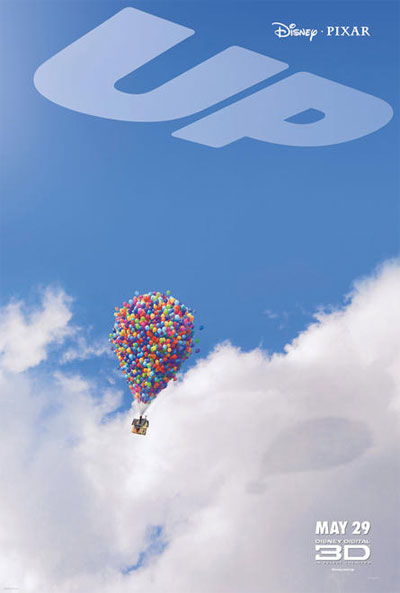
There is really no need to introduce Pixar Animation Studios. No need to explain how, over the past 15 years, Pixar has released the most timeless and transcendental animated features since the golden age of Walt Disney. Furthermore, it is pointless to note that Pixar is a studio comprised of adults making sophisticated and thoughtful films, consistently marketed toward children, that obliterate age demographics. Instead let's focus on the micro evolution of Pixar's thematic content and vision. Toy Story was primarily a singular childhood fantasy which dealt with the less than instinctive practice of social acceptance. Finding Nemo used a dual narrative in order to find common ground between the desires of children and the protective qualities of overbearing parents. Ratatouille etched a beautiful portrait of the relationship between independence and interdependence in romance and society. WALL-E delivered a universal (and overtly political) message against ennui and the distractions of the digital age. With Up, Pixar's 10th feature, the studio has delivered its foremost adult film. With themes of aging, loyalty and the burden of memory, Up is Pixar's most finely cultivated and quietly introspective film yet.

Known more for humanizing marginalized animals and objects (fish, rats, toys, robots, etc.), Up is only Pixar's second film to exclusively follow human characters. Moving beyond the familial adventure of The Incredibles, Up is both familiar and unfamiliar to the studio's filmography. To begin, its principle character is a senior citizen. At first this choice may seem unorthodox but Pixar brings in familiar elements to marry the film with the rest of its canon. First, the tried and true “unlikely ensemble”: the old man (Carl), a pudgy and useless boyscout (Russell), a 13 foot tall exotic female bird named Kevin, and a “talking” dog called Dug. Second, the growth of the principle character who remains obstinately insular until an emotional breaking point whereupon he commits himself wholeheartedly to righteous morality and the happiness of his companions. Pixar's films could be considered structurally formulaic in this sense, but each navigates its scenario in a way that is so thrilling and highly involved that the complaint becomes virtually invalid.

In each of Pixar's films there is some sort of initial disturbance ranging from the innocuous arrival of a new toy to the capture of a fish's sole offspring. These are the moments, which are usually affixed with modest tension, which catapult the narrative into motion. Up doesn't necessarily break this pattern but the film does structurally postpones its ascent into linear narrative. Beginning with Carl's childhood and the meeting of his eventual wife Ellie, the film enters a harrowing and emotionally wrenching montage that encapsulates the passing of time and the strife of two lovers. It is unveiled that Carl and Ellie's dream is to travel to South America and discover the enchanted lands of Paradise Falls, which first captured their mutual imagination when they were children. However, as so often happens in the real world, events interject. As the montage progresses there is shot after shot of a glass coin jar, which contains their funds for the trip, smashed in order to recover from loss (injury, destruction, etc.). The montage is particularly moving in its dealing with two mature themes which are broached silently and sadly: an incapacity to have children (or perhaps, worse still, a miscarriage) and Ellie's death. Cinematically masterful this montage serves a very special function for the rest of the film: it injects meaning into personal objects causing them to later become representative of Carl's memory.

Carl, after battering a civil servant and being ordered to abandon the house he has lived in for most of his life, inflates thousands of balloons and soars into the sky toward South America. The rest of the story is an exercise in classic Pixar adventure, although at times the film works a little too hard to overcome its own sentimental inertia. Carl remains dedicated to the house which has become the embodiment of his dead wife. Even with the buoyancy of adventure (which the balloons represent) the house (Carl's memory) still remains a burden to him until circumstances arise that force him to choose between this precious relic of his past or a new life of meaning. Choosing the latter, there is a beautiful and iconic shot of the house, colored balloons still tethered to it, sinking away into the clouds: a weighty and powerful memory finally being released by its owner.

Back in 1995 I was seven years old and likely polishing off the last of the Walt Disney classics that I was raised on. That same year Pixar released its first feature and, in retrospect, its safe to say that a new epoch began. While Toy Story's animation was groundbreaking then (and still remains a milestone in digital animation) it is a “child's plaything” in comparison to Pixar's recent accomplishments. Known for their uncanny attention to detail, since the turn of the century the studio's animators have exploded into larger and larger digital environments. From countries to continents; the epic vastness of the ocean to the infinite reaches of the universe, Pixar has visually transported viewers to the very limits of imagination. Though it may seem a somber step back from WALL-E's intoxicating spectacle, Up moves viewers in a distinctly different way: emotionally. The subtlety and communicable depth of the film far exceeds anything yet achieved by Pixar. Though not without fault, Up is yet another massive achievement from a studio still reinventing itself and redefining popular cinema.

Saturday, September 26, 2009

District 9

Dir. Neill Blomkamp
2009
8.6


On an episode of the British comedy Spaced, Tim Bisley (Simon Pegg) tells Daisy Steiner (Jessica Stevenson) in defense of science fiction that “the thoughts and speculations of our contemporary authors and thinkers have never been closer to the truth.” Quickly undermining this point is a scene of several children/midgets in shiny silver alien costumes outside a comic book store. Nevertheless, Bisley's point remains supremely valid. Science fiction has long been a medium where certain socio-political statements can be made because of the unreal realm in which they take place. In the 50s American science fiction worked as an anti-Soviet propaganda machine and since then has functioned to both critique and commend society. Working inside the super natural framework of the genre there is a sense of leniency that is unavailable to other modes of film making. Where a political documentary film maker can level accusations against the government that instantly become controversial, a post-apocalyptic vision of the future where human beings subject a body of nomadic, homesick aliens to ghastly persecution can slip under the radar as an inter-galactic and imaginative thriller. Even at their most ludicrously transparent sci-fi films making or attempting to make statements about the nature of humanity and its susceptibility to corruption struggle to cause the same uncomfortable tremor that realist fiction or documentary make. District 9, the debut feature film of director Neill Blomkamp, is aware of the limitations and possibilities of its genre. Despite the by-now-well-defined boundaries the film works within, it finds an impressive balance between the awe inspiring spectacle that viewers expect from sci-fi and the engaging landscape of insinuative metaphor that goes on beneath it.

Taking place in Johannesburg, South Africa District 9 at first begs to be seen as an anti-apartheid film. This is certainly the most basic reading of the film's narrative. An oppressive private military contracting company (MNU) is put in charge of controlling a body of 1.8 million aliens who are forced to land due to their malfunctioning ship. The film's cinéma vérité style allows for a number of “experts” to give their initial impressions on the ship's landing, the discovery of the arthropod-like creatures that were found inside and the ensuing, indelicate scramble of relocating them to an internment camp within city limits. Intercut between these interviews and the film's well paced storyline is sequences of television broadcasts which greatly assist the serious realism the director is aiming for while still maintaining a plot that exists only in the sphere of speculation or fantasy, depending on the candor of your imagination.

District 9 exists to illuminate the potential Pandora's Box that could be opened if/when an unforeseen event of incomparable magnitude occurs. It is a strong criticism not only of the xenophobia and social inequality prevalent not just in South Africa but all over the world, but also the greedy administrators who calm the public conscience into believing that such deplorable acts as those historically seen and cinematically witnessed in District 9 are not only acceptable but morally correct. Despite apartheid, the Holocaust, genocide and all other forms of mass, ritual murder District 9 makes a convincing case that rather than learn from these horrendous atrocities, we as a species have only blinded ourselves from the suffering of others. The arthropod “Prawns”, as they are derogatorily named, function as the physical representation of the dehumanized subject. Throughout the film they are thoughtlessly slaughtered, disdainfully banned from public places, and abominably abused.

While the film insinuates much about our growth, or lack thereof, as a species my biggest complaint is that after an exciting 20 minute faux-historical introduction, the film by and large surrenders to its own appetite for violence. The brute force with which the soldiers harass the Prawns into complying with their forced eviction escalates into the explosive recovery of the black liquid from MNU headquarters by humanoid Wikus van de Merwe, the film's zealous and slightly idiotic protagonist, and Christopher Johnson, the intelligent and perceptive Prawn attempting to rescue his people from persecution, climaxing with an all out invasion of District 9 by military forces to recover Wikus, who combats the army from within a Mecha-like fighting suit capable not only of stopping bullets with magnetism but rockets with its bare metallic claws. See what I mean? What was once a sociological study has devolved into a substantial melee.

To his credit, Blomkamp's violence is spectacular, well arranged and infinitely exciting. However at times it nearly overpowers the emotional core of the film, whose powerful message is about humanely embracing life and not attempting to control it. It has all the overtones of oppressed populations everywhere; the desperate cries for help; the pleads for equality. The film concludes on a morally speculative note with the fate of Prawns and humans left up to Christopher Johnson as he soars off toward his home planet. The film's external monologue begs the question: what will he do if/when he returns? Rescue his fellow Prawns? Wage war on humans? Make peace between the disparate races? It is here that focal point of the entire film is revealed, drawing the curtains away from the physical story in order to reveal the ethical narrative that has been coursing beneath the surface throughout. District 9 achieves intellectual and visceral weight by encouraging the viewer to consider all sides of the dilemma. It is a stimulating and thought inspiring film, proving once again the underrated abilities of science fiction.

Monday, September 14, 2009

Inglourious Basterds

Dir. Quentin Tarantino
2009
3.0


Quentin Tarantino is a hype monger. His films are so kitchy, so absurd and yet so popular they defy all reason and logic. His cult-like following has been growing exponentially since his emergence in the early 1990s. However, the quality of Tarantino's films since the turn of the century has been inversely shrinking. His neurosis, which waxes alongside his stardom, is threatening to engulf him. Constructing a fictional universe out of his spectacular awareness of film history, Tarantino has always stood apart from the rest of the major Hollywood film directors. Originally his films were boldly unique and unnervingly occult. Their intense visual stimuli was appeased by subtext, something just out of sight like a gold light emanating from a brief case. It was this subtext, this profound and exciting sense of mystery, in the early Tarantino films that culled the sycophantic behavior most of us are familiar with in his fanbase. The trouble is that that enticing Esotericism has all but disappeared and in its place violence and indolent carnal pleasure have taken up a position of self-satisfied, smirking hedonism, casting occasional condescending glances towards a devout viewership who still believe these delights mask anything meaningful.

Inglourious Basterds is Quentin Tarantino's worst film to date. The follow up to 2007's Death Proof which, although surprisingly well focused given both Kill Bill's vague vagrancy, felt more like a warm up to a full length feature rather than a feature itself, Inglourious Basterds is the culmination of what feels like too much thought and far too much money. It is a sprawling war epic described by Tarantino as a “spaghetti western with WWII iconography,” which should come as no surprise. By Tarantino's loose definition of Spaghetti Western half his filmography has been some iteration of that short lived genre. The formula is relatively simple: take clear cut villains and good guys, both of whom possess a pathological tenacity, mix with a generous portion of memorable/inventive cinematic effects and plenty of gutsy violence and you have it. Nevertheless, there is a unmistakable aspect of IG which separates it from the rest Tarantino's filmography: realism. Despite being a questionable transposition of socio-political history, the film is, in many ways, shockingly grounded. Even if any parts of Tarantino's other films were possible they were more importantly unbelievable. What's different about IG is the potential for the film to drag you into its universe and not in a surrealist, dreamy way like Pulp Fiction.

Of course that is aided by its premise: the Nazi occupation of Europe and more specifically, France. Tarantino's universe becomes a tangent universe to our own. What disappoints about the film is the potential for it to unveil something deeply subconscious about our relation to this memorable time in international history. Tarantino could have suggested something about our relation to history and how much we take it for granted; how where we are today is largely due to history we hardly consider consciously but which nonetheless is ingrained in us from our earliest years onward. Instead Tarantino takes the easy route, lamentably inserting his stylistic and thematic cues into a genre they are not suited for. Like a child's play toy with shapes that correspond to holes for those same shapes to pass through, Tarantino obstinately tries to make a square peg fit in a round hole. His Nazi's are one dimensional clowns, unlike the humanized WWI German foot soldiers of Lewis Milestone's All Quiet on the Western Front, one of the high water marks in war cinema. Tarantino's Nazis are brutal and merciless, inducing the same fear that Michael Meyers or Freddy Krueger might, imparting a sense of fantasy that moves far beyond plaintive “suspension of disbelief”. The symbols of the Nazi party, like the rising strings that suddenly cut to silence as the college coed creeps through a silent, dark forest, will always terrify. They contain an unstoppable emotional inertia, but without creativity we are simply crushed by their blandness. Even the film's sympathetic German Sergeant Yorke is a Fascist at heart. Which is not so terrible because he is a Fascist, but because he is only an idea.

This is my biggest complaint about Tarantino's characters. They are almost always some variant of Sociopathic personality. Tarantino's Sociopath archetypes are, in many ways, the type of people we want to be: goal oriented, inhumanely focused, and capable of doing anything that “needs” to be done. Much in the same way Tarantino does everything that “needs” to be done in order to continue being recognized. More than just sacrificing content for style, Tarantino is trading genius for wit, at best. He is cutting himself off from the industry, rather than expanding beyond it. Tarantino is one of the most recognizable names in the industry and also its most indulgent. Like his characters he refuses to interact with a reality that he is quickly losing touch with. His own Sociopathic tendencies are beginning to show.

With pathetically underdeveloped characters, slapdash cultural innuendo, and so much graphic violence that it literally detaches the viewer from any emotional relationship with the travesty he is portraying, Inglourious Basterds is a severe low point in Quentin Tarantino's career. It relies far too heavily on his reputation instead of the skills that define it. His films operate within an insular sphere of the Intelligensia and conversely the myth making Fanboy. The hype that surrounds them is almost indestructible. The ensuing post-release intellectual debate is insusceptible to doubt. What Inglourious Basterds forces us to confront is exactly why that is.

Saturday, August 15, 2009

Julie and Julia

Dir. Nora Ephron
2009
8.0

I don't know about you but when I get in the kitchen things start happening. If I haven't made the recipe before you can count on a lot of swearing and no! no! no!'s but an inevitable trance-like state comes over me. Perhaps it is the precision of working with a recipe mixed with a few last minute “I hope to God this comes out alright” alterations but there is something about cooking that is wholly absorbing. It's a process and one that can be either extremely rewarding or completely devastating. What is often forgotten in the age of microwave dinners and Thanksgiving leftovers is that cooking is an art; a bi-lateral interaction between person and form. That fact is at the heart of Nora Ephron's 2009 film Julie and Julia: a poignant and timely renewal of the romantic comedy with an intrinsically satisfying psychology.

The first thing that strikes the viewer about Julie and Julia is its binary narrative. Beginning after WWII in Paris, Julia Child (Meryl Streep) is a recently married upper-middle class woman who is bored. After experimenting in a few other fields Julia settles on a cooking class where she quickly eclipses her male classmates, incrementally discovering new opportunities in the world of food. Julia endeavors to design a French cookbook for “servantless” middle class Americans. On the other side of the world more than 40 years later Julie Powell (Amy Adams) is a servantless American living with her husband in Queens. Her life as a social worker in post-9/11 New York is exhausting. Nearly at her wit's end, Julie lands on her pet project which also becomes the premise for her slice of the storyline: cook the entirety of Julia Child's “Mastering the Art of French Cooking”, all 524 recipes, in one year. At this point the lives of the two women, separated by thousands of miles and several decades, converge elegantly and their frequencies begin to resonate as one.

Coincidence is not a word that describes this portion of the film. Rather than inaptly suggesting a certain level of parallelism between two characters, Julie and Julia naturally weaves together key similarities between the two women. On both sides, the relationships between the characters are preformed. This is not a “boy meets girl then proceeds to wins girl over in an hour and a half” romantic comedy. When we meet Julie and Julia they are already cemented in the relationships that will carry them through to the end of the film. The dominant male aggressor, passive female recipient relationship does not exist in this film. In a genre nearly monopolized by men it is so refreshing to see strong, independent women. Not only that, these are women who, while being totally in love with their respective husbands, are enamored not with a man or even another human but with an art. For the most part men play ancillary roles. They are morally supportive, witty, and capable. Both male leads, Julie's husband Eric (Chris Messina) and Julia's husband Paul (Stanley Tucci), are nuanced and gracefully subtle characters. They have dreams and aspirations but are mature enough to realize that they are not the main characters of this story.

The drawback is that this format nearly keeps the film from having any dramatic arc at all. While Julia fights to get her book published and bring French cooking to America, struggling with her home country's pre-occupied, stay-at-home mom style of cooking which is simple, quick and entirely lifeless, Julie's presence is comparably vapid. Her lifestyle and storyline are terribly sedentary. Either she is consoling the grieved over the phone in her office, blogging on her home computer, or eating. Her drama can even be difficult to understand if one is not willing to submit themselves to the hopelessness of Julie's existence. New York is an alienating and lonely place, even when one is neither alienated nor alone. Her friends are growing up and becoming successful and she is deliberately portrayed as being younger and less mature. She is writhing under the crushing burden of a boring job which devours most of her time. Her blog, the appropriate medium of a failed writer, where she publishes her culinary introspections, paired with her cooking is her escape. Bordering on addiction she begins to neglect her husband until his misery (which is coarsely entrenched in his not getting laid) upends Julie's daydream. This is really the only point where the film borders on being unconvincing. Writer/director Ephron weaves an enthralling story out of such a plain life and keeps the viewer's attention even when it is framed next to Meryl Streep's characteristically on-point portrayal of Julia Child, that the moment in which Julie's husband leaves her we suffer from emotional whiplash. It would seem from the pacing and organic passion, built piecemeal from the ground up, that all of a sudden Ephron realized she had to insert some kind of tension or else the movie was destined to remain on one plane throughout. It is vaguely forced and quickly settled, resolving back to the film's naturally uplifting tone.

Cooking has come a long way since Julia Child first exploded onto the scene. Julia introduced to women all over America the indulging and engrossing world of home cooking. Her impact on female independence cannot be overestimated. However, Julie and Julia is not a feminist film, at least not in a textbook sense. Its more of a film about the exceptional qualities inherent in ordinary lives, a concept relatively common in art but rarely displayed as gracefully as Ephron has done here. Julie and Julia is the culmination of a measured directorial hand, precise dramatic ingredients, and a few contemporary inclusions added to enhance dramatic affect and appeal. Ephron clearly knows how to handle all of her supplies and is not afraid to experiment. The resulting fare is delicious and nourishing. Bon appetit.


Thursday, August 13, 2009

I Sell the Dead

This review was originally published here on Tiny Mix Tapes.

Dir. Glenn McQuaid
2009
6.5


The term “low budget” is written all over writer/director Glenn McQuaid's debut feature film I Sell the Dead, both subtlety within the film and literally in the director's statements about it. In so many instances the term “low budget” is used as a general defense of a flawed portion or portions of a film. For instance if the cinematography seems to have been shot mostly with a Handicam or if the special effects appear to have been designed by a 15 year old boy with an unnerving idolatry of Stephen Segal movies. I Sell the Dead suffers from neither of these conditions but in a sense is still making excuses for itself. It is a study of how a film with all the potential to be perfectly good can fall by the wayside if all of its elements are not tended properly.

Like so many low budget films I Sell the Dead suffers from the theory that it is almost always easier to make a low budget comedy than a low budget drama. History has shown that a couple grand and a penchant for raunchy or corrupted dark humor can yield a noteworthy or even significant comedy. Low budget drama, on the other hand, rarely translates. Having lost the ability to turn in on itself and mock its own contemptible lack of funds, the low-budget drama tends to overdo it like a teenage drama queen with larger aspirations. It's those same aspirations and vanities that flourish in Hollywood where grit can be transformed into gold almost overnight. IStD is not a Hollywood movie but it is a highly stylish and insular piece of cinema. Starting as a manageable drama it quickly devolves into lowest common denominator comedy. It takes equally from the pulp fiction of comic books and cult nature of B-list horror films, with the built-in campiness of both. Although the film is at times tongue in cheek and at others painfully sincere its biggest hindrance is not its cast, crew, or plot but rather its director.

IStD is more an elongated montage than a film. Using the near cliché narrative device of a condemned criminal's flashbacks on a life spent in an underworld closed to the average law abiding citizen, in this case grave robbing, the methodical development of the film's protagonist, Arthur Blake (Dominic Monaghan), is inferred rather than shown, leaving the audience to fill in the evolutionary blank spots between his tales. As the film progresses these stories become increasingly outrageous, bordering on and finally plunging head first into fictional absurdity. The introduction of fantasy into the narrative doesn't necessarily ruin it but it is a detractor. The film also has a disagreeable tendency of being winkingly modern and inauthentic which may be more a flaw of budgetary restrictions than slack writing. Authenticity is a purchasable commodity in the film world. A big budget buys sets, experts and most importantly: time. Where Martin Scorsese has the time and financiers to make a bold period film like Gangs of New York other less fortunate (read: rightly legendary) directors have to make due with what they can get. In the end, what could have been a potentially interesting musing on life and death is turned into a farce. Still, this is not entirely uncommon in film and IStD might serve quite nicely alongside a film like Shaun of the Dead in the ever growing canon Zom-Com.

All this would have been tolerable, perhaps even seriously enjoyable if the film was not so painfully aimless. Despite being adequately cast and containing a visual ideal which at times borders on brilliantly original, the film lacks a distinct direction or message. Perhaps it is high-brow idealism to believe that a film should contain a definitive message. However it should at least have a point. Curiously similar to Albert Camus' first novel “A Happy Death”, IStD suffers from an eagerness to prove something and in the process forgets that it is supposed to be telling a story, a common syndrome of an artist's first work. Curiously what both need is to be condensed as Camus did when he ultimately re-drafted parts of that forgotten first novel into his unforgettable second “The Stranger”. If McQuaid can condense his ideas, extend his budget and knowledge, and most importantly focus inwardly on what he is trying to communicate he has a more than a fighting chance at becoming a memorable film maker. He already has the style, confidence and adept hand of an older, more experienced director. Now all he needs is to become settled. Though I Sell the Dead falls short of being a marked success due to certain aspects of it being left untended and others over cared for it is nonetheless a striking debut and an impressive film given its self-declared low-budget label.

Sunday, June 14, 2009

I Love You, Man

Dir. John Hamburg
2009
6.0

Before I begin I should probably account for a certain pretension which may also be simply a viewing trend, one that I find tolerable although perhaps not entirely excusable: I don't go to see too many soon-to-be-blockbuster films. I am somewhat intimidated by the modern cineplex with its blocky 50s bomb shelter aesthetic. Rather I find myself in the would be smoky dens of indie cinema. Its not that I'm indifferent to the visual depiction of subconscious desires fulfilled by the big names and recognizable faces of Hollywood, it's more that I am a young and prone to idealism. Having limited time and funds I'd prefer to shell out nine bucks for a movie that expands my understanding of humanity rather than one that makes me giggle and drool (although it's a plus if both happen). Having said that I did go see I Love You, Man mostly of my free will. As Hollywood material goes it looked promising. I love Paul Rudd and am in support of any former Freaks and Geeks character getting what's owed to them (I'm looking at you Seth Rogen). The problem is that I Love You, Man was just what I hoped it wouldn't but nonetheless assumed it would be: a formulaic comedy. Still, it is important to recognize that this formula works and is in almost every way more suitable to the appreciative tastes of a wide audience as compared to many of the films projected upon the silver screens of modern indie cinemas.


The premise of the film is textbook with a few promising but ultimately subverted footnotes. Promising young suburban yuppie Peter Klaven (Paul Rudd) is all set to marry adorably banal sweetheart Zooey (Rashida Jones) when he realizes that he doesn't have a best man for his wedding. Introduce caricature family: loving but sometimes painfully blunt mother, dry droll father, and understated gay brother. Gay brother, Robbie (Andy Sanberg), who beyond this appropriately bland title displays almost no homoerotic tendencies, sets up Peter on a series of “man dates” in an attempt to find a best man. This scenario allows for a few guffaws, but rapidly switches genre gears to reveal that Peter is having difficulty marketing himself as a Realtor. Enter casual, mostly unbelievable d00d-guru complete with basic psycho-babble on latent desires that most first year college students, having breezed through a few paraphrased readings of Freud, have at the ready: Sydney Fife (Jason Segel). Segel plays his character as if Sydney was a predestined archetype rather than a vapid bro; his laziness in acquiring a relationship with his character is not only obvious but embarrassing. Paul Rudd, known for his characters with twisted, dark humor and fierce Independence plays his role like a well dressed man whose shoes don't quite fit. Despite the fact he has acquired the rest of the outfit, it is the discomfort and on screen awkwardness that gives away his own reticence to play such a lifeless character. It is here that too many critics have confused miscasting and misplaced actor empathy with originality.

While the plot moves forward aptly given its tendencies towards the obvious and predictable, screen writer Larry Levin develops something resembling a platonic drama by way of a homoerotic comedy. While many great opportunities for developing this narrative are lost he does capitalize on the congenital irony of heterosexual brother Peter getting mixed up in so many insinuatingly homoerotic scenarios while homosexual brother Robbie struggles to find a suitable relationship while simultaneously exerting a strong hetero influence in the gym where he works as a personal trainer. However, this more subtle (I use this term very loosely) humor is overpowered by Levin's over reliance on tried and true formulas for easy laughs. For instance the reoccurring homogenization of The Office-like awkward and immediately regrettable comments made by Peter, Sydney's jejune topical humor, and Sarah Burns (as Zooey's friend Hailey) regrettable choice of wearing thin a Saturday Night Live skit that wasn't all that funny to begin with.

The film makes a few good passes at drama and few more at humor and finishes up with everything in its right place. Technically speaking the film is an excellent example of pure comedy. However, that is precisely its problem. Being aware of a genre's modus operandi is one thing; following it without embellishment is quite another. I Love You, Man encounters plenty of opportunities to utilize more sophisticated and engaging humor but instead willingly delegates itself to that ever growing collection of forgettable films that are too busy reproducing current social values and comedic/dramatic standards to recognize that they are dated almost as soon as they are released.

Sunday, March 15, 2009

Watchmen

Dir. Zack Snyder
2009
1.0

Critical discourse on cinema is dialectically centered around an abstract concept of quality and its relation to success. The more a film is surrounded by advertising, hype, direct and indirect forms of attention, the higher the likelihood that upon its release and posterior analysis it will become something it is not. Take Synecdoche, New York for example. My favorite film of 2008 found critics praising its ingenious structure and unparalleled scope OR dismantling it as a piece of esoteric fiction, too personal to reach a mass audience and too precious to be thrown away. I remember in junior high school going to see some trashy B-list film (The Replacements...starring Keanu Reeves), and observing two middle aged people who entered the theater, sat through the preview of Lord of The Rings: The Fellowship of the Ring, and left as soon as it was finished. That film, released in 2001, was my first introduction to movie fanaticism. A midnight showing the night it came out; teenagers and adults alike dressed in costumes; a strong showing at the Academy Awards that same year, et cetera. A few years later the “original” Star Wars trilogy was horribly mangled and shipped back into theaters, for the poor kooks who didn't get enough the first time and the pathetic borrowed nostalgia of wayward and lonely teens. Same deal, sans awards. I did not see Watchmen at its midnight showing. I did, however, see it the following afternoon. Good choice. The 6:30pm showing that followed had lines out the door and I saw several costumed Rorschachs. Jump back 6 months. I read Watchmen the graphic novel and am floored. The sophistication of its combatant philosophies, the pure ecstasy of its visuals, and the crushing brutality of its final conclusion (which finds its earliest links in the Platonic theory of “the noble lie”) were enough to get me more than excited, and suspicious, about a film adaptation by one of the rising stars of visual carnage: director Zack Snyder. In the months that followed, a countdown (which finds an ironic parallel in the novel's famed Doomsday Clock) to the film's release began and Watchmen garnered a zealous following. Rumors that Snyder and his screenwriters were using the original novel as a visual map were stimulating but reports that the novel's writer, Alan Moore, refused to have anything to do with the adaptation on the grounds that what was done in his and illustrator Dave Gibbons' work was untranslatable to the silver screen were worrisome. Now, 23 years after its initial publication Watchmen is a major motion picture. The near sexual pre-release tension has entirely dissipated and the only thing left to do is wade through the rubble of a masterpiece self-destructed.

There are several ways to approach reviewing a film that has been adapted from another medium. On the one hand a reviewer can assume that his/her reader is familiar with the original manuscript. This however is not always the case. On the other is just the opposite: take the film as a film and relieve it of its paralyzing history. Neither is entirely just. However, the legacy of Watchmen as a graphic novel and seminal piece of 20th century fiction cannot be ignored. Its transference to the cinemas of the world was not a mistake, but the film fails to compete with its brainchild on so many levels that it is sometimes painful to watch. On the whole, all points of the film are underdeveloped. Characters, moral philosophies, mayhem, politics, et all. Even essential plot devices and explanations are completely avoided or left out. A film that underwhelms so completely and still clocks in at over 160 minutes needs to take its inspiration from the sweeping epics of the 1960s. Where was David Lean's influence on tragic heroism? Where was Kubrick's ideas on odyssey and science? With such a tremendous opportunity to make a picture so impactful and profound it terrorizes the mind to remember the minute and a half long soft core porn scene after Sally Jupiter (Malin Akerman) and Nite Owl (version Dull Dan, aka Patrick Wilson) rescue a group of minorities from a burning tenement building. Seriously. What the fuck? Not only that, but their intimacy was as phony as Akerman's acting, which was cringe inducing at best. Her performance was as void of humanity as Dr. Manhattan's (Billy Crudup), only without the original intent for it to be so. In fact the only characters that took on any semblance of multi-dimensional presence were The Comedian (Jeffrey Dean Morgan) and Rorschach (Jackie Earle Haley) even if his internal narration reads like a Godspeed You! Black Emperor text. Between these two characters a dull death rattle is blown and instantly drowned out by visceral and trope-ish Hollywood violence.

Having said all that, I'd like to now make a point that will seem to entirely contradict all those before it: Watchmen is the most iconic film of the decade. Not since The Matrix has a film been released that is surely to be parodied, impersonated, and gracelessly flaunted for its sheer visual presence. It really doesn't matter that the film was a near complete abortion of creative integrity or the fact that its original plot, with devices swinging wildly in huge, untraceable and gyroscopic movements is stripped of its inertia and forced into a linearity of which it can only toss and roll awkwardly unsure of where it's actually supposed to go, or that its characters are flimsy and lifeless, or that compared to The Dark Knight, which saw its own release less than a year before, it is a step backwards in the culmination of the long, painful history of filmic science fiction. That history began in the 1930s, saw a surge in popularity in the 50s (thanks in part to alien takeover becoming subconsciously equated with the threat of Soviet invasion), pinnacled with 2001: A Space Odyssey in the late 60s and since then has been sticking its head up every now and again (Blade Runner, Terminator, Solaris, and so on) to remind audiences that sci-fi is not a genre for nerds and engineering students, but rather a body of work that is both glittery and serious, in fact the self conscious realization of the best (but still sadly under-indulged) side of Hollywood: glamor and sophistication.

Here's another contradiction: Watchmen is not an abject failure, although its pretty damn close. As films go, it is a little too sure of itself, playing on its own absurdities (every punch comes with that ridiculous “whoosh” noise) and temperance (Adrein Veidt hung out with David Bowie...great...). It wouldn't have been a great or for that matter predictable choice on the part of Snyder to have made a film that didn't take itself seriously. For all its glorious action 300 can be really really boring, and that same kind of unmistakable triteness assimilated into Frank Miller's godawful 2008 film The Spirit (which tried desperately to cash in on the Watchmen hype by literally stealing visual cues from the novel). Snyder has the budget and Hollywood backing to make incredibly good looking pictures. A close friend likened his directorial style to Kinko's, insinuating that he makes a product look snazzy but adds nothing to its value as an object. Moving beyond that questionable fault, Snyder does seem to have a relative devotion to making these spectacles mostly enjoyable for his audience. In a sense he is very much a stereotypical Hollywood director but one that has, by no fault or appearance of effort, found himself ahead of the curve, producing the pictures that go on to affect the types and kinds of films that are subsequently released in theaters. In that respect we can all look forward to Watchmen knock-offs for the rest of this decade, which will only increase the film's undeserved reputation as a remarkable motion picture.

Regrettably I have to admit that as entertainment (read: stimulation) goes Watchmen is pretty top-notch. Its least impressive digital (and this movie is tres digital) effects cop directly from the formative action films of the last 15 years, but its most memorable are highly inventive and original, again excusing the almost certain cult like replication of the film's visuals in the near future. With any luck someone in Hollywood, preferably a high powered director with good taste (Hello? Is there anybody out there?), will recognize Watchmen's inherent faults as an adaptation from a still underrated and misunderstood medium, but also its potential as an incisive and intelligent film, and learn from it. Perhaps Watchmen will even prove to be the jumping off point for the public's true and final embrace of science fiction. Yes, and maybe Americans will learn to love anime...

On the whole, the dialectics of Watchmen are pretty cut and dry. Fans of the graphic novel will likely despise it, shamelessly, for not living up to the original. Action movie fanatics and young movie goers everywhere (especially those under the age of 18 who probably snuck in to see the film by the millions this past week) will be super stoked and buy the uncut, extended and ludicrously expensive special editions as they are released from now until the end of time. But most of all the critics will have no idea. I recently saw a web post with egregiously poor grammar that essentially said that it was the fan's decision whether the film was any good. This is pretty close to the truth. The truth is that it's anyone's decision, fan or not, and being a fan hinders the ability to judge fairly. Any personal connection, which is largely inescapable, hinders that ability (right Jon?). So the bottom line is that Watchmen, in its failure to live up to the iconic and philosophic standards set by Alan Moore and David Gibbons, and its success (thus far) as a big-budget Hollywood action film, will never be entirely understood. As viewers we can only watch as the legend (of which I am making the assumption that there will be) grows and covers any and all critical relations between the film and its viewership. In short, I think this is bigger than both of us.