2002
7.4

Watching Martin Scorsese's Gangs of New York recently, I came to appreciate–rather belatedly I must admit–certain drawbacks to the now [in]famous auteur theory. Of course, the theory itself is meant to define a director as an author of a film by highlighting thematic and stylistic motifs from the his/her output. The goal was to realize authorial preeminence within an industrial process. The consequences of an academic theory that proffers solidarity with an artist only make themselves evident much further down the line, when aged auteurs are given greater credence than their upstart contemporaries. Gangs of New York plays like a study on the inborn flaws of auteurism. Foreshadowing the narcissistic debacle of Quentin Tarantino's Inglourious Basterds (2009), Gangs is ultimately not a self contained historical epic but a Martin Scorsese Historical Epic.
Beginning a film with a vainglorious and highly orchestrated battle sequence that skews aestheticization of violence in favor of glorification via rapid editing and ill-advised, anachronistic score choice (not to be confused with the ironic audio visual juxtaposition of, for instance, Scorsese's own Mean Streets), exceeds the limitations of 'minor transgression'. It cheapens the sincerity of the entire enterprise. This imprudent tactic leaves Scorsese with a lot of ground to make up. Thankfully, the remainder of the film is rhythmically and tonally well tempered. A period drama about Irish immigrants in New York City during the mid-19th century, the film's script surreptitiously extracts dramatic plot points while moving gracefully through a compelling story. Scorsese's attention to surface details both broad and confined is simply extraordinary. His sets are towering marvels in particular the subterranean Irish tavern of the Five Points.
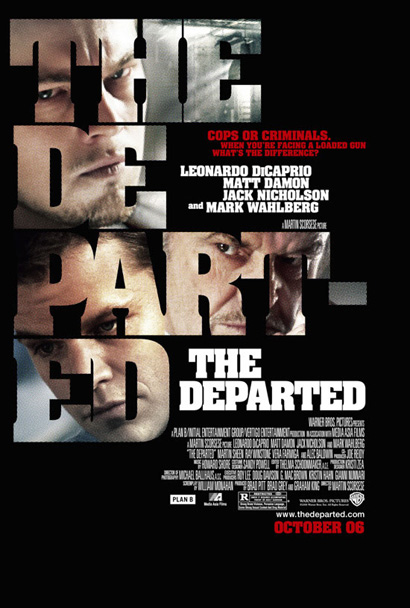
Scorsese has become well known for extracting memorable performances from his leads and Gangs is no exception. Daniel Day-Lewis' William “Bill the Butcher” Cutting anticipates the fire and brimstone of America's own Daniel Plainview in P.T. Anderson's There Will Be Blood (2007). Cameron Diaz's Jenny Everdeane is one of Scorsese's strongest female characters and the director's most forceful indictment of the misogyny more than occasionally found in his own films. And of course there is Scorsese's muse, Leo. His understated performance as Amsterdam Vallon, the son of a slain Roman Catholic priest, stands quietly and thus all the more noticeably in the shadow of Day-Lewis' furious histrionics. The emotional territory he covers in Gangs (in particular, contradictory feelings of guilt and loyalty) would be covered again in Scorsese's magnificent The Departed (2006) but it is not the weight of the burden but the mode of coping that makes his restrained performance so affecting. His internal angst reveals itself seldom but the verisimilitude by which he conveys Vallon's psychological trauma lends his trajectory an undeniable sense of fatalism and gives his performance meaningful depth.
Then the problem is not within the superficial fabric of the film. With great performances, unparalleled art direction and a fine script, what is lacking in Gangs is found in the smallest but most unexpected errors of confidence. In particular, in two long time Scorsese collaborators: editor Thelma Schnoomaker and DP Michael Ballhaus. Both have worked with Scorsese since the 1980s and perhaps one can chock these mistakes up to hive mind mentality. Schoonmaker's editing on her first collaboration with Scorsese, Raging Bull, undoubtedly played a part in that film's critical success. In Gangs, her cutting is mostly appropriate but occasionally (as in the aforementioned battle scene) becomes an exercise in excess. Rapid alternations between POV and third person shots cause the action to be confounding and disorienting but hardly heighten the immediacy of the violence. Ballhaus' cinematography is practiced and patient. In one sublime sequence his camera outlines the entire existential journey many of the immigrant Irish will make: arriving in one boat, departing in another and finally arriving “home” in a third wooden vessel. His shots are well composed though his muted tonal palette, handsome as it is, seems calculated to meet the expectations of an American period drama. Furthermore, he occasionally injects a “Scorsese shot”, particularly favoring the dolly zoom most memorably used in Goodfellas. The technique is as tasteless here as it was brilliantly metaphysical in that film.
The fact that Gangs of New York comes embedded with Scorsesean calling cards does not render it defective but certainly has a pejorative effect. The problem is not with the motifs themselves. His ideological themes of masculinity, patriarchy, Catholic guilt and morality are adequately explored here as they are in many of his other features. However, despite the good faith by which he investigates these subjects, the sheer amount of material Scorsese attempts to cover even in a film of such girth, while incorporating ample amounts of romance and action, inevitably invites skepticism in regards to what could have been left on the cutting room floor. Scorsese's hamburger comes with everything on it effectively reducing the impact of individual flavors and textures. Each additional aspect obscures the subtleties of the others. Shifting the film's political agenda into high gear toward the finale eclipses the intricate underpinnings of the emotional relationships between the principle characters, especially Vallon and Cutting.
My last complaint is in regards to how, despite the sheer amount of creative intensity, Gangs of New York is in some ways sadly predictable. Everything about the film is entirely explicable. Scorsese opts for legend over myth and grounds his film in historical realism occasionally airing on the side of melodrama. Which is not a cinematic sin but does jive with the Scorsese's history of innovation and the film's tangible sense of self-importance. Gangs can be placed in a very broad category of historical dramas which attempt to place discrete relationships and intricate emotions, some of which are intrinsically linked to the time period, into a wider socio-political and historical context. The goal is to make the viewer aware of the likeness between what they are seeing in the “past” and what they live in their daily lives. Contemporary relevance in period films can often get over extended for the sake of viewer empathy. In doing so, some or all of the unique perspective of the time can be lost. Scorsese generally demands a lot and Gangs in particular is so saturated with detail and context that it very nearly alienates the viewer. There is much to enjoy in Gangs of New York. Still, it will never be a great film. For better or worse, it always be a Martin Scorsese film.