Showing posts with label 2008. Show all posts

Monday, August 9, 2010

The Dark Knight

Dir. Christopher Nolan
2008
6.9


The problem with retrospective criticism is obvious. A film's value is dynamic. It changes over time based on a number of variables. Of particular interest here is how the quality of the films that follow it in the director's oeuvre might adversely affect an otherwise accomplished feature. For me, no two films better emphasis this dilemma than Christopher Nolan's The Dark Knight and his follow up, the turgid Inception. Two years ago The Dark Knight so thrilled me that I went to see it in theaters a half dozen times. I fondly remember weeks of infatuation and discussion amongst peers. Since that time, I have tried to embrace an unyielding critical eye that will righteously recognize superficiality; not simply looking past but looking through. I admit that on occasion I have overcompensated. In my youthful attempt to aggressively assert my opinion, I may have treated some films more harshly than they perhaps deserved. I failed to exercise the discretion and rectitude I have come to respect in many of the critics I follow. I am still, it seems, in the anti-navel gazing stage of my development as a film critic.

Which makes reanalysis that much harder. Inception so negatively influenced my opinion of Christopher Nolan that I was persuaded to reevaluate what I loved so much about The Dark Knight. Much of what I initially enjoyed is still present: the orchestration of spectacle, the convincing use of archetypes as mouthpieces for oppositional philosophies, Heath Ledger's still awe inducing performance. What crops up though, which cannot be excused as projection of doubt, are various flaws which detract from the pleasure of analytical examination. Though Nolan, with the assistance of his brother Jonathan, manages to write sophisticated monologues that inform like a college lecture on the fundamentals of philosophy, he largely fails to write many characteristically human interactions. Case in point: Bruce Wayne and Rachel Dawes strained relationship is certainly not helped by a noteworthy lack of humanity in their conversation. As Bruce Wayne has to constantly conceal his alter ego, so too does Nolan sometimes inexplicably conceal fulness of being beneath an exterior shell of fractured identity. Though we are meant to sympathize with Bruce Wayne, the viewer is often at odds with Wayne's lack of genuinely sympathetic characteristics.

There is also the inevitable complaint about the film's structure and lack of a distinct climax. The film prefers incident over arc to power its narrative. Though, as in Inception, each setpiece heightens the film's overall intensity, the dead air between them tends to suffocate rather than extend the drama. By the end, the hazards of the film's numerous action sequences are fully divorced from the emotional drama that initially propelled them. The intensity is inexhaustible but its impact is deadened by Nolan's decision to make the whole back half of his film a climax (sound familiar?). The irony of the bathetic consequences of such an adrenally influenced decision is somehow base and transcendental. Motivations are expository and relatively clear though not necessarily simplified. Nolan designs a complex polemical web with The Dark Knight and rigorously avoids resolution of ontological dissonances. This lack of resolution is the fundamental characteristic that keeps the film from disappearing into the void of sterile action cinema. It is also the film's most well deserved plaudit.

Nolan should be lauded for taming his wild horse of a film though the fact that he is responsible for its bad behavior slightly diminishes the accomplishment. Though The Dark Knight's conclusion doesn't quite hold water it is nonetheless comforting to see a director willing to put his reputation at risk both intentionally and inadvertently. Throughout the film, Nolan juggles chainsaws and swims with killer sharks; knowing full well that his solipsism may cause him irreparable harm. If anything was evinced by Inception it was that Christopher Nolan has a dangerously high opinion of himself and his films. While that film took fewer risks than The Dark Knight and resulted in a notably smaller pay off, it cemented directorial traits one could have chosen to identify or ignore in The Dark Knight. Interviews with Nolan elicit empirical levels of conceit, misplaced confidence in his base knowledge of the world and stubborn artistic inflexibility. He is amiable but vaguely puerile in his conception of how movies should be made.

A good friend pointed out that Inception is a highly enjoyable movie to watch but does not hold up under close scrutiny. I second this notion. As for the The Dark Knight, it fairs far better but is still best enjoyed viscerally rather than academically. The film captures an insular and microcosmic world that bears more than a slight resemblance to our own. Nolan supplies his film with a largely empathetic populace: confused, naïve to the complexity of the law, bigoted and self-righteous. That so many words are minced in reference to “the people” conveys directorial accordance with the film's assertion about the unnerving lack of facility for the principles of democracy to effect change. For a film so enthusiastically involved with diametrically opposing pairs, it is disheartening that this conclusion exists without opposition. Inception left me with little hope that Nolan fully appreciates or even recognizes this subtextual insinuation. In the end we are left to wonder if the reason why Inception was such a bloody mess was because Christopher Nolan amputated himself in some indelible way with The Dark Knight.

Wednesday, April 7, 2010

The Hurt Locker

Dir. Kathryn Bigelow
2008
9.6


With a film as culturally significant as Kathryn Bigelow's The Hurt Locker it can be difficult to identify a critical starting point, especially at this late hour. I begin this way because after its sweep of the Oscars, its feted run at the major international film festivals and the editorial press it has received from nearly every film magazine in print not to mention the publicity it has accrued through American political journals, it is difficult to imagine a time when The Hurt Locker did not exist on such a broad plane. Had I written this review while the film was still in theaters or even upon my first viewing several months ago this introduction would have never crossed my mind, never mind this page. Nevertheless, here we are. As a budding critic I feel the push to add my personal perceptions to the insurmountable melting pot of analysis that surrounds the film. However, as a young cinephile for whom great films often take on an untouchable, transcendent quality I struggle with reconciling my intrinsic and often contradictory desire to be both an objective spectator and enthralled participant. Fortunately, I found a cinematic outlet for this internal conflict in the landscape of struggle that defines The Hurt Locker.

Though The Hurt Locker is indisputably greater than the sum of its parts, its ten minute opening set piece nevertheless sets the hyper-kinetic and fragmented tone of the narrative. Captured under the tyranny of the relentless sun, the film instantly makes psychic connections to Spike Lee's Do the Right Thing and Albert Camus' The Stranger, works driven by that celestial malevolence whose unforgiving intensity can shatter the soul of man. This scene, as with all other major set pieces in the film, is intensely calculated to produce a specific effect: the tension-release of drug addiction. The impatient POV shooting combined with the extra-diegetic sound of jets screaming overhead and confrontational babble readily assert the intensity of the fear we immediately recognize in ourselves and the relief we feel when the bomb finally does explode. This technique invariably lays the framework for painful self-actualization in the viewer and the infinitely more complex sense of guilt that will arise when we realize our self-indulgent proclivity for immediate resolution over long term suspense. Barry Ackroyd's masterful cinéma vérité camerawork, a distant relative of Emmanuel Lubezki's more phantasmal work with Alfonso Cuaron, immediately interpolates the viewer into the position of voyeur. This placement puts us alongside the crowd of Iraqi civilians who watch casually from their balconies as the film's bomb squad protagonists go to work. The conclusion of this powerful opener casts an ominous influence on the way the bomb diffusers view these detached witnesses. Not only that, their paranoid gaze implicates our own displaced pleasure at watching personal and political drama unfold.

These themes (voyeurism and addiction), for which Ackroyd's jittery camera and Sergeant William James' (the brilliant Jeremy Renner) cigarette are the respective symbols, maintain a ripeness of meaning throughout the film. The film's self-declared agenda, to elucidate the “war as drug” metaphor, is thankfully proved in context rather than in exposition. Not unlike Apocalypse Now!'s hallucinatory realization of the Vietnam War as a personal battle of remote morality versus conditioned madness, The Hurt Locker supposes that a radical shift must take place within any man at war in order for him to either thrive in his environment or flee the face of horror. At first, Sergeant James seems an archetype, a Pragmatic Nihilist, but spoils this simplicity in his questionable attachment to (and ultimate obsession with) the Iraqi boy he befriends. My personal favorite reading of James' character is the modern Leviathan: a composite of America's contradictory desires and misplaced trust, a comparison that takes on a level of superficial believability whenever James' dons his Man-God bombsuit. He is at once Pontius Pilate washing his hands (or body) of the blood of an innocent and Jesus Christ the self-sacrificing savior of mankind. In the end, of course, Bigelow does all these reductive types one better by proving that James' is just a man with one love: life in the crosshairs of death.

James' presence is the catalyst for the painful catharsis' of his fellow team members. Sergeant J.T. Sanbourne (Anthony Mackie), the dogmatically conservative member of the group, discovers in himself an acute jealousy at being outperformed by the new maverick. After a near death experience in the film's final set piece, Sanbourne drops his facade of machismo and flaunts an unwavering affection for both James and the world he has left behind. Specialist Owen Eldridge (Brian Geraghty) is troubled from the start, hoisting on himself the blame for the death of his former team leader. A reappearing Army therapist adds an introspective and revealing quality to Eldridge's suffering, while simultaneously offering him the emotional support soldiers often deny themselves in the face of wishing to appear unbreakable. It is of course a purposeful irony that said therapist's untimely death in the field would be the impetus for Eldridge's immediately-repressed nervous breakdown. While Sanbourne initially outwardly despises James and then comes to love him, Eldridge goes from expected ambivalence to indignant hatred after a frenzied and ill-conceived mission results in an injury which hospitalizes him.

With an appropriate if melodramatic epilogue leading into the film's much needed metaphysical 'release', The Hurt Locker concludes by being nothing short of outstanding. A feverish travelogue through the dark night of the soul, the film bridges a thirty year gap with the greatest of hyper-realist war films: Apocalypse Now! While that film was a hazily beautiful piece of deconstructionist filmmaking and despite the great number of obvious differences, The Hurt Locker is truly its cinematic complement. Here the drug of choice is not a psychedelic which distorts reality and detaches the participants from the grotesque realities of war, but a narcotic which brings the immediacy and visceral intensity of combat to an almost intolerable closeness. The Hurt Locker is, in short, the most complete and intense staring contest any lover of cinema could ever hope for. You blink, you die. So, how did you do?

Friday, April 2, 2010

Mid-August Lunch

This review was originally published here on Tiny Mix Tapes.

Dir. Gianni di Gregorio
2008
7.2


Intermittently throughout Gianni di Gregorio's debut feature Mid-August Lunch (of which he is the writer, director and lead actor) I couldn't help but ask myself “What would Woody Allen do?” Gregorio the writer/director culled his screenplay from a would-have-been scenario: in mid-August, just before the Italian summer holiday Ferragosta, his landlord drops in to remind him of his mounting debt. The landlord gives Gregorio the option of wiping the slate clean by watching after his aging mother for a few days. Where Gregorio the writer/director, who already spends much of his time caring for his own madre, pridefully declines, Gregorio the character resignedly acquiesces. Knowing this fictional fork in the road, Gregorio the actor fails to convince the audience he is living anything other than a fanciful daydream; a “what if?” scenario one muses on absently rather than considers thoughtfully.

Allen, who often relived the most acutely painful and rapturous moments of his life through his films, managed to maintain a distance between himself as an artist and the intimacies of his private life even as they were being portraying honestly on the screen. Gregorio intuitively limits the artistic and emotional distance between himself and his precious chamber comedy. It's important to realize that Gregorio did not originally write the part for himself. However, when it came time for production and a “middle-aged man, more or less an alcoholic, who had lived for years with his mother” was called for, Gregorio presumed the autobiographical nature of the part would allow him to easily transition between the subjective, lived-in role and his directorial duties. This assumption proves incorrect. Gregorio's Gianni is a shallow, uni-dimensional character, lacking the intuitive self-criticizing and moral doubtfulness of Allen. Gianni's character is a patron saint of patience and humility. Even his constant consumption of wine is merely a crutch the director uses to insinuate rather show Gianni's frustration and stress.

Once this initial barrier of absurdity is crossed and the ladies (four in total) settle in with Gianni as their dutiful caretaker the film does take on a relieving, earnest realism. The set pieces are finely realized and range from the comic (the landlord's mother escaping for a night of drinking and smoking and her misguided attempts at seducing Gianni) to the genuinely affecting (the chattering mother of Gianni's doctor thoughtfully reminisces about her youth as the camera moves slowly across the room toward a dimly lit open window). In fact, the film's most imprecisely enjoyable moments occur when Gianni is elsewhere and any combination of the non-actors playing his lounging geriatrics are left to their own devices. They quibble and elicit fond forgotten memories drawing an attentive portrait of a culture that is quietly disappearing.

This particular aspect is definitely the film's strong suit: the credence given to the experiences and the motivations of the elderly. When it comes to consensus on aged Italians stereotypes abound: from venerable and dangerous (think Tony Soprano's mother) to callous and crazy. Few take into consideration the loneliness faced by the elderly who, even in their ostensible childishness, are nevertheless reaching out desperately for camaraderie. The acute sadness felt at the film's final scene where Gianni announces that the landlord will be arriving soon to retrieve his kin is the mature complement to kids at summer camp. The “it's over already?” sensation and the pleading with the retrievers for just a few more precious moments in the anomalous universe they've built for themselves through mutual affections and shared experiences. Though Gregorio alleviates the tension coarsely by turning it into a half-hearted joke, the attentive viewer retains the impression nonetheless.

This Italian indie proves not so much an outstanding success as a modest and occasionally elegant first effort. Gregorio, whose previous credits include co-writing the critically celebrated Gomorrah, has proved that he can do wide scope writing in a socio-political context. However, it has never been an accepted assumption that because one can paint beautiful landscapes that one can also produce a fine portrait. Though Mid-August Lunch is clearly a beloved pet project and one more devotedly human than Gomorrah if Gregorio is to exceed the unpretentious expectations set by his debut he may want to take a page from that other, aforementioned triple-threat filmmaker.

Tuesday, March 16, 2010

WALL-E

Dir. Andrew Stanton
2008
9.3


When I reviewed Pixar's Up a few months ago I mistakenly labeled WALL-E as “overtly political.” Needless to say, further viewings have revealed a much greater depth of field. WALL-E's combative message is not merely aimed at the near sighted politics of greedy, flag-waving fascists but at anyone who has bought into the edenic capitalist consumption myth of having whatever we want whenever we want with no consequences. Taking place over 800 years in the future the film's themes find their roots in the California gold rush, the early days of oil, and the roaring 20s. Though WALL-E's point is clear the film is never obtuse and manages to do what Pixar does best: tackle a specific and relevant issue through the narrative framework of entertaining cinema. In this case it's a humanitarian message of preservation and symbiosis by way of a taut romantic thriller.

“Taut romantic thriller” may not be the first words that come up when discussing WALL-E. That is largely because the film was marketed as a movie for children and as a culture we have systematically lowered our collective expectations about the capacity for a children's movie to be either engaging or insightful. Lowered expectations may account for a fraction of Pixar's critical success but pales in comparison to the consistent accomplishments of the studio. The Pixar family are cinephiles. Over the course of ten films they have channeled, referenced and parodied so many great and memorable films that their Cinema of Reference has become a complex web of influence and tongue-in-cheek cultural pandering to mature audience members. This is not meant to sound negative. However, we have to ask ourselves if we aren't suppose to laugh at the by-now-cliche references to 2001: A Space Odyssey? Perhaps we are, but what do we make of the live-action Hello, Dolly that WALL-E watches obsessively and mimics enthusiastically? And how do we account for the influence of Mack Sennet and Charlie Chaplin on the film's delicious use of slapstick? Never mind the intricate use of realistic camera angles and techniques which subtly show deep gratitude to the principle output of Roger Deakins and Barry Ackroyd. By all accounts, WALL-E is not merely an incidental piece of children's entertainment but instead an impeccably balanced and fully realized work of art.

Perhaps what I enjoy most about WALL-E is the level of critical discourse that surrounds the film. To add to the ideological melting pot I'd like to suggest that WALL-E diagrams three different relationships to the universe: the Human, the Analog and the Digital. In the film the Human is heavily repressed, almost completely subordinate to the Digital, suggesting the timeless idea that we are slaves to our technology. The Digital is the streamlined and ultimately degrading process of subjugating one's own desires to one's duty. The Digital works unconsciously and effectively to accomplish its “directives” before embarking on its next objective. The Analog is the meeting point of the two. Technological but imperfect, the Analog is filled with a sense of history; a memory that is not its own (hence WALL-E's adoration for Hello, Dolly). The Analog works in cooperation with the Human but effectively utilizes the time and energy saving components of the Digital. Admittedly esoteric, this theory is built up throughout the film's plot and truly comes together in the film's closing credits which show short scenes of machines working in combination with humans to heal the Earth. Avoiding the pitfalls of Luddite doctrine, WALL-E suggests that technology (both Analog and Digital) work in cooperation with humanity. The film plainly states that we need to control our technological reliance. We must also reconcile our desire to explore the infinite domain of the Digital with our duty toward our planet, each other and our selves.

Considering the strong influence of the post-apocalyptic film genre, WALL-E brilliantly avoids the inconclusiveness and lack of resolution those films so often contain. The film's objective is admirably optimistic albeit in a characteristically simplified way. The film's only flaw is a effectively impotent antagonist. This nominal “villain” is a HAL 9000 protege cleverly named Auto whose only motive is “staying the course” aka maintaining the methodical (if unintentional) disintegration of the population's empathy and collective conscience, not to mention their anatomy. At the film's climax the Captain (who symbolizes the oppressed Human mentioned earlier) overthrows Auto and by doing so emancipates the ship's passengers from the tyranny of their own self-imposed slavery. The Axiom is revealed to the audience as a Panopticon with Auto seated at its zenith.

Herein lies the cinematic problem: the need for an antagonist when the true enemy is the weakness of the collective. The focal point of the film is not who is to blame but how to fix the problem. This is, of course, refreshing in an world where there is a constant need for scapegoats and it is heart warming to consider the possibility of moving beyond our crude system of ulterior motives disguised as moral righteousness. However, as a cinematic reflection of the real life situation we are in, this notion leaves something to be desired, especially if one considers how the humans are portrayed as blameless idiots who destroyed Earth simply because they didn't know any better. This idea is excusably one dimensional and the uplifting message of working together tends to over power the question of whether or not we are destined to repeat our same mistakes. By and large, however, WALL-E succeeds over other films which attempt to grapple with the true nature of our current dependence on technology and our susceptibility to what is easy. The film never once becomes heavy handed or “overtly political” but rather exists in a sublime sphere of inspiration and humanely motivated filmmaking, deftly blending stunning visual poetry and empathetic insight to produce a humble portrait of humanity through the lens of technology.

Friday, January 29, 2010

Wendy and Lucy

Dir. Kelly Reichardt
2008
9.0


Director Kelly Reichardt's 2008 film Wendy and Lucy has been described as a “politically urgent road movie.” Though it may seem a trifle particular, Wendy and Lucy hardly gives the sense of any urgency, be it political or otherwise. Rather the film moves slowly and quietly, unfolding in a way that is both precious and intensely difficult. There is also the problem of the genre “road film” which in this case is entirely nominal. Meeting Wendy just as her car breaks down in a quiet Oregon town, the viewer finds the protagonist covering very little in the way of pavement. However, metaphysically the film is a constant state of determined wandering. The question is then: what defines a road film? Is it the pretense under which so many characters and people alike set out on: the hope of uncovering some occult or sublime truth about themselves or humanity. Or is it instead some unconscious and thus inescapable urge to escape? It would seem to be the difference between a want and a need. Something created or driven by an outside force and the internal struggle for spiritual survival that presses all other needs to the side. Wendy and Lucy, as a film, travels the latter route and arrives painfully at the spiritual awakening that so many seek to achieve while watching America roar past them.

Based on the short story “Train Choir” by Jon Raymond, Wendy and Lucy instantly gives the impression of a short but masterfully written novel where every word is carefully selected in order to achieve maximum affect (think Hemingway). The film is also highly reminiscent of the late master director Ingmar Bergman. Here the stark countryside of Sweden has been replaced by an almost picturesque (if implacable) small American town. Wendy (Michelle Williams) chaffs with the town's locals who seem to have achieved some sort of sad, monotonous stability with only the smallest hints of the "political urgency" mentioned earlier. Placing the film in a contemporary context the viewer knows the times are troubled. While the story may take place on the fringe of economic stability, the film does not hit you over the head with sentiment or guilt. Rather it is Wendy whose straits are more dire and urgent than anyone she meets in town.

She has arrived in town only to find that her car won't start and, after an uncomfortable incident with a rhetoric charged youth at a grocery store, her dog, Lucy, has gone missing. Lucy in turn becomes the symbol of Wendy's own lostness. Wendy's search for Lucy quite literally becomes a search for herself. So charged by her unconscious need to be reconnected with Lucy, Wendy forgoes all other hardship. Even a potentially dangerous encounter with a deranged homeless man only strengthens Wendy's resolve to find Lucy. When she does, seeing her sitting happily in the yard of a foster family's home, the tight constraint and determination that had held her together up until this point snaps. She weeps at seeing Lucy so happy without her and realizes that if she is to truly succeed in her journey toward becoming a happier more fulfilled person (for which her destination of Alaska is only a tangible, if idealized, representative) she has to let go. The film proposes that in order to move forward one must blow away the last sediments of the past. Her catharsis is magnificently placed alongside a scene of her boarding a train and an extended shot of the placid coniferous trees of North West America blending beautifully together, framed by the setting orange sun.

Supported by a unique ensemble cast of mostly unrecognizable or non-actors (with the notable exception of Will Patton) Michelle Williams carries the film's emotional weight as if it was truly her own. Her performance is engaging and pitch perfect, reminiscent of the most memorable of classic performances. Enough can not be said about her acting accomplishment in this film and though the framework is lo-fi indie the emotional depth she communicates with such a sparse script is beyond measure. The film itself succeeds where many “character films” do not due to its utterly engaging vision of a classically structured America disintegrating before our very eyes. The words of the Walgreen's security guard ring loud in our ears “There used to be a mill here. Now I don't know what people do.”

The film could have easily succumb to myth making, what with the extensive use of train whistles and the socially marginalized that populate their barren tracks and woods, if it were not so humanizing in its vision. The film does not seek to propagate the mysterious charm of isolation and travel, the mixture by which some assume a spiritual awakening will manifest. Rather it seeks to show the depravity of such ideas; the sheer unmistakable absurdity of wanting such circumstance. If Wendy's rejection of Lucy is any indication then we may conclude that enlightenment is not in looking but in finding. Maturity and self-understanding are the results of facing what we discover, be it good or bad. Understanding and divulging this sublime understanding, Wendy and Lucy is as socially committed as it is effortlessly poetic.

Tuesday, November 17, 2009

Frownland

This review was originally published here on Tiny Mix Tapes.

Dir. Ronald Bronstein
2008
9.0


The trick and motivation of independent cinema has always been the same: to do more with less. This ideology is hardly revolutionary and in many cases is not so much a stylistic choice but rather a necessity for existence. Enter: Frownland, a 2007 low budget drama by first time director Ronald Bronstein. Frownland categorizes the contradiction of independent cinema in that it is both remarkable and mundane; with the two aspects feeding into each other simultaneously. It takes a bizarre, twisted, and ultimate depressing urban existence and forces us to realize that it is our own. It makes us hate and pity characters only to realize they are us. It makes us recoil in disgust at the abomination of life only to realize that this is it. Frownland is not a 21st century indie film. It is life.

Frownland does not reveal too much of its transcendence upon its initial viewing. Its opening segment is long, difficult and a precursor to all the long, difficult scenes ahead. To put it plainly: Frownland is a long, difficult movie. It is at times almost unwatchable, not because it is, by any standard, bad but because the shards of its awareness cut very deeply and can be severely uncomfortable. It is filled with the awkward silences and pathological anxiety that we desperately try to shield ourselves from in life. In many ways Frownland begs to be turned off; forgotten about; dismissed. It takes an extraordinary risk in being so hopelessly frank and honest, one that not every viewer is going to be OK with. The film contains no romance, a miserably unhappy yet cathartic ending, and an almost indiscernible plot. But something far more profound and unexpected happens during the film's 105 minutes. Something plain and yet spectacular. Slowly the viewer is interpolated into the film's hopelessness and becomes one with its misguided entourage of characters. Like a famous novel, what is deep between the lines of perfectly human dialog begins to reveal itself. Frownland is the sound and text of human suffering and alienation. It is a disgusting, beautiful portrait of regret and contempt. It is the cinematic rendering of the see-saw of indifference.

It is difficult to explain how Frownland accomplishes all these accolades. There are few instances of truly revealing dialog. More is said by following the arc of the film's characters. At the start of the film Keith, the mentally unsound main character, is confronted with a friend's tears and finds no reaction within himself. By the end of the film, through endless and tireless scenes of sweat, tribulation and panic, Keith finds himself crying and broken on the rooftop of a New York City apartment building. Along the way Keith experiences perhaps the single most appropriate rendering of a physical catharsis. Surrounded by the ungodly noise and color of a city party in a scene that is ferociously dizzying and maddeningly reminiscent of Antonioni's Blow Up, Keith pukes before exiting the building. All his fear and anxiety comes to the surface in this final scene and his rooftop weeping is the film's most prominently upsetting moments. His roommate Charles also experiences a similar revelation. He lives in a comfortable world of cultural know-how and academia only to find that he is losing his ability to pay his rent and maintain his bubbled-in lifestyle. He comes face to face with a nameless hypocritical antagonist who verbally assaults his desperate need for comfort, telling him in one of the film's funnier moments (paraphrase) “You're telling me in the middle of this ontological crisis (the test Charles has just taken) that all you can think about is fucking candy.” What these two story lines drive at is the whole of Frownland's message: any person can be driven to any logical extreme. No one is safe from a life that is hard, complex and painful revelatory.

While all this is happening the film maintains the gritty iconography of 1970s American New Wave. It's elegance is in its lack of polish, the rejection of classic ideals in beauty. The characters are ugly and normal. They lack the outstanding physical features that have become detractors to content in Hollywood. Frownland is filled with a mysterious pus that is somewhere between a disease and a soul. It is all the grandeur and decadence of sadness and anonymity. It lets light through to illuminate but refuses to reveal its own design. It is miraculous and somehow not miraculous at all. It points to the fact that we have all suffered trauma. If you haven't, perhaps consider yourself unlucky. Frownland meditates on and seems to fully believe in the modern notion that to suffer is to live. Growth is painful. Experience can hurt like hell. But it brings us closer to ourselves. And it is largely unavoidable. Everyday is a struggle, but without that inherent struggle our lives would lack a fundamental dichotomy. They would lose all semblance of meaning, of value. So, in that sense, maybe Frownland had a happy ending after all.

Friday, October 30, 2009

Happy-Go-Lucky

Dir. Mike Leigh
2008
8.3


There is something seriously paralyzing about unrestrained optimism. In a time when pessimism encroaches on us from all sides and dissent is a way to spend a free afternoon, optimism has the potential to seem like baseness. There is an assumption of hollow dumbness when it comes to those free-of-care types. A subconscious envy of their bliss exists that is senselessly undercut by an open deriding of their pacified nature. The belief is that happiness stems from ignorance while hopelessness stems from enlightenment; that happiness is a byproduct of stupidity. Those who are miserable defend their anguish with paranoia and anxious morbidity. One side sees a brilliant green lawn, the other side sees chemicals and the autocratic cultural need to “keep up the Johnsons.” Like oil and water the two groups are bound to mix but never mingle. Happy-Go-Luck is the sublime story of a woman, Poppy (Sally Hawkins), who lives in an exalted state of joy. She acts without pretensions, loves without regret and forgives without question. She is not just an exemplar of passionate goodwill, but a reason to do good in this troubled world.

We are introduced to Poppy as she rides her bike down a city street, stopping to inspect a local bookstore. Inside she attempts to converse with the man working there. He completely ignores her cheery gabbing and wisecracks. She exits nonchalantly unaffected by the man's lack of hospitality. Outside her bike has been stolen. Where the former scene of poor temperament may have possibly gone unnoticed by the average person having a good day, the stolen bike surely would have swung their internal emotional pendulum back toward antipathy. Polly's reaction? She didn't get to say goodbye to the inanimate object of her affection. Thus her heroic world begins to unfold before us with all its intricacies and delicate folds, like living origami.

The first assumption a person might make about Poppy is the same one mentioned above: that she is blind to reality. If you saw only the first half of Happy-Go-Lucky you might be prone to agree. The first hour of the film meanders, daintily plucking scenes from Poppy's day to day life as a primary school teacher, drinking buddy and good natured, fun loving girl. Terms like “fun loving” and “good natured” are like the word “nice”: we use them when there is little else to say about a person. Poppy is at no point completely unidirectional, but dimensionally she flourishes in the film's second half.

At this point the film wanders away from the emotional ground upon which it was founded. In order to prove its versatility, it puts the viewer in awkward, intimate environments with friends, family and strangers. We meet vicious , emotionally unstable driving instructor Scott as well as over controlling, defensive and unsatisfied sister Suzy. These two characters in particular represent challenges to Poppy's earnest, grounded optimism. Scott tells her, during paranoid rants, that she should be unhappy because the government is making its people into slaves and seemingly everyone is moronic beyond comprehension. Suzy tells her she needs to “plan for the future” and “take life seriously”. They both cruelly make assumptions about Poppy's good nature, mostly that she is lying to herself. Poppy on the other hand knows her happiness but also instinctively puts others before herself. She doesn't need to argue because her conviction cannot be shaken. Poppy doesn't make any grand, sweeping statements about the state of the world, nor does she try to inflict her ways upon others. She exerts her influence in positive, thoughtful ways that make her not only irresistible but inspirational as well.

The film's message is clear: It is good to be happy and it is also good to be balanced, suggesting that the one enhances the other. Poppy is both. She meets the challenges in her life rather than attempting to avoid them. In a climactic scene with Scott, during which he flies into in an inexcusable rage fueled in part by his repressed childhood trauma and his unrestrained passion for Poppy, the audience is given a true picture of her character. In the face of physical abuse she still tries to help Scott, doing everything in her power to extend even a little bit of her happiness to him. He refuses it. The incident is not ignored but rather kept in context, one of Poppy's best qualities. She moves forward not giving up but rather taking from the encounter any lesson that could have possibly been learned and adding it thoughtfully to her lexicon of satisfied living.

In Happy-Go-Lucky Mike Leigh, through a penchant for natural filmmaking and a strong belief in humanity, has given the world a character worth talking about and a story worth remembering. He has conquered the injustice of insensitive fools who equate naivete to happiness and cynicism to rationality. He has shed light upon the complexities latent in the optimist. Most of all though he has a told a story of a hero who actually deserves her happy ending.

Saturday, October 24, 2009

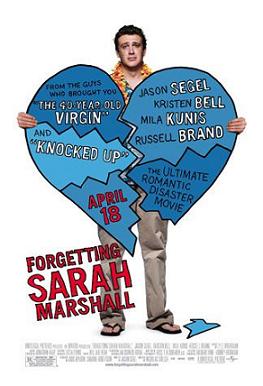
Forgetting Sarah Marshall

Dir. Nicholas Stoller
2008
6.5
The break up film is a weapon of mass confusion and illusion in America. The very words conjure up images of lone men sprinting through airports, heart broken singles in sappy song montages, and, for some reason, the Seattle Space Needle. The whole purpose of the genre, tied inexorably to the romantic comedy, is the affirmation of love and life and that both go on in the wake of personal upheaval. It is supposed to get the viewer slightly emotional and relatively connected to the plight of its characters. It is supposed to relieve that viewer of any and all anxieties about severed romance, nomadic loneliness, and all other banal abstractions somehow related to losing some kind of a connection. What break up films do instead is instill a false confidence about the irrefutable obviousness of the now-ex-lover's stable mental health. In Layman's terms they suggest that we are too stupid to be sad. Everything is going to be fine because we're not even thinking of the alternative: that everything will NOT be fine. That the world is going to fucking end. That we will never love again.

Recuperating from a bad break-up (in which you, the reader, are the victim) is like recuperating from a bad break up movie. At first you feel OK because you want to feel OK. Then you reflect. After feeling OK for a little while you over compensate by being hugely critical. You assume everything was a waste of time. You are remorselessly cruel to yourself for even participating in the travesty. However, after enough time goes by you can put everything into proper perspective. You can calmly evaluate the pros and cons. You kinda realize that you were cheated by falsity, but that harshness would have really hurt your feelings. You go back and see how things could have been a little more balanced and a little more real. Forgetting Sarah Marshall is not your typical break up movie, although it is mostly about a typical break up, only on a much larger scale. Though Appatowian (official terminology) in its realism, the film is restless without the crutch of the standard romantic comedy structure. Full of modest laughs and efficient dialog the film ends up hobbling around for 90 minutes before deciding to sit down, get some work done, and get over itself.

So all that was pretty meta. The break up film as break up; the film as protagonist; its self realized nature. It's a mind fuck when you really think about it. But that's what films associated with producer/director/writer/cult god Judd Appatow are like. They are intensely self-reflective, unsure of themselves and geeky as fuck, kind of like Appatow and most of his buddies. They take the tried and true genres we're familiar with and give them a truly enlightening sense of earnestness and familiarity. Appatow's most effective weapon, besides his humor, is his disarming sense of honesty. I don't need to remind you that Appatow, in one way or another, has been a part of the best film comedies of the last five years. Appatow's influence on a film isn't always so much seen as it is felt. In Forgetting Sarah Marshall, Appatow is not the director nor a writer, yet you can feel his aged wisdom in lead actor Jason Segel's script. You can also see it in his performance. Segel plays Peter Bretter, a gawky guy trying to be funny, failing a lot of the time, disconnected and basically waiting to have his life ruptured in some way. Of course, that happens when long time girlfriend Sarah Marshall (Kristin Bell) breaks up with him for “tragically hip” rock star Aldous Snow (Russell Brand). Then Peter accidentally follows the new couple to Hawaii. He attempts to sabotage their rendezvous but ends up upsetting himself to greater and greater extents until he meets and falls for hotel receptionist Rachel (That 70s Show's Mila Kunis).

Given all that, what's most disappointing about this movie is also what's most obvious: the absence of a noteworthy climax. Is it when Peter rides his surfboard into Aldous after finding out how long his ex-girlfriend's affair had been going on? Or is it when he propels himself off the side of a cliff into the crystal clear Pacific? Is it when Sarah and Peter attempt to have post-break up sex only to find that Peter's penis is too near the heart that Sarah smashed into a million pieces to have effective consensual intercourse? It is pretty unclear. What's clear is that toward the end of the film things go down hill cinematically while conversely becoming cliché and uplifting. The film submits to it's own disingenuous desire to fit a pattern, to pull the wool back over our collective eyes. After opening the viewer's mind to the myriad ways in which reasonable, sane and otherwise average people react to being broken up with, it turns around and insists that even if you're writing a rock opera about Dracula which incorporates lots of streamers and puppets, the hot girl you met in Hawaii will totally come to see it and realize she wants to be with you. Oh, and she will see you naked. Synopsis: Forgetting Sarah Marshall. Funny? Yes. Disappointing? Indeed. Broke my heart? Well, let's just say I'm just getting off the couch.

Tuesday, March 24, 2009

The Class

Dir. Laurent Cartet
2008
9.5


Middle school is hell on Earth. Any and all quiet respect for authority at that age (12-14) is thrown out the window. As a teacher, it is considered an achievement to get your class under control, never mind transmitting any knowledge. Where elementary school lays the foundation for a person's conception of education and high school develops on top of it a rickety framework of hyper-specific and compartmentalized spheres, middle school always seems to just be a big push out the door. Standards of behavior and learning are dismantled and reassembled into something between prison and playground. The years in middle school are some of the most confusing years of all, and not just for students. The Class, a 2008 French film by Laurent Cantet and recipient of the prestigious Palme d'Or at the Cannes Film Festival, provides a stunning introspection on the commitments and contradictions of being an educator, as well as the duties and obligations inherent in the occupation. Culled from the personal experiences of an inner city Parisian teacher, Francois Begaudeau who also plays the film's protagonist, The Class is a beautiful, and at times uncomfortable, piece of honest-to-god filmmaking. Its clarity of vision, lack of pretension, and complete certitude allow, and in fact encourage, the film to evolve past being a simple conceptualization and reproduction of the uncertainties and trepidations of scholastics into a commentary on the oft-ignored dilemmas of modern education.

In theory the film presents a near impossible task: the development of a classroom of characters into a classroom of students: obnoxious, insular, obtuse but most of all believable. The film centers around Mr. Marin's (Begaudeau) eclectic class of middle school aged students, who range from Chinese, video game loving Wey to Malian, disciplinary nightmare Souleymane. The film begins formlessly enough, a tasteful choice on Cantet's part, allowing the viewer to become acquainted with, in all likelihood, an unfamiliar setting. The inner city and multi-national aspect of the film took some getting used to, not to mention the sheer intensity of the middle school setting with its blurring dialogs and extreme divides between hormonally engaged students and caffeine affixed, sometimes utterly disenfranchised teachers. The film presents its own themes literally, using questions posed by students and debates between teachers to elaborate on what is already being presented. Take a question by one student: What does condescension mean? As a maturing young adult its pretty clear how blatantly patronizing Mr. Marin is towards his students, knowing that they have yet to fully develop a sensitivity to his subtle jeers. They are not completely unaware though, as they occasionally chastise him for making fun of them or even insulting them, which they ironically find unjust. The question that develops out of this slightly detached introduction is that of who deserves what kind of treatment.

There is an emphatic conviction in youth that adults are infallible, unquestionable, and amoral. Their word is law. However, by the time a child hits the age of 13 that belief is turned on its head, and becomes instead the recalcitrance of the pre-teen years in which all authority can and must be questioned, to degrees which are often absurd. Development at this stage is a painful process, and in The Class the figurehead of such a crisis is Souleymane, who, after stepping in to defend two female students who Mr. Marin has just accused of “acting like skanks”, disavows all points of classroom law, pushing and shoving his way out the door after accidentally cutting open the eyebrow of a fellow problem student, Khoumba. The incident, which is the film's tense climax, results in Souleymane's expulsion from the school. All the while, and in fact since the film began, an ideological war is being waged between the teachers on how to best govern the school, which they naturally approach rather bookishly. These conversations, perfectly juxtaposed with the scenes in the classroom in which Marin's thoughts on education are put into profound praxis, edify the films' self-awareness and function as a more direct means of calling into question long since defunct prerogatives of teachers and the means by which they control education. In America, in the shadow of George W. Bush's “No Child Left Behind” doctrine, these scenes take on a quality of pain by self-realization. Many of us were educated, publicly and privately, under similar statues, and seeing them presented here in a confused frenzy of idealizations and total hopeless disillusion and the bitter conclusion that nothing is working, calls into question how any of us ever made it past the 8th grade. Better still it points to our own depressingly low level of education, with so many college students possessing only elementary grasps on grammar and syntax, never mind literature and politics.

All things considered, what makes The Class remarkable is not its criticism of educators, who have one of the most difficult jobs imaginable, but rather its acceptance of youth culture. It asks the classic insolent question “When are we ever going to use this?” and does so eloquently and with near perfect verisimilitude. It embraces the student perspective and integrates it into its final evaluation. That evaluation is not exact. It is not a precise suggestion. It is more a warm embrace of the possibilities of evolving educational standards and the part that children, who are the whole impetus of education, must play in that process. The Class reads like a textbook that might have a title like “How to Teach and Learn”. Its point is articulate and timely and owes its precision to an educator who saw himself not as a demigod, but as a human-being attempting to transmit the gift of knowledge to a group of young people who weren't sure that they needed or wanted it. It is a serious achievement in academic assessment, as well as an exquisite piece of cinema.

Waltz with Bashir

Dir. Ari Folman
2008
7.6

The most important line in Ari Folman's 2008 film Waltz with Bashir is also its thesis. When speaking to Folman about the nature of memory, a friend tells him “Memory is dynamic.” Waltz with Bashir is a meeting of historic documentary and subjective/selective cognizance. It is a dramatic retelling of the 1982 Lebanese War told through a series of animated vignettes via individual flashbacks told by and to Folman as he journeys backwards through time to relive a part of his life that has been closed to him for over 20 years. When I say closed I mean that the basis of the film's narrative is that Folman is incapable of remembering his time spent as an Israeli Defense Force (IDF) soldier occupying Lebanon, in particular his armies seige of Beirut. While the film attempts to back this dilemma up psychologically (an interview with a post traumatic stress doctor brings about and wistfully defines this neurosis as “dissociative memory”) it inevitably succumbs to its own terribly powerful story, leaving the reasons for it being told in the shadows of colossal human destruction and genocide. The intent is hardly sinister since Folman, as a means of communicating with a non-Middle Eastern audience, relies on emotive relations over a systematic understanding. Still, Waltz with Bashir is fecund with impressive visuals and sublime meditations on individual humanity in the face of war.

Folman's dreamlike film begins quite literally: in a dream. This dream which is being told to Folman, an ex-IDF soldier turned filmmaker, by an old friend releases a war-torn memory in Folman which triggers an almost instinctual desire to discover where the vision extends from. He begins seeking out various former fellow combatants and tells them about his dream and how he can't remember anything about the war. These becomes the pieces by which Folman's own story is told. The problem then becomes dissociating what is real from what has become real over the years; reality by association. Folman adopts the memories of the men and women he speaks to as his own and then, by an inexplicable magic known nominally as psychology, he begins to remember parts of the war. His visions are impressively concrete, given that their content usually involves close range death and mayhem. They are rendered immaculately by the team of artists who utilize flash, classic and 3D animation to bring to life, with impressive dedication to detail, the near hallucinatory visualization of war. Waltz with Bashir's vision of carnage and destruction contains originality bordering on Apocalypse Now's stimulating spectacle, but falls short of that “anti-war” film's impeccable restructuring of war as a personal journey. In that sense Waltz with Bashir feels more like a vicarious day trip rather than a cataclysmic deportation.

The problem is not how the film looks but rather how it moves which is choppy and fragmentary. While dubbed a documentary, the film eschews education of mass audiences in favor of sublimation of feelings as facts. Save the tantamount example of the massacre at Sabra and Shatila, which in of itself exercises the use of raw stock footage of the weeping wives and mothers of murdered men, women and children, the entirety of Waltz with Bashir is presented in away where the viewer is lead to believe that what they are seeing is based on fact, but finds itself so twisted in its own self proclaimed idiosyncrasies that the viewer is hard pressed to discern a meaning. Was Waltz with Bashir meant to portray the total inglorious war or the mutilated personal war? It unfortunately settles for inconclusion and vagueness, where further development could have provided a much clearer vision.

As an artifact of history Waltz with Bashir is an original piece of cinema. Though somewhat rudimentary in its narrative presence, and at times distracting in its visual one, the film does manage to pose an important intrinsic question. That question is one of distance. Who can see more clearly the destruction of war? Those from afar, who are in no danger and can easily fall prey to apathy (see: Israel's party atmosphere in the 80s, in the midst of a foreign war) or those who are too close to make out the epic hugeness of the damage they themselves have caused? A fleeting reference is made to the Holocaust during the film, when Folman realizes that he may have very launched the flares under which thousands of Palestinians were brutally executed. I gathered that this reference was meant to signify an idea of implausible and totally irrational deniability, like the Nazis who claimed not to realize that the gas chambers in the concentration camps where they were stationed were used to kill Jews by the millions. War has always been an act which we as humans have been incapable of, and unwilling to see in its entirety, because we know that it signifies a total fall from grace. Where Waltz with Bashir succeeds is in confronting the totally inhuman aspect of war, and shouldering the responsibility of the deaths Folman and others caused. By the conclusion, the film is no longer a documentary but rather an exercise in cleansing. Though wrought with imperfections of voice and structure, Waltz with Bashir is a progressive work of personality coping with impassable history.

Sunday, February 15, 2009

Revolutionary Road

Dir. Sam Mendes
2008
4.5

As everyone probably knows by now Sam Mendes is married to Kate Winslet. They are not exactly the stereotypical Hollywood couple. Mendes has four films under his belt but his status as a director has been somewhat depreciating since his debut film American Beauty. Winslet is the the chronic underdog of Hollywood with a number of fine performances under her belt and a reputation as a solid, sensual actress, but has been consistently denied Hollywood's “highest honor”: an Academy Award. It seems that these “but” laden post-scripts are what's standing in the way of either Winslet or Mendes becoming a breakthrough, although both have been highly celebrated in more minor, but perhaps also more well-refined, film circles. So it kind of fits that Mendes most recent film, Revolutionary Road, which stars Winslet and Leonardo Dicaprio as the misfit couple Frank and April Wheeler, is a disappointment. After being denied access to more conventional appreciation (ie. the masses) Mendes turned to more orthodox subject matter and cast Winslet in hopes that the double achievement of popularity and critical acclaim might be attained for both himself and her. Unfortunately what happened instead was that he made a film void of any standout features. The widely recognized faces of Dicaprio and Winslet (“Together Again!” ran headlines after the announcement of Mendes new film) ended up working against him, not just because so many were hoping that Revolutionary Road would be an epic romance comparable to Titanic. Both Winslet and Dicaprio are noteworthy character actors, but without dimensional, yet malleable, characters even the greatest character actor is bound to falter. Revolutionary Road fails because it is not sure, and thus its characters and actors are not sure either, what exactly it is trying to say. It lacks the audacity to be bold and surrenders to pondering and compulsively exploding at all the wrong times.

Revolutionary Road embodies a growing trend in Hollywood since the turn of the century: divulge the 1950s. Though Mendes set design and appropriation of the time is adequate he renders the 50s in a way that further mystifies rather than clearing up. Unlike Mad Men or Far From Heaven which capture the false sincerity and strident dedication to normalcy, Mendes erects an abysmally obvious artificial insecurity. April and Frank are not a happy couple. They decide that moving to Paris will solve all their problems (Europe is tres chic). Thus begins a theme of secondary or alternative lifestyle that pervades the film but is never dealt with head on. Middle America is boring and confining and Europe is mysterious and appealing; a place where a person can really "discover who they are”. This mindset, although it is absent of rationality, is not uncommon but the reasoning behind it is as flimsy and two dimensional as the reason for placing the film in the 50s. The idea is to make everything seem edgier. Frank and April laugh at their neighbor's shocked reactions to their moving announcement, and find the mentally deranged son of their landlady very agreeable for his outsider's view of the world. That is of course until everything goes to Hell. Frank is tempted into staying at his job. April has several mental breakdowns, makes love to her neighbor, and all the while is contemplating aborting the baby she and Frank made together in a moment of unrefined and unbelievable passion. We're supposed to be shocked at the behavior of two people in a generation known for its conservative, patriotic and straight laced mannerisms. That idea, however, has long since been rebuked, and Mendes motifs of insecurity, specialty as dressed up simplicity and an abstention for the commonplace all feel rather trite. Adding to the limited conviction inherent in the film is how awkward a couple Dicaprio and Winslet are. It's almost as if they are trapped inside a bag of indefinite size and are simply groping around, sometimes frantically, sometimes apathetically. Be it poor pacing on the part of screen writer Justin Haythe or perhaps just a confounding circumstance that never seems to go in the direction you think it's going to (in this case that is a bad thing), any connection between the two characters seems entirely forced. Even in the relatively few moments where the film achieves tenderness or some kind of authentic emotion, the two fall quickly back into their real roles as big name stars in a film that doesn't adequately live up to their respective talents.

In a way, Mendes seems to have inadvertently assumed a directorial role equivalent to the social position of the Wheelers. Frank and April are entirely convinced of their originality; so full of false modesty and sentiments, and yet so utterly incapable of being anything other than melodramatic. Similarly Mendes seems to be attempting to make a film that is simple, viable and passable, but fails because of an earnest belief that Revolutionary Road is something terrific and praiseworthy. While Revolutionary Road is not a complete failure, its redeeming qualities, particularly the portion of the film that takes place after April's botched bathroom abortion, cannot do anything to overpower the overwhelming feeling of a film that is entirely forgettable. In the end I feel exactly the same way April and Frank's neighbor, Shep, feels when he says “I don't want to talk about the Wheelers anymore.”

Tuesday, February 3, 2009

The Wrestler

Dir. Darren Aronofsky
2008
8.3

Throughout the first part of Darren Aronofosky's latest film The Wrestler I couldn't help thinking about a film made 10 years ago: the Coen Brothers' Barton Fink, and how the majority of that film is devoted to lead character Barton's attempts at making a 'wrestling picture'. I kind of wonder if Aronofsky's film wouldn't be the modern realization of Barton's insinuated masterpiece, the difference being that The Wrestler is not kept under lock and key by a megalomaniac studio executive for it's “fruitiness” and abundance of “that Barton Fink feeling”. In place of said feeling is a different kind of feeling, but a similar perspective. An aging professional wrestler, Randy 'The Ram' Robinson (played superbly by Mickey Rourke), beaten down by life's daily tragedies makes one last attempt (or is it?) at reaching the perfection of his craft. At least that's the idea anyway. The lively and gigantic metaphor of struggle, appearance versus reality and the utterly depressing realization that life has a habit of moving forward without one's permission is what makes The Wrestler memorable but what also causes it, at various points, to falter under its own weight.

Roland Barthes wrote an essay about wrestling where he postulated (academics don't 'write' they 'postulate') that people who love wrestling love it because the outcome is predetermined, known long before the wrestlers begin to throw their weight around, and that, categorically, the line between good and evil is physically manifest in the two hulking masses in spandex. Most people would call that theatrics, but Barthes is not interested in the apathetic spectator, but rather the fan. In the film, Aronofsky does a competent job at playing down the false pretense under which so many wrestling matches take place, but this sentiment is at times painfully counteracted when he jibs the simulated intensity of the sport by showing lengthy conversations between various wrestlers about which moves will be used during their match, and promising not to go too hard on each other. He oscillates between trying to create a mockumentary of wrestling and desiring to make an emotionally engaging film. The emotionally engaging aspect mostly wins out, after The Ram's post-match heart attack leads him into complex set of emotions that occur only when a person is deprived the ability to do the one thing they know how to. The turn at this juncture leads the viewer down a dark, sad passage of the narrative where Randy seeks out love and finds failure and rejection. His relationship with his daughter, Stephanie (Evan Rachel Wood), is beyond repair; "broke" as she puts it so eloquently in one of the films most climactic and upsetting scenes. He courts a stripper, Cassidy/Pam (Marisa Tomei), who continuously refuses to accept her own feelings for him on the basis that he is a "customer" (at the strip club where she works), furthering the film's theme of conflicting dual existences and the subjectivity of reality. In the end Randy enters back into the only world he knows for what, we are meant to believe, is his final match. It is before this match that The Ram delivers one of the most poetic pieces of dialog written for the film. While Pam tries to convince him not to fight, citing his medical condition he brushes her off saying “The only place I can get hurt is out there”, referencing the world outside the ring that has all but left him behind. Its too bad that the entirety of the film isn't as subtle and moving as it's final sequence. It feels like Aronofsky saved all his credentials and aptitude for this scene and while it certainly succeeds in convincing the viewer of the authentic emotion behind one of the most contrived of spectacles, it doesn't entirely make up for the leaps and bounds of progress that brought us there.

When The Wrestler finished and Bruce Springsteen's “The Wrestler” began to play over the closing credits and the image of The Ram flying through the air towards what might be both his simultaneous victory (the match) and ultimate defeat (his death), I walked out to my car to drive home. When I started the engine Springsteen's “Racing in the Street” flooded out of my speakers and I couldn't help feeling that that song better captured the tone of The Wrestler than the song that bears its namesake. “Racing in the Street” is a nostalgic look back on a life spent in the carefree and daring world of street racing and the life that has blown by the singer in a blur of passion and loud motors. He, like The Ram, is left with just the overbearing memories of youth and highly localized fame. The Wrestler is a movie about the crushing reality of age and commitment to an art form. I think Roland Barthes would agree with my calling wrestling an art. For all it's cheap tricks and glossy, exaggerated appearance, wrestling is still profoundly important to some people. Aronofsky's intent may have been slightly contradictory at times but what he ultimately achieves is something between a life-size mock up of a fictional, iconic figure and an emotionally devastating portrayal of a defiant man in the shadow of defeat. The Wrestler shows how when something is truly important to a person, their entire life even, it doesn't make a damn bit of difference how sophisticated or widely accepted it is. It only matters that it exists for them and for those who share that same passion.

Monday, February 2, 2009

Synecdoche, New York

Dir. Charlie Kaufman
2008
9.6

Charlie Kaufman is one of a kind. In case you haven't been paying attention Kaufman is the man behind the screenplays of some of the best pictures of the last decade including Eternal Sunshine of the Spotless Mind and Adaptation. From his humble beginnings as a writer for the TV show Get a Life, Kaufman has built his reputation as a master surrealist from the ground up since the early 1990s. As far as I can tell all his strife and talent culminate in his Synecdoche, New York which he wrote and directed himself. Starring the consistently incredible Philip Seymour Hoffman as aging theater director Caden Cotard, the film starts at the beginning of the end. Cotard has reached a point in his life where all he can think about is death and, despite some vain efforts to overcome these thoughts, failures and tragedies befall him constantly. His health over the course of the film deteriorates to a sad but hysterical point, his relationships with women, including his wife, are almost all ruinous, and he is hounded by insecurity about his life and artistic work. To summarize the plot of the film would be pointless for two reasons, the first being that it would take far too much time, leave the reader confused, and fall notably short of really describing what's going on in the film, and second because Synecdoche is life, and who wants to read a summary about that?

Synecdoche has received mixed reviews by critics all over, yet what is impressive about these reviews is how polarized they are. It would seem the adage “you either love it or you hate it” actually applies to something. Many critics have cited Italian director Federico Fellini's influence on the film and while this is certainly a reasonable parallel it has often been used as a criticism rather than a praise. For those of you who haven't seen any Fellini films Fellini tended to make nomadic, philosophical films that aptly captured the theatricality of life. His characters and scenarios were often larger than life and his films require several viewings before any sort of a definitive message could be found. Synecdoche is a little more straightforward than say 8 ½ but while Fellini could intrigue and surprise the viewer, Kaufman does him one better by creating characters that are not archetypes; characters that live, breathe, say stupid things and who are, in the end, totally fallible. In other words they're real people, where Fellini sometimes seems to only want to produce caricatures. Still, the comparisons make sense. Some of Kaufman's dialog is only great if you keep in mind that he is intending it to be awkward. This intentionality in cinema, and all art for that matter, is often the fine dividing line between genius and naïve stupidity. Kaufman makes his characters, who (especially towards the middle and on to the end of the film) have spent most of their lives being theater pieces, speak like actors. They employ dramatic platitudes, like something out of a Shakespearean tragedy. They cite pretentious philosophical theories and abstract works of literature to cover their insecurities about being boring people and their ultimate fear of being forgotten. They play characters in order to escape themselves. That last sentence is the meat of Synecdoche. Escapism is probably too harsh of a word but throughout the film Kaufman hammers home the solitude of human life and the layers people form around themselves to keep their weaknesses from showing until they arrive at the point where they feel they hardly know themselves, never mind anyone around them. Kaden especially becomes enveloped in his huge theater piece to the point where it eventually becomes his actual life. This process is slow but is marked along the way by Kaufman's blurring of the lines between reality and fantasy until the viewer can hardly tell the difference between what is supposed to be going on and what is actually going. It is a daunting task just to get a handle on the physical aspects of this film never mind the psychological, but Kaufman has a gift for the delicate balance between the two. As in Eternal Sunshine of the Spotless Mind, while the film is visually stunning and at times even distracting, Kaufman slowly unveils the inner thoughts and feelings of his characters. Like a great novelist Charlie Kaufman never gives away too much and knows exactly when to reveal certain precarious details.

Synecdoche was far and away my favorite film of 2008. I have a habit of seeing one really great movie every 3 to 8 months and, naturally, I never know what its going to be. This one was it. I suppose I should feel fortunate to see “great” movies this often or perhaps, some would argue, I should try raising my standards but this film is a beautiful, moving tribute to the sublime, and sometimes daunting, reality that exists in all human life. It is one of those rare occasions in which modern cinema does have something new to say and says it so articulately; so profoundly and, in the end, so simply that it makes all the other films you saw before it seem superfluous. Synecdoche, New York will not leave you feeling good which is perhaps why so many people didn't like it. The ending is exactly what it should be, given what the film is about (I won't ruin it for you). Kaufman has built a tower of excellence; a film that is worth watching again and again.