Sunday, May 30, 2010

Mysterious Object at Noon

Dir. Apichatpong Weerasethakul
2000
8.0


In dramatic cinema we are constantly being met with the moment when everything falls into place. Sometimes this is accomplished through a gradual building up of narrative steam or the sudden onslaught of “the twist.” Either way, our outlying concerns for the welfare of the given film's characters and our enthusiasm (ranging from ecstatic to stupefied) for the film's mystery are neatly wrapped up. We have even come to expect this kind of neatness (perhaps even more so) in documentary films. So you'll understand what I mean when I say that it as much a relief as a frustration to meet a film that wraps nothing up; that lays itself bare (or at least seems to) for the repressed scrutiny of an audience not altogether comfortable with this kind of candid behavior. I use these active verbs to stress how Mysterious Object at Noon, the debut full length documentary from Apichatpong “”Just Call Me Joe” Weerasethakul, engages with its audience as a means of locating an abstracted understanding of itself both as a film and as a representative of Weerasethakul's home country of Thailand.

Mysterious Object is a conceptual piece of documentary filmmaking. The film is based on the Surrealist parlor game Exquisite Corpse wherein a small group will build an illustration piecemeal usually resulting in an abstract representation of collective psychic continuity. One person draws along part of the paper then covers their drawing leaving only a line trailing down to where the next person will sketch. In Weerasethakul's film he and his film crew travel across their native Thailand asking people to tell a small section of an apparently invented folkloric tale. Intercut into these serenely earnest moments is Weerasethakul's no-budget visual translation of each teller's tale. As it it stands this is an unremarkable albeit faintly clever concept and stretching it to 85 minutes might have been an unfortunate choice were it not for Weerasethakul's own natural gifts as a story teller.

Using the documentary footage and stagey adaptation as a base, the director assembles an unconventional collage of relationships. The story tellers become linked to their creations through the call and response style editing. The tellers also link themselves to the personal memories which inform their take on the film's story; those memories themselves greatly affected by Thailand's history. The film crew becomes linked to the story tellers and often engage with them from behind the camera. The film crew too becomes engaged with the non-professional actors who are used to visualize the evolution of this modern day folk tale. Slowly a world begins to form one that is both highly autonomous and frighteningly at odds with reality. This reality, the internal contradiction of how Thailand has viewed itself cinematically throughout history vs. how the "other half" has lived and continues to live there, is at the center of Weerasethakul's beating heart of a film.

The tale told is one of transformation and hidden identity. A young crippled boy is looked after by a caring teacher who one day unleashes from within her a “mysterious object” that becomes a young boy with the ability to transform into anyone he likes. The teacher is revived and the crippled boy must choose between the teacher and the magical young boy who is impersonating her. He chooses the teacher. Allegorically speaking the tale's meaning is as clear as day: though it may look and sound the same, Thailand's portrayal in cinema is not only at odds with its true identity but must be rejected in order for the country to reconcile itself and move forward. If this is the case one might guess that the tale's crippled boy is none other that Weerasethakul himself, a filmmaker unable to get his films screened in his home country due to unfortunate censorship laws that deems his films “unfit” for Thailand's Nationalist cinema.

Though highly interpretive, Mysterious Object at Noon instills in the viewer a feeling of interconnectivity and unity despite its abstractions. If the tale told in the film and the fragmented means by which it is told is in fact the story of the Thai people then one might assert that the melancholy that begins the film and the youthful playfulness that ends it imply an optimistic outlook. There is no doubt that Weerasethakul is a humanist and a director unlikely to abandon his home in the quest for notoriety. The film he has given us, built out of the shattered pieces of a country rich with love and ripe with suffering, is in turns somber, joyous, absurd, cruel, hopeful and most of all beautiful.

Thursday, May 20, 2010

Exit Through the Gift Shop

This review was originally published here on Tiny Mix Tapes.

Dir. Banksy
2010
10.0


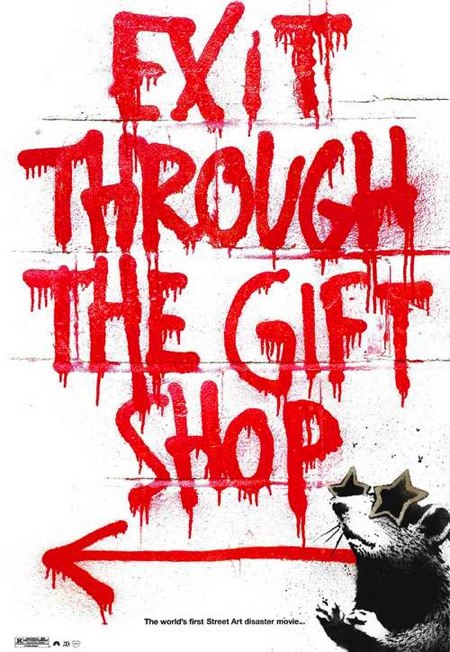
In light of the serious theoretical debate surrounding English street art pioneer Banksy's “documentary” Exit Through the Gift Shop I'd like to pose a multi-tiered question. In our highly academic engagement with the complexity of the Banksy ethos aren't we becoming the victims of the very same joke we are trying so desperately to escape being the punch line of? Is this obsessive Holier-Than-Though atmosphere just a malignant side effect of the critic's self loathing? Are we not as bad as L.A.'s soulless faux-literati who parade their affectations of seriousness and insight (not to mention sincerity) or the art collector pricks who juxtapose Banksy's work alongside minor Renoirs without batting an eye? Hugging our pretensions close we have unknowingly become the targets of Banksy's anti-expectation art. Critics have made a lot of oblique assumptions about Banksy's intentions with Exit in a vain attempt to deconstruct his film and simplify its elliptical dialectics. I'm going to attempt to be less crass but no more succinct: I am the victim of Exit Through the Gift Shop's recondite gag, if it in fact exists at all, though I try so hard to escape the ideological pot holes other critics have fallen into on their way toward “figuring out” the film. As we look desperately for the code to decipher this endlessly unfurling life à clef, Banksy laughs all the way to the moral bank to deposit the sea of coins we've tossed into the infinite fountain of the occult, from which he draws not only his healthy humanitarian salary but also the inspiration that has propelled him into the stratosphere of modern art.

Exit Through the Gift Shop is in turns affecting, insightful and hilarious. It supercedes narrative constraints in a way that is pure Banksy: emotionally modern and structurally post-modern. Banksy, despite his capacity for vicious satire, is devotedly human at heart. His work is a seismic indicator of his dedication to the people often overlooked by sovereigns and tycoons. However, his tactics are reactionary. Street art itself is a reaction to the depravity of high art. Banksy's hidden identity is a retaliation against celebrity which itself is often a facade masking an ugly reality. Exit, like the rest of his art, is emotionally rich and psychologically complex. And the premise? Deliciously meta! A French ex-pat (Thierry Guetta) who never stops filming promises to create a documentary which is never truly made and in turn becomes the subject of a new documentary (accredited to a man without a face) which some propose (in a paranoid attempt not to be the tag line of an elaborate and possibly self-created Banksy hoax) is itself not a documentary at all.

For any person with intellectual hang-ups this will be something to lose sleep over. Banksy, who has undergone a dramatic apotheosis at the hands of a desperate and self-degrading youth culture, is an artist for whom the immediacy of his medium has always been its most important aspect. It is the act of street art, not so much the culture that formed out of the connection between himself and other artists, that defines Banksy's genius. His genuine love of and adoration for the people for whom his work serves as a reminder of life's trials and tribulations as well as its simple pleasures is supported through his contempt for and subversion of fascism and abusive social institutions. This naturally stands in stark contrast to the supercilious seriousness of today's youth who selfishly utilize anything and everything as a means of assimilating its "importance" into their own lives in the vain hope of finding the one thing that is going to validate their entire existence. If these holy fools ever managed to find the immortal something they want so desperately they would undoubtedly strangle the life out of it.

As for the film's proto-idiot savant protagonist, for whom the final product and/or the process by which that product is reached is always secondary to how it can utilized for self-serving desires, his self-constructed alter ego, Mr. Brainwash, gets it all wrong. During the film he notes that “street art is about brainwash,” which the viewer interprets as Thierry rightly recognizing street art's themes of anti-authoritarianism and contempt for political corruption. What the film reveals however is something altogether darker: that the “artist”-by-way-of-pathological-observer-gone-culture-debasing-charlatan (not to be confused with filmmaker, documentarian or even authentic artist), who inarticulately expresses himself through bumbling non-sequitors and confused metaphors, has accidentally discovered street art's power of manipulation over not just wanton youth but snarky bourgeoisie as well. While Mr. Brainwash rakes in thousands of dollars for derivative works of kitschy pop art pastiche, Banksy, Shephard Fairey and others look on in horror and disbelief. The latent disciple of street art has unwittingly overthrown the masters.

If all this has you scratching your head like the apes of Banksy's graffiti then consider yourself unequivocally united with the collective subconscious of all who have viewed this brilliant meta-docu-film. More than just an engaging social and psychological study, the film is also a eulogy for the lost innocence of not only street art but man as well. Effortlessly constructing a spellbinding tale of obsession, fate, identity and illusion, Banksy has once again created a work that will undoubtedly turn commercially successful (and inevitably be co-opted by the “hip” who will further misconstrue and denigrate its diverse set of meanings) despite the great lengths he goes to show his derision for such a possibility. The film has already fallen prey to intense self-congratulating skepticism (which somehow passes for criticism...?) and there is no end in sight for that. Exit Through the Gift Shop's impeccability is in its refusal to glorify the viewer's intellect or their capacity to uncover the remote “truth” of a film. The back patting experience of contemporary art house cinema and the stupefying effects of the Hollywood blockbuster prove, in Banksy's paint stained hands, two sides of the same coin: one that is meant to make the viewer feel superior. Banksy instead places a shadow just outside the viewer's peripheral vision and dares us to guess what it is, where it comes from and what it means for us. But unlike so many filmmakers his well being does not rely upon our interest. In fact, Banksy's take it or leave it disposition may be the most mysteriously engaging aspect of his work. Like Plato's allegorical cave we struggle against the chains of our expectations all while philosopher king Banksy beckons us forth into the searing rays of enlightenment.

Banksy
has always been an artist aware of the capacity for his art to disappear forever. This idea obviously chokes the creative subconscious of Mr. Brainwash but if anything it arouses in Banksy the ability and knowledge to achieve the transcendental attitude by which he goes on surreptitiously making his art, in plain view of the public, largely for himself. Given all this intrigue, this may be the best time to ironically suggest that the film quietly told me what it was about in one brief snippet wherein a passerby to Banksy's mutilated telephone booth piece when asked what she thinks about it wryly replies in a sublimely Banksian manner “someone doesn't like BT telephone service.” In other words: analysis has its cost. So, shut up and watch the damn movie.

Friday, May 7, 2010

A Taste of Cherry

Dir. Abbas Kiarostami
1997
9.0


More than a decade before critics came up with a term for the growing trend of thoughtful albeit at times affectation smothered films featuring protagonists plodding their way through life's dreary necessities (also known as Slow Cinema), Abbas Kiarostami anticipated and transcended the movement. However, as in all arenas of history there is rarely one discreet starting point for a movement and to suggest that Kiarostami's A Taste of Cherry laid the foundation for Slow Cinema would be indelicate and ignorant. What A Taste of Cherry does discreetly represent is an apex of the pre-Slow Cinema age of spiritual perambulating over perfunctory story telling, a trait which would later become one of the myriad slippery signifiers of Slow Cinema. More so than its debatable cinematic importance (the film did win the Palm d'Or at Cannes after all) is the film's power as a cinematic metaphor of projection.

This concept of projection works splendidly in cinema because it is bound to the most basic and common manner in which film has historically been viewed. However, the kind of projecting required and unconsciously elicited by A Taste of Cherry is defined by its viewers. Unlike the flash-bang of narrative cinema with its constructs and manipulations, A Taste of Cherry takes away the tension/release or question/answer framework which most narrative features adhere to. In the absence of clear direction and motivation in the film itself, the viewer is left to decide everything. Rather than have questions answered or even have them posed at all, we as viewers have to project onto the film our own desires, misgivings and insecurities. Thus the film takes on a unique quality of assimilated personality and vulnerability.

We enter into a cerebral mode early on as Kiarostami interpolates us not as perverse voyeurs but spiritual passengers. We spend much of the film in protagonist's Mr. Badhi's passenger seat (fittingly this seat was filled by Kiarostami himself throughout the shooting). Badhi drives slowly around Tehran before entering into the city's solitary foothills, all the while eliciting an unknown favor from strangers. As it turns out Badhi is seeking someone to bury his body after he commits suicide. Upon this revelation the film releases some of its former passivity and begins to ease the viewer into a series of episodes which constitute a familiar “life in a day” structure. In and through meandering conversations with three outsiders (a soldier, a seminarian and a taxidermist) each with a profoundly different relation to death (the soldier destroys life, the seminarian attempts to maintain it, and the taxidermist seeks to preserve it) Kiarostami demonstrates, via the reactionary Badhi, man's evolution from the bullying anti-logic of youth to the closed-door spirituality that has little relation to a real, complex world and finally the practiced pragmaticism of the aged who accept death begrudgingly. Each episode is a journey for Badhi not simply through physical terrain but his soul and intellect as well.

If there is a theme in A Taste of Cherry it might be the meeting point of the latter two. Badhi has calculated that his life has no value amongst the living although the doubt that slips in toward the film's conclusion is a telling reminder that value like life itself is dynamic. The same kind of calculation might be practiced on film or any art for that matter. What merits excellence and aren't our perceptions wielded (at least in part) by our pretenses? Badhi appears well off and in good health although his tanned handsome face slopes downward toward his self-dug grave. However, this is not enough for him and while we never discover what has prompted his decision to end his life Kiarostami seems to be suggesting through the film's minimalist dialog that the reason is not so important. For Badhi, as with Kiarostami, the action becomes subordinate to the decision to act.

Of course all this investment in Badhi and his journey evaporates with the film's conclusion. Kiarostami pulls away the curtain of artifice that exists in even the most methodically unmethodical regions of cinema. Handicam footage of the shooting of A Taste of Cherry reveals, however, not the “tiresome distancing strategy” Roger Ebert interprets, but rather an uncharacteristic openness to cinema's largest intrinsic fault: its corrupted imitation of real life. Even in a film as visually beautiful and emotionally haunting as A Taste of Cherry, Kiarostami's willingness to interrupt his own quiet reverie should be celebrated rather than condemned. The footage, only a few minutes worth, evokes a tangible human relationship between people which we retrospectively discover mimics our own relationship to Badhi. The moment in which lead actor Homayon Ershadi hands Kiarostami a cigarette illustrates a sublime counterpoint to the heart breaking final shot of Badhi's face: eyes closed, lit by strands of lightning darting from the heaven he hopes to soon occupy. The closing shot of soldiers (whether they are actors or actual army men is never made clear) socializing along the slopes underlines the intention of this unlikely inclusion: in every act of theater, beyond every curtain and behind every character there are human beings whose lives are the inspiration for and starting point of all performances.

Friday, April 9, 2010

A Serious Man

Dir. Joel Coen and Ethan Coen
2009
8.8


Co-en-i-za-tion:
-noun
the attribution of a universal or symbolic quality to transient and otherwise helpless human beings.

A Serious Man, the Coen brothers' 14th feature, opens with the quote “Receive with simplicity everything that happens to you.” If ever there was an aphorism which the characters in the brothers' films applied less to their lives, I would like to see it. Whether it be the vendetta driven Lewelyn Moss or the scheming of Jerry Lundegaard, Coen characters have a unfailing tendency to complicate their lives in a misguided effort to simplify them. In A Serious Man we bear witness to the trials and tribulations of Larry Gopnik (Michael Stuhlbarg). In a state of constant frenetic panic, Larry's world unwinds until nothing remains but the very core of his being. In it's calling into question the usefulness of allegory and its subsequent affect on our ability to endure misfortune, the Coen's make one of the more remarkable turnarounds of their impressive career. A Serious Man exalts rather than depraves the suffering of its protagonist, easily making it the most humanitarian film in the brothers' grim body of work.

Over the course of their career, the Coens have become masters of allegorical realism. The self-contained worlds of their films give the impression that there is always a lesson needing to be learned. Occasionally this attribute has devolved into absurd social satire (Burn After Reading) but for the most part the Coens have maintained the heady combination of stories unique enough to capture our interest but universal enough to sustain the high moral ground they tend to tread upon. A Serious Man aligns itself most closely with Fargo as a film about the universe inflicting its indifferent wrath upon a man. Like Jerry Lundegaard and Barton Fink before him, Larry Gopnik becomes painfully aware of his own simplicity and impressionability, which in turn shatters the small world he lives in. However, the parallels to A Serious Man are not found simply within a single text or within the Coen's oeuvre. The film is a composite of numerous stories with each marking the point at which faith in a higher power must either be accepted or rejected.

To call A Serious Man a film about Judaism is both a under and overstatement. The important religious elements are here (faith, morality, fidelity, etc.) but the film is not simply about a man coming to terms with God's way (“The boss isn't always right, but he's always the boss.”). Larry, in Murphy's Law free fall, is driven by the question “Why?” but the Coens are driven by a different, related question: “How?” How do we believe? The brothers point to the religious significance of allegory and parable which have played a large part in how they tell their own stories. Where Larry, in vain attempts to assert his seriousness, seeks to understand the math or the reason behind his suffering, the Coens suggest that there is no reason and never was. In their impressionistic use of the story of Job (Larry), David and Goliath (Larry's habitually pot smoking son Danny [Aaron Wolff] is hounded by the beastly Fagle), and Adam and Eve (the film's prologue in the Polish shteti) among others, the Coen's are really illustrating a complex portrait of the uselessness of parables as a means of, or reason for, living.

This reading is complicated because without the allegories to give it existential buoyancy A Serious Man might never leave its narrative bed; lying prostrate in the face of an uncaring universe. When Larry seeks spiritual guidance from a trinity of Rabbis he finds the naivete of the junior Rabbi an immediate tool for reassessment. When this fails, the practiced pragmatism of the 2nd Rabbi, who not only gives Larry a feasible solution but also becomes the mouthpiece for the Coens assertions about the use of purpose driven tales, only redoubles Larry's conviction that God wishes him to suffer. From the 3rd Rabbi he is given nothing, which is perhaps all he ever needed. Throughout the film various characters give credence to Larry's suffering as he proclaims to everyone “I haven't done anything!” The tighter Larry grips his metaphysical oiled rope, the faster he descends into the swirling madness of the film's finale.

“I understand the math. I don't understand the cat,” Larry asserts to his blackmailing Korean student, Clive. In this case the context is Shrodinger's Paradox, but the quote can be read widely. Larry is a rational man but the world is not a rational place. Through sheer perseverance Larry attempts to understand why these unfortunate incidents keep occurring in his life but ironically detaches himself from their real life consequences. We constantly are catching him in media res, always shocked by some new fact that, to him and us, has come out of nowhere. Though it may sound like a world of suffering, the Coens actually come to empathize with Larry. Calling attention to their own thematic use of allegory, the Coens have finally found a character they do not wish to make a martyr of contemporary morality. They almost give him a satisfying ending but then it wouldn't be a Coen brothers film without some level of ambiguity. Larry's call from the doctor and the approaching storm are not the final nails in the grave of the Gopniks or the Jewish clan at Saint Louis, Minnesota. They are, in fact, reiterations of the film's opening quote. We never truly figure out what is right and wrong because the destructive will of the universe (or God) comes to sweep us all away before our existential queries are answered. With questions swirling around the film's ending (What will happen Larry? Why isn't Danny frightened of the oncoming tornado? What is the significance of the recurring Jefferson Airplane song?), the film's iconic final shot may be the best answer. Or perhaps better still are the words of Clive's inconsistent father: “Please, accept the mystery.”

Wednesday, April 7, 2010

Fantastic Mr. Fox

Dir. Wes Anderson
2009
6.3


For what it could have been, anyone might have assumed Wes Anderson was the perfect director for a film adaptation of the Roald Dahl's Fantastic Mr. Fox. Anderson has a history of channeling the repressed trauma of childhood and chronicling the misplaced desires of patriarchs while still being lovingly committed to traditional familial values and affection. However, while Dahl presented a knowing and gentle sympathy for children, Anderson's Mr. Fox appears mysteriously callous toward kids and adults alike. In the last decade, the director's profound empathy for his characters has receded leaving in its wake a shallow, superficially delightful circus of fantastic auteurist signifiers (the “Anderson trademarks”: slow motion sequences over 60s pop music, perfectionist refinement of costume and set detail, banal quirkiness, etc.). What makes Anderson's films fun to watch used to be meticulously balanced with what made them difficult to watch. His archetypes (the unholy trinity of The Loser, The Stoic Wife and The Bastard) though recognizable throughout his filmography have been systematically reduced from flawed but beautiful statues to infantile water color portraits. Much as Mr. Fox delights in lateral movement over depth of field (see the film's opening sequence) so too has Wes Anderson come to delight in fanciful vision over rigorous realization.

Perhaps the question really is: why the high standards for Anderson? While he is certainly of the American school of auteurism, beyond The Royal Tenenbaums it is arguable that Anderson has done little that is anywhere near as complete. Rushmore is the pretentious purist's favorite while The Life Aquatic was perhaps his most accessible film (or at least most widely seen) before Fantastic Mr. Fox. Darjeeling Limited was a failure on almost every level and one is hard pressed to find a casual viewer whose actually seen Bottle Rocket. However, this lack of obviousness, the vague sense of the occult, is what brings viewers back to Anderson's films even if they themselves don't realize it. While Anderson's most important elements and themes came together with exquisite empathy in The Royal Tenebaums, it has largely been left up to the viewer to discern the importance (or lack thereof) in the remainder of his oeuvre.

And for the most part it has been there: the psychological portraits of the aforementioned archetypes and their patient and sympathetic dissection, the non-linear transgressions into bizarre, idiosyncratic worlds, and the strangely updated sign posts of classic cinema. Anderson has always represented an intentional and thus self-aware digression from the norms of Hollywood. Despite his big name rosters he has never been an actor's director. His films are alternatingly cathartic and not with narrative structures that air on the side of nomadic and ephemeral. Though his art direction is compulsively organized, the films themselves appear loose, capable of going in one direction or another; shifting their weight distractedly while making plot decisions on the fly. There are no real surprises in Anderson's filmography because everything is some kind of a surprise.

So, where does Fantastic Mr. Fox fit into all this cerebral cinephilia? It doesn't. The trend one could identify as early as The Life Aquatic has been fully realized. With Mr. Fox, Anderson has largely abandoned his early earnest efforts to portray unrealized characters. He opts instead for the venue of children's film and uses it as an excuse for lazy and hopelessly disappointing workmanship. Mr. Fox, (here The Bastard becomes not a “son-of-a-bitch” but a “Wild Animal”) is worse than his predecessors, who recited self-prepared speeches about their obvious short comings without really believing in them, by knowingly betraying the one's who care about him all the while celebrating for them their fortune at having such a “fantastic” presence in their lives. This difference is naturally thin and difficult to nail down in writing but painfully obvious on screen. It is also greatly aided by an important inter-oeuvre thematic transgression: constant character (and thus viewer) empathy for The Bastard. Compare the way Mr. Fox's family (with the exception of his son Ash who plays the alienated and hopelessly self-deluded Loser) and friends treat his selfish actions throughout the film with the coldness Royal Tenenbaum is met with upon his return to his family home. Despite the seemingly great lengths that Mr. Fox goes to win back the respect and adoration of everyone (ironic yet expected given that this has always been his intention) they are physical not emotional hurdles. The 85 minute adventure narrative condenses all Anderson's once carefully detailed themes into visual tropes and dull exposition.

Anderson has always loved The Bastard, the one who turned his back on everyone who ever gave a damn about him in order to satisfy some internal, animalistic and deeply (although never too deeply) repressed desire. Mr. Fox is Anderson's most simplified and fully-realized Bastard. A self declared Wild Animal, Anderson embraces this default persona and calls for all the film's animals to all become “Wild,” which, if we follow the analogy, means they should all become slaves to their respective primal instincts. Which, especially at the point during which this action is called for by Mr. Fox, should not involve working together to help the the bastard who has, of course, single-handedly gotten them into their current predicament. The Bastard used to be a loner in Anderson's films: the guy no one wanted to see, much less help. In Fantastic Mr. Fox he becomes the down-and-out self-sacrificing character who all other characters eventually come to pity despite that he has not truly changed nor attempted to. Which, for anyone dedicated to the subtly of Anderson's films, is even more disappointing than the film's deplorable deus ex machina finale. In the end, despite Fantastic Mr. Fox being the ill-fitting puzzle piece of Wes Anderson's authentic puzzle of modern relationships, the film is best summarized by the simple platitude (which is also Anderson's uncomfortable, obvious and contradictory self-reference) Mrs. Fox expresses at the film's cavernous mid-point: this story is just too predictable.